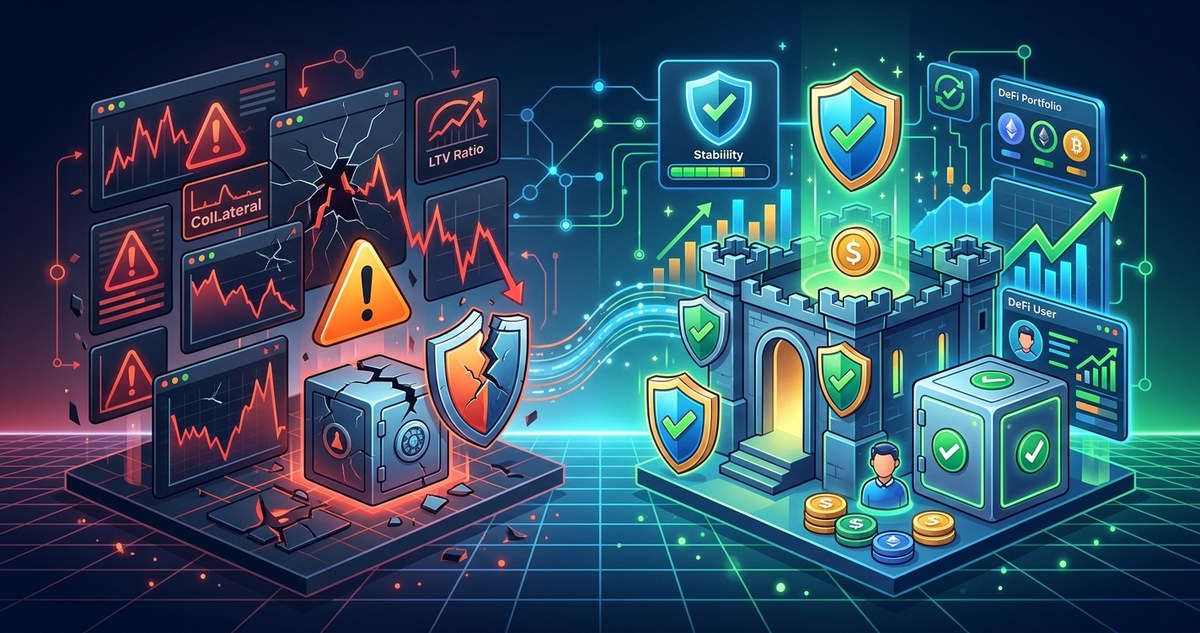
You put up your favorite crypto as collateral, took out a loan to grab some yield elsewhere, and everything felt solid. Then the market sneezed. A few hours later, your position got wiped out. That is the cold reality of DeFi loan liquidations. They happen fast, they feel brutal, and most of the time they are completely avoidable.
Lending protocols are not emotional. They do not care about your long-term thesis or the fact that the market usually bounces back. They follow one rule: if your collateral ratio dips below the threshold, the smart contract sells your assets to cover the loan. No warnings, no second chances.
The good news? Almost every liquidation follows a pattern. If you know the traps, you can sidestep them. Let us walk through the seven critical mistakes that trigger these events and, more importantly, how you can keep your collateral safe.
DeFi loan liquidations happen when your collateral value falls below a required threshold, triggering an automatic sale. The seven biggest mistakes include ignoring liquidation prices, over-leveraging during volatility, forgetting gas fees, using volatile collateral, neglecting health factors, missing top-up windows, and ignoring oracle risks. Avoid them by setting alerts, maintaining buffers, and diversifying collateral.
Mistake 1: Ignoring the Liquidation Price
Every DeFi loan has a liquidation price. That is the price your collateral asset must stay above to keep your position safe. Most borrowers check it once when they open the loan and then forget about it.
Here is the problem. The liquidation price is not static. It moves with your loan-to-value ratio, which changes as the borrowed asset’s value shifts. If you took out a loan in a stablecoin but your collateral is ETH, the liquidation price rises and falls with ETH’s market price.
You need to know your exact liquidation price before you even sign the transaction. Write it down. Set a price alert on a tracking app. Treat it like a stop-loss order that you cannot cancel.
For a deeper understanding of how these ratios work, check out our guide on understanding collateral ratios. It walks through the math so you never guess where your safety line sits.
Mistake 2: Over-Leveraging During Volatile Markets
Borrowing at 75% loan-to-value during a bull run feels safe. The market is up, your collateral looks strong, and the APY on your borrowed funds seems like free money. Then volatility hits.
Crypto markets can drop 30% in a single day. If you are maxed out on your borrowing limit, that drop pushes you straight into liquidation territory. You have no buffer.
A safe rule of thumb is to borrow no more than 30% to 40% of your collateral value. That gives you room to survive a major dip without getting liquidated. It also means you can ride out the storm and wait for recovery.
This is especially important if you are new to the space. If you are just getting started, our complete beginner roadmap can help you understand the basics before you put real capital at risk.
Mistake 3: Forgetting About Gas Fees and Transaction Costs
Gas fees are the silent killer of DeFi positions. You might have the math right on your collateral ratio, but if the network gets congested and gas prices spike, your top-up transaction might not go through in time.
Imagine this scenario. The market starts dropping. You see your health factor declining, so you send a transaction to add more collateral. But gas fees are high, and your transaction gets stuck in the mempool for an hour. By the time it confirms, your position is already liquidated.
Always keep a small amount of native gas token (ETH on Ethereum, MATIC on Polygon, etc.) in your wallet. This ensures you can move quickly when you need to. Also, consider using Layer 2 networks during high congestion periods. Our guide on which Layer 2 networks work best can help you choose the right one for your needs.
Mistake 4: Using Highly Volatile Collateral
Some tokens swing harder than others. If you put a newly listed altcoin or a leveraged token as collateral, you are asking for trouble. A single whale selling off can crater the price and trigger your liquidation.
Stablecoins and blue-chip assets like ETH and BTC are safer choices for collateral. They have deeper liquidity pools and more predictable price action. If you absolutely must use a volatile asset, keep your loan-to-value ratio extremely low. Think 15% or 20%.
Here is a breakdown of collateral types and their relative safety:
| Collateral Type | Volatility Risk | Recommended LTV | Best Use Case |
|---|---|---|---|
| Stablecoin (USDC, DAI) | Very Low | Up to 80% | Safe borrowing for yield farming |
| ETH / stETH | Moderate | 30% to 40% | General purpose loans |
| BTC | Moderate | 30% to 40% | Long-term holds |
| Major altcoins (LINK, MATIC) | High | 15% to 25% | Short-term positions only |
| Small cap / new tokens | Very High | Avoid unless experienced | Not recommended |
Mistake 5: Not Monitoring Your Health Factor Regularly
DeFi protocols use a “health factor” to show how close you are to liquidation. It is usually displayed as a percentage. When it drops to 100% or below, you get liquidated.
The mistake is assuming the health factor updates in real time on your dashboard. It does, but only when the blockchain processes the latest price data. If the market crashes during a volatile event, your health factor can drop from 150% to 90% in minutes.
Set up automated alerts using free tools like DeFi Llama or protocol-specific bots. Some platforms let you receive Telegram or email notifications when your health factor crosses a threshold. Use them.
You should also understand how smart contracts handle these calculations. The logic is baked into the code, and knowing how it works removes the guesswork.
Mistake 6: Missing the Top-Up Window
Most protocols give you a grace period to add collateral before liquidation. But that window is not generous. You might have only a few minutes to react once your position enters the danger zone.
The top-up window is not a suggestion. It is your only lifeline. If you wait, hoping the market will bounce back, you are gambling. By the time you decide to act, it may be too late.
Here is a practical process for staying safe:
- Set a personal alarm at 200% health factor, not 110%. This gives you time.
- Keep extra collateral in a separate wallet, ready to transfer.
- Practice the top-up process on a test network first.
- Use a hardware wallet for your main collateral and a hot wallet for quick moves during emergencies. Learn more about choosing between hot and cold wallets.
- If you are unsure about the process, read our guide on what happens during a DeFi liquidation so you know exactly what to expect.
Mistake 7: Ignoring Oracle Risks and Price Feeds
Your loan position depends on price data from oracles. These are services that feed real-world asset prices into the blockchain. If the oracle goes down, gets manipulated, or reports a stale price, your position could be liquidated based on incorrect data.
This is not a theoretical risk. There have been incidents where oracle manipulation caused mass liquidations. The protocol executed sales based on a price that never actually existed on any exchange.
To protect yourself, check which oracle your lending protocol uses. Major protocols typically use Chainlink or a similar decentralized oracle network. Avoid lending on platforms that use a single, centralized price feed.
Understanding the role of oracles in DeFi will help you evaluate the risk of any platform before you commit your funds.
“The safest DeFi borrowers are the ones who assume the worst will happen and plan for it. A 40% market drop, a gas fee spike, and a slow block confirmation all happening at once is not a black swan. It is a Tuesday.” — DeFi risk analyst, 2026
Building Your Personal Liquidation Prevention Plan
You now know the seven mistakes. But knowing is only half the battle. You need a system.
Start by calculating your liquidation price before you take any loan. Use that number to set your personal safety threshold at 200% health factor minimum. Keep a separate wallet with gas tokens and extra collateral ready to deploy. Monitor your positions with automated alerts, not manual checks.
Review your positions at least once per day during normal markets. During high volatility, check every few hours. If you are in a time zone where you sleep through major market movements, consider using a stop-loss bot or a trusted friend who can top up your position while you are away.
For a complete security approach, our DeFi security checklist for beginners covers everything from wallet hygiene to protocol vetting.
Your Collateral Deserves Better Than Blind Trust
DeFi lending is powerful. It lets you access capital without selling your assets, earn yields on borrowed funds, and build financial strategies that were impossible in traditional finance. But the power comes with responsibility. The protocol will not save you. The market will not pause for you.
You have to be the one watching the numbers, keeping the buffer, and acting before the liquidation engine kicks in. The good news is that it is not complicated. It just takes consistent attention and a little preparation.
Set your alerts. Know your liquidation price. Keep your buffer. And never borrow more than you can afford to top up during a crash. Do that, and you will dodge the liquidation trap that catches so many other borrowers.