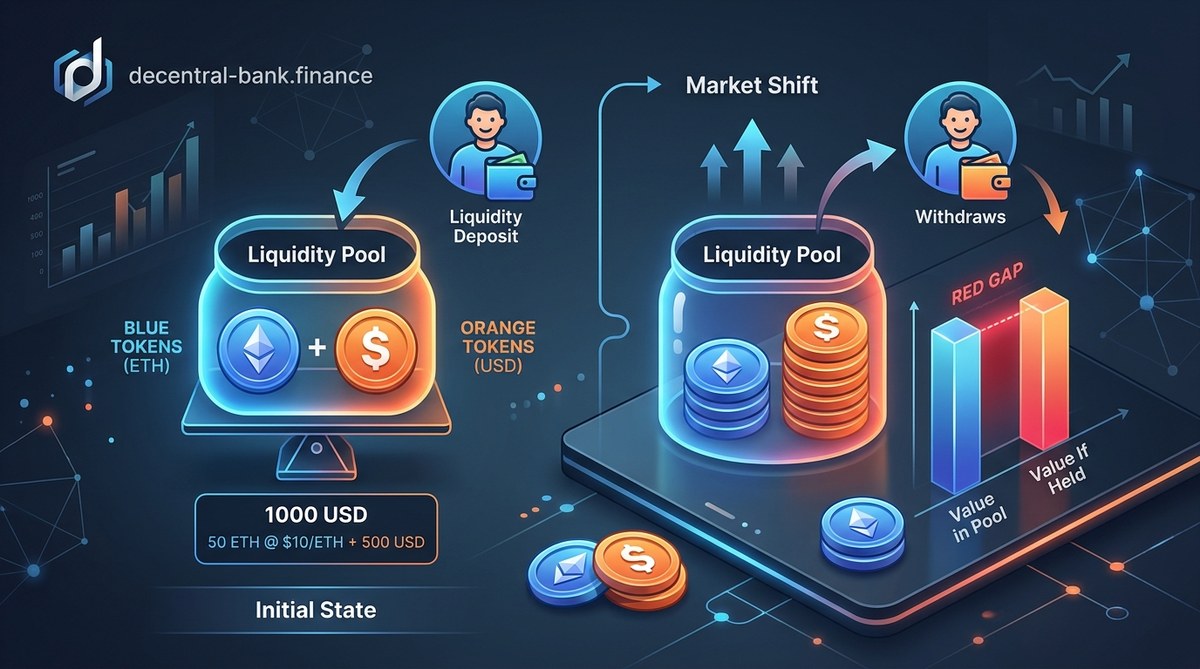
You deposit $10,000 into a liquidity pool and watch the APY tick up every day. The fees roll in nicely. A month later you go to withdraw and the balance is lower than you expected. No rug pull happened. The trading volume was solid. So where did the money go? That is impermanent loss. It is not a bug or a scam. It is a mathematical side effect of how automated market makers work. And once you understand it, you can make smarter decisions about where to put your crypto.
Impermanent loss happens when the price of your deposited tokens changes compared to the price at deposit. The wider the price move, the bigger the loss. It is called “impermanent” because if prices return to the original ratio, the loss disappears. But in practice, most price moves are permanent. You can reduce the risk by choosing stablecoin pairs, lower volatility assets, or using single-sided liquidity protocols.
What Exactly Is Impermanent Loss?
Impermanent loss is the difference in value between holding your tokens in a wallet versus providing them in a liquidity pool. When you add tokens to a pool like Uniswap or Curve, the automated market maker (AMM) algorithm keeps the product of the two tokens constant. If one token goes up in price relative to the other, arbitrage traders buy the cheaper token until the pool rebalances. You end up with more of the losing token and less of the winning token.
If you had just held both tokens in your wallet, you would have kept the full value of the winner. The pool forces you to sell the rising asset and buy the falling one. That forced rebalancing creates the loss. It is not a cash charge against your account. It is an opportunity cost compared to holding.
How Does Impermanent Loss Work? Step By Step
Here is the process broken down into three clear steps:
- Deposit equal value tokens. You provide two tokens in a 50/50 ratio by dollar value. The pool mints liquidity provider (LP) tokens representing your share.
- Price moves. The external market price of one token changes. Arbitrageurs buy or sell from the pool to bring the pool price back in line with the market.
- Withdraw at new ratio. You redeem your LP tokens and receive a different mix of tokens. The total dollar value is less than if you had held the original two tokens separately.
A Real Example of Impermanent Loss
Let us use a simple example with ETH and USDC. Assume you deposit $5,000 worth of ETH and $5,000 worth of USDC into a pool. ETH is $2,000, so you deposit 2.5 ETH and 5,000 USDC. The pool has a total of $10,000.
Now ETH doubles to $4,000. Arbitrage traders buy ETH from the pool until the ratio adjusts. When you withdraw, you will have less ETH and more USDC than you started with. Let us run the numbers:
- New pool ratio: because the price doubled, the pool rebalances so that the value of ETH and USDC remain equal. You end up with roughly 1.77 ETH and 7,071 USDC.
- Your withdrawal value: 1.77 ETH at $4,000 = $7,080, plus $7,071 USDC = $14,151.
- Holding value: 2.5 ETH at $4,000 = $10,000, plus $5,000 USDC = $15,000.
Your loss is $15,000 minus $14,151 = $849. That is impermanent loss. You still made money overall because ETH went up. But you made $849 less than if you had simply held.
Calculating Impermanent Loss
You do not need to do the math manually every time. The formula for a 50/50 pool is:
- Loss = 2 * sqrt(price ratio) / (1 + price ratio) minus 1
Thankfully, there are plenty of online calculators. A common reference table gives you the impact:
| Price change (%) | Impermanent loss (%) |
|---|---|
| 1.25x (25% up) | 0.6% |
| 1.5x (50% up) | 2.0% |
| 2x (100% up) | 5.7% |
| 3x (200% up) | 13.4% |
| 4x (300% up) | 20.0% |
| 5x (400% up) | 25.5% |
The loss is symmetrical for price drops. If ETH drops to $1,000, you would still lose the same percentage because the pool forces you to hold more of the falling token.
Strategies to Reduce Impermanent Loss
You cannot eliminate impermanent loss entirely, but you can lower the risk with these approaches:
- Use stablecoin pairs. Pools like USDC / DAI have almost no price divergence, so impermanent loss is near zero.
- Pick correlated assets. Pairs such as ETH / stETH (liquid staking derivatives) move together, reducing divergence.
- Provide liquidity on concentrated liquidity pools (like Uniswap V3). You can set a narrow price range to earn higher fees, but the risk of being fully outside the range also grows.
- Consider single-sided exposure. Some protocols (like Bancor or some yield aggregators) protect against impermanent loss with built-in insurance or dynamic fees.
- Only deposit tokens you are comfortable holding long term. If the price swings, you will still own the tokens.
- Monitor the pool regularly. If one token moons, you might choose to withdraw early to lock in gains and avoid further loss.
Expert advice: “Impermanent loss is often a smaller cost than the trading fees you earn. For pools with high volume and low volatility, fees can easily outweigh the loss. Always compare the expected fee revenue against the potential divergence loss before depositing.” – DeFi risk analyst on a recent panel.
Common Mistakes Liquidity Providers Make
Here is a table of common errors and how to avoid them:
| Mistake | Why It Hurts | Better Approach |
|---|---|---|
| Depositing into a pool with one wildly volatile token | Large price moves create big impermanent loss | Use stablecoin pairs or correlated assets |
| Ignoring pool fees and volume | Low volume means you earn less fees, making the loss more painful | Check 30-day volume and fee APR before depositing |
| Not planning an exit strategy | If price moves heavily, you might panic withdraw at the worst time | Set a price target or rebalance periodically |
| Using a pool with high concentration risk | If one token crashes, you lose both from price drop and IL | Diversify across different pools and assets |
Why It Is Called “Impermanent”
The loss is called “impermanent” because if the ratio of the two tokens returns to the original level, the loss disappears. Say ETH went up 100% and then came back down to $2,000. The pool would rebalance again, and you would end up with the original 2.5 ETH and 5,000 USDC (minus fees earned). For that reason, some liquidity providers treat IL as a temporary state.
In practice, however, most price moves are permanent. ETH rarely goes back to the exact same dollar value. Still, if you are in a pool for the long haul and believe the tokens are correlated, the impermanent loss might only be a small drag compared to the fees you collect.
Making Impermanent Loss Work for You
Impermanent loss is not a reason to avoid liquidity provision altogether. It is a cost you need to factor into your strategy. If you understand how it works, you can choose pools where the fees reliably exceed the expected loss. You can also use tools like the impermanent loss calculator to simulate scenarios before you commit funds.
Start small. Pick a stablecoin pair or a high-volume ETH / USDC pool on a trusted DEX. Track your returns over a month. Compare your actual balance to what you would have had holding. That will give you a gut feel for how IL behaves in real markets. Over time, you will learn which pairs and which conditions work best for your risk tolerance.
The goal is not to avoid impermanent loss. It is to earn enough in fees that the loss becomes irrelevant. With the right pair and enough volume, liquidity provision can still be a solid way to put your idle crypto to work.