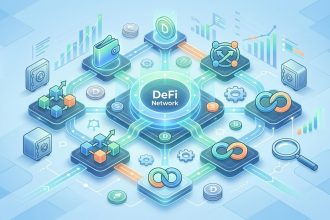
You have probably heard stories about people earning double-digit returns on their crypto. Maybe you assumed those numbers were too good to be true, or that they required a finance degree to understand. Neither is the case. Decentralized finance, or DeFi, has created a parallel financial system where your assets can work for you without a bank manager’s approval. The secret is not magic. It is a combination of smart contracts, economic incentives, and a willingness to trade a bit of risk for a lot of potential reward.
DeFi yield generation relies on automated protocols, not human bankers. Returns come from staking, liquidity mining, lending, and yield farming. Each method carries distinct risks like impermanent loss, smart contract bugs, and market volatility. The key is matching the strategy to your risk tolerance while using security tools like hardware wallets and audits to stay safe.
What Makes DeFi Yield Different From a Savings Account
A traditional savings account pays you interest because the bank lends your money to borrowers at a higher rate. The bank keeps the difference. In DeFi, the middleman disappears. Smart contracts connect lenders directly with borrowers, or they reward users for providing liquidity to trading pools. The result is that more of the profit flows back to you.
But there is a catch. Without a bank, there is no FDIC insurance. If a smart contract has a bug, or if a protocol gets exploited, your funds can vanish. That is why understanding how these yields are generated is not just interesting. It is essential for protecting your money.
The Four Main Engines of DeFi Yield
DeFi protocols generate returns through a handful of proven mechanisms. Each one works differently, and each carries its own flavor of risk.
1. Staking
Staking is the simplest way to earn yield. You lock up a cryptocurrency, usually a proof-of-stake token like Ethereum or Solana, and help secure the network. In return, the network mints new tokens and distributes them to you as a reward.
Think of it like a certificate of deposit, but with a variable rate and no guaranteed return of principal. If the token price drops, your staking rewards might not cover the loss. For a step-by-step guide on getting started, check out our walkthrough on how to start staking crypto.
2. Liquidity Mining
Liquidity mining is the engine behind decentralized exchanges. You deposit two tokens into a liquidity pool, say USDC and Ethereum. Traders use that pool to swap between the two assets, and they pay a small fee each time. Those fees accumulate and are distributed to you based on your share of the pool.
The catch is impermanent loss. If the price of one token moves far away from the other, you could end up with less value than if you had just held the tokens separately. We have a full guide on how to provide liquidity on Uniswap without losing money that explains how to minimize this risk.
3. Lending and Borrowing
Protocols like Aave and Compound let you deposit crypto and earn interest from borrowers. Borrowers put up collateral, usually more than the loan value, and pay a variable interest rate. Lenders earn a share of that interest.
This is probably the closest DeFi gets to a traditional savings account. The main difference is that your deposit is not insured, and the interest rate can change daily based on supply and demand. If you want to see which platforms are popular this year, our list of 5 best DeFi lending platforms for passive income in 2026 is a good starting point.
4. Yield Farming
Yield farming is a strategy that combines the above methods. You might stake a token, receive a reward token, then stake that reward token on another protocol. It is like a financial version of a video game combo move.
The returns can be impressive, but so can the complexity. Each additional protocol layer adds a new point of failure. If any single smart contract in the chain gets exploited, your entire position could be at risk.
A Step-by-Step Look at How a Typical Yield Farm Works
Let’s walk through a concrete example using a hypothetical protocol called FarmToken.
- You deposit 1,000 USDC into a liquidity pool on a decentralized exchange.
- The pool gives you LP tokens that represent your share of the pool.
- You take those LP tokens and stake them on FarmToken’s website.
- FarmToken rewards you with its native token, FARM, every block.
- You can either sell FARM for USDC or reinvest it by staking it again.
This process is called compounding, and it is the reason some users see APYs that look absurdly high. But remember, those APYs are usually paid in the protocol’s own token. If FARM drops in price, your real returns could be negative.
Common Mistakes Beginners Make With DeFi Yield
Even experienced crypto users make errors that eat into their returns. Here is a table that outlines the most frequent pitfalls and how to avoid them.
| Mistake | What Happens | How to Avoid It |
|---|---|---|
| Chasing the highest APY | The protocol might be a scam or unsustainable. | Stick to audited protocols with a track record. |
| Ignoring impermanent loss | You earn fees but lose value on the underlying tokens. | Use stablecoin pairs or pools with low volatility. |
| Forgetting about gas fees | Small deposits get eaten by transaction costs. | Use Layer 2 networks for smaller amounts. |
| Staking without an exit plan | Locked funds can’t be moved during a crash. | Check lock-up periods before committing. |
| Using the same wallet everywhere | A compromised protocol can drain all your funds. | Use separate wallets for different protocols. |
“The biggest mistake I see beginners make is treating DeFi like a casino. They jump into the highest yield pool without reading the smart contract or checking the audit report. A 1,000% APY is usually a red flag, not an opportunity.” – Anonymous DeFi security researcher
How to Choose a Yield Strategy That Fits Your Life
Not every strategy is right for every person. Your choice should depend on how much time you can dedicate, how much risk you can stomach, and how much capital you have.
- If you have less than $500 to start, focus on lending stablecoins. The returns are modest, but gas fees won’t eat your deposit.
- If you have $1,000 to $10,000, consider liquidity mining with stablecoin pairs. You avoid impermanent loss while earning trading fees.
- If you have more than $10,000 and can handle volatility, staking major cryptocurrencies like Ethereum or Solana offers solid returns with relatively lower risk compared to smaller protocols.
For a complete overview of the ecosystem, read our guide on traditional finance vs DeFi to understand how the two systems compare.
Security Habits That Protect Your Yield
Earning yield is only half the battle. Keeping it is the other half. Here are the habits that separate safe users from those who get hacked.
- Use a hardware wallet for any significant amount. Software wallets are convenient, but they are also more exposed to phishing and malware. Our analysis on whether hardware wallets are really necessary for DeFi users can help you decide.
- Check smart contract audits before depositing. A protocol that has not been audited by a reputable firm is a gamble. We have a list of 5 free tools to check if a DeFi protocol is safe that can save you from disaster.
- Revoke token approvals you no longer use. Many hacks happen because users approved a contract years ago and forgot about it. Learn how to spot these in our article on what are token approval exploits and how can you revoke them.
- Never share your seed phrase. No legitimate protocol will ever ask for it. If someone does, it is a scam.
What Realistic Returns Look Like in 2026
The days of 1,000% APY on every new protocol are mostly behind us. The market has matured. Here are realistic ranges for different strategies as of this year.
- Staking Ethereum: 3% to 7% APY, depending on network activity.
- Lending stablecoins: 4% to 12% APY, varying by platform and demand.
- Liquidity mining on major DEXs: 8% to 25% APY, with higher risk of impermanent loss.
- Yield farming on newer protocols: 20% to 60% APY, but with significant smart contract risk.
These numbers can change quickly. A sudden market crash can wipe out months of yield in a single day. That is why diversification matters just as much in DeFi as it does in traditional investing.
Putting It All Into Practice
You now know the main ways DeFi protocols generate yield. Staking rewards you for securing a network. Liquidity mining pays you for providing trading pairs. Lending lets you earn interest from borrowers. Yield farming stacks these strategies for potentially higher returns.
The smartest move you can make right now is to start small. Pick one protocol, deposit a tiny amount, and watch how it works for a week. Learn the interface. Understand the fees. Get comfortable with the rhythm of claiming rewards and tracking your position. Once you feel confident, scale up gradually.
DeFi is not a get-rich scheme. It is a new way to put your money to work, and like any financial tool, it rewards patience and knowledge over recklessness. Take the time to learn the fundamentals, and you will be far ahead of most people who jump in blind.