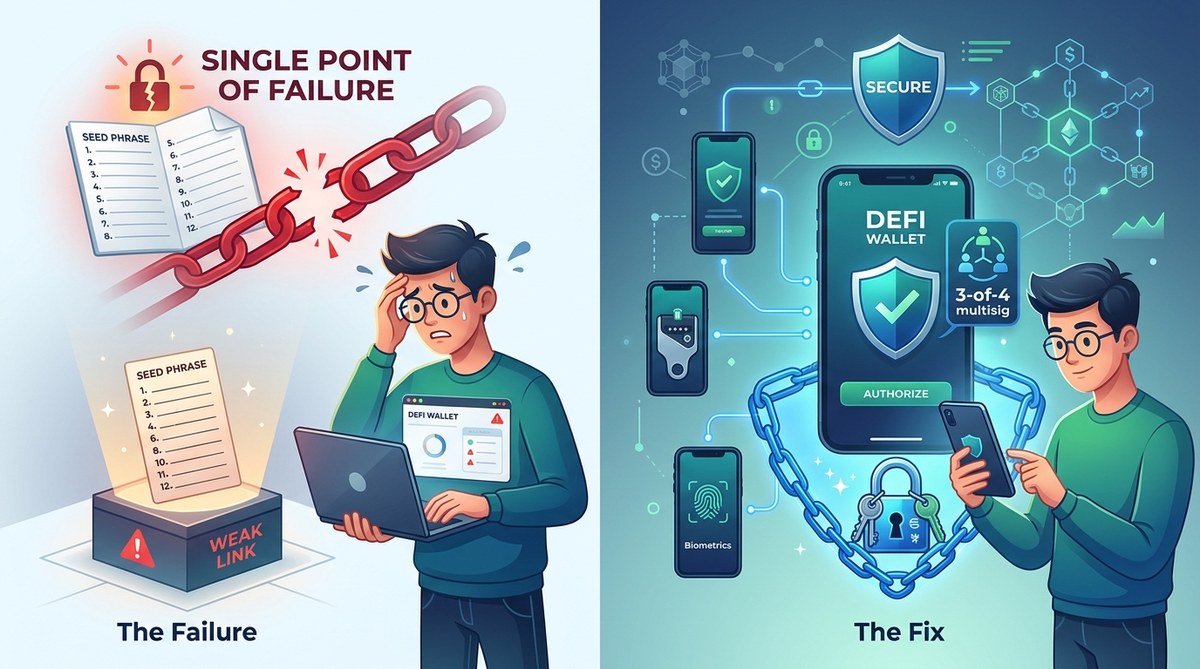
Your DeFi wallet feels like a fortress. You have a password, a hardware device, maybe even a secondary PIN. But none of that matters if someone gets your seed phrase. Those 12 or 24 words are the master key to every asset you hold. Lose them, and your funds are gone. Share them by accident, and a stranger can drain your wallet in seconds. This is the reality of the DeFi wallet seed phrase single point of failure, and it is one of the most dangerous vulnerabilities in self-custody.
Your seed phrase is the master key to your entire DeFi wallet. If it is stolen, lost, or exposed, you lose everything. This guide explains why that single string of words is a catastrophic vulnerability and shows you real solutions: multi-signature wallets, social recovery, hardware wallets, and passphrase strategies that break that single point of failure and protect your crypto.
Why One Set of Words Controls Everything
Your wallet uses a system called hierarchical deterministic (HD) key generation. One seed phrase creates an infinite number of private keys. That is convenient. You back up one phrase and restore your entire wallet on any device. But it also means one compromised phrase compromises every single address you have ever used or will ever use.
Think of it like a master key that opens every lock in a skyscraper. If a thief copies that key, they can open the front door, the apartment door, the storage unit, and the safety deposit box. Your seed phrase works the same way. It does not matter if your hardware wallet is tamper proof or if your mobile app has biometric locks. If the seed phrase is exposed, all those protections are useless.
The Three Ways Your Seed Phrase Gets Compromised
Most people lose their crypto through one of these three scenarios. Recognizing them is the first step to fixing the problem.
-
Digital exposure. You take a photo of your seed phrase and save it to your phone. A piece of malware or a phishing app reads your gallery. Or you type the words into a website that claims to be a wallet recovery tool. The attacker now has your seed phrase.
-
Physical theft. You write your words on a piece of paper and store it in a desk drawer. A burglar, a house guest, or a dishonest roommate finds the paper. They can now import your wallet and drain it.
-
Loss or disaster. You store your single copy in a fire safe. The safe is destroyed in a flood or fire. You remember the phrase was 24 words, but you cannot recall the order. Without that phrase, your crypto is permanently locked.
The Fix: Remove the Single Point of Failure
The solution is not to be more careful with your seed phrase. The solution is to design your security so that a single seed phrase is no longer enough to access your funds. You need to spread the control across multiple factors. Here are the three most effective strategies.
Multi-Signature Wallets
A multi-signature (multi-sig) wallet requires more than one private key to authorize a transaction. Instead of one seed phrase controlling everything, you create a wallet that needs 2 out of 3 signatures, or 3 out of 5. Even if an attacker steals one seed phrase, they cannot move your funds without the second signature.
This is the same security model that institutions use. You can set up a multi-sig wallet with a hardware wallet, a mobile wallet, and a recovery seed stored in a bank safety deposit box. No single point of failure exists.
Social Recovery with Shamir’s Secret Sharing
Shamir’s Secret Sharing (SSS) splits your seed phrase into multiple parts called shares. You can set a threshold of 3 out of 5 shares. You give one share to a trusted family member, one to a lawyer, one to a close friend, and keep two for yourself. To recover the wallet, you need at least three shares. An attacker who finds one share gains nothing. A single lost share is not a disaster.
Many hardware wallets now support SSS natively. You generate the shares during the initial setup and distribute them securely. This method is powerful because it protects against both theft and loss.
Passphrase (The 25th Word)
Most wallets allow you to add a passphrase on top of your seed phrase. This passphrase is not stored anywhere on the device. You must type it in manually every time you restore the wallet. Even if an attacker steals your 24-word seed phrase, they cannot access your funds without the passphrase.
The trick is to store the passphrase separately from the seed phrase. Write the seed phrase on one piece of steel and the passphrase on another. Store them in different physical locations. This turns your single seed phrase into a two-factor system.
Common Mistakes and Better Approaches
Here is a comparison table that shows the difference between risky habits and safer alternatives.
| Mistake | Why It Is Risky | Better Approach |
|---|---|---|
| Storing seed phrase in a password manager | If the password manager is hacked, your seed phrase is exposed. | Use a hardware wallet with a passphrase. The seed phrase never touches a computer. |
| Typing seed phrase into a website | Phishing sites look identical to real wallet apps. You hand over your keys. | Only restore a wallet using the official device or app. Never type seed words into a browser. |
| Keeping one paper backup at home | Fire, flood, or theft destroys your only copy. | Store a metal backup in one location and a second backup in a bank safe deposit box. |
| Sharing your seed phrase with a friend for safekeeping | The friend could lose the paper or be coerced into revealing it. | Use Shamir’s Secret Sharing so no single person controls access. |
A Practical Step-by-Step Plan
If you want to fix your seed phrase single point of failure today, follow this numbered process.
-
Buy a hardware wallet. A device like a Ledger or Trezor keeps your seed phrase offline. It never touches your phone or computer.
-
Generate a new seed phrase on the device. Do not use a seed phrase that was created on a mobile app or browser extension. Start fresh.
-
Add a strong passphrase. Use something memorable but not obvious. A combination of a pet name and a street number from your childhood works well. Do not write it down in the same place as your seed phrase.
-
Engrave the seed phrase on a metal backup. Use a product like Cryptosteel or a simple metal stamping kit. Paper burns and degrades. Metal survives.
-
Store the metal backup in a secure location. A fireproof home safe is acceptable. A bank safety deposit box is better.
-
Store the passphrase in a separate secure location. This could be a second metal plate stored at a relative’s house or a trusted password manager if you must.
-
Test the recovery process. Use a small amount of crypto for this test. Wipe the wallet and restore it using your seed phrase and passphrase. Confirm you can access the funds.
An expert once told me: “The only backup that matters is the one you have tested.” Do not trust your process until you have successfully restored a wallet from scratch.
When to Use a Multi-Sig Setup
If you hold more than a few thousand dollars in DeFi, multi-sig is not optional. It is the standard for anyone who wants institutional grade security. A 2-of-3 multi-sig wallet with a hardware wallet, a mobile wallet, and a paper backup gives you protection against theft, device failure, and loss.
For example, you could use a Trezor as your primary signing device, a MetaMask mobile wallet as your second signer, and a printed copy of the third key stored in a safe. If your Trezor is stolen, you still need the MetaMask key and the paper key to move funds. If your house burns down, you can buy a new Trezor and use your MetaMask key plus the paper key to recover.
This approach is explained in more detail in our guide on multi-signature wallets explained.
The Hidden Risk of Wallet Import Functions
One of the most dangerous features in DeFi wallets is the import function. You can paste your seed phrase into a new wallet app to restore access. That sounds helpful, but it creates a massive risk. If you import your seed phrase into a compromised app, the app developer or a malware author now has your entire wallet.
The same risk applies to browser extensions. Many DeFi users install a browser extension to interact with protocols. That extension requests permission to read clipboard data. If you copy your seed phrase to paste it into an extension, the extension can read it silently.
The safest rule is simple: never enter your seed phrase into any software. Only enter it into a hardware wallet device using its physical buttons. If you must restore a wallet on a mobile app, do it on a brand new phone that you trust and only use the official app from the app store.
For more details on this specific risk, read our article on the hidden risks of DeFi wallet import functions.
What If You Already Have a Single Seed Phrase?
If you are reading this and you already have a wallet protected by a single seed phrase, do not panic. You can migrate to a safer setup without losing your funds.
- Generate a new seed phrase on a hardware wallet.
- Send your crypto from the old wallet to the new wallet using small test transactions first.
- Once you confirm the new wallet works, send the rest of your funds.
- Securely destroy the old seed phrase. Shred the paper or wipe the device.
This process takes less than an hour. It is the single best security upgrade you can make in 2026.
Your New Security Baseline
Here is a bullet list of the core principles you should follow from today forward.
- Your seed phrase should never exist in digital form. No photos, no cloud storage, no password managers.
- Your seed phrase should be stored on metal in at least two separate physical locations.
- Your passphrase should be stored separately from your seed phrase.
- Your wallet should require at least two factors to authorize a transaction.
- You should test your recovery process at least once a year.
Building a System That Outlasts You
The goal is not just to protect your crypto today. The goal is to build a system that survives accidents, disasters, and even your own mistakes. A single seed phrase cannot do that. But a multi-sig wallet with a passphrase and geographically distributed metal backups can.
Think about it this way. If you lose your phone, you buy a new one and log into your accounts. If you lose your hardware wallet, you buy a new one and restore from your backup. If you lose your seed phrase, you lose everything. That is why removing the single point of failure is not just a technical improvement. It is a fundamental shift in how you think about self-custody.
Start with one change today. Buy a metal backup plate. Add a passphrase to your existing wallet. Test your recovery. Each step makes your DeFi wallet stronger. Each step moves you away from the vulnerability of a single string of words.