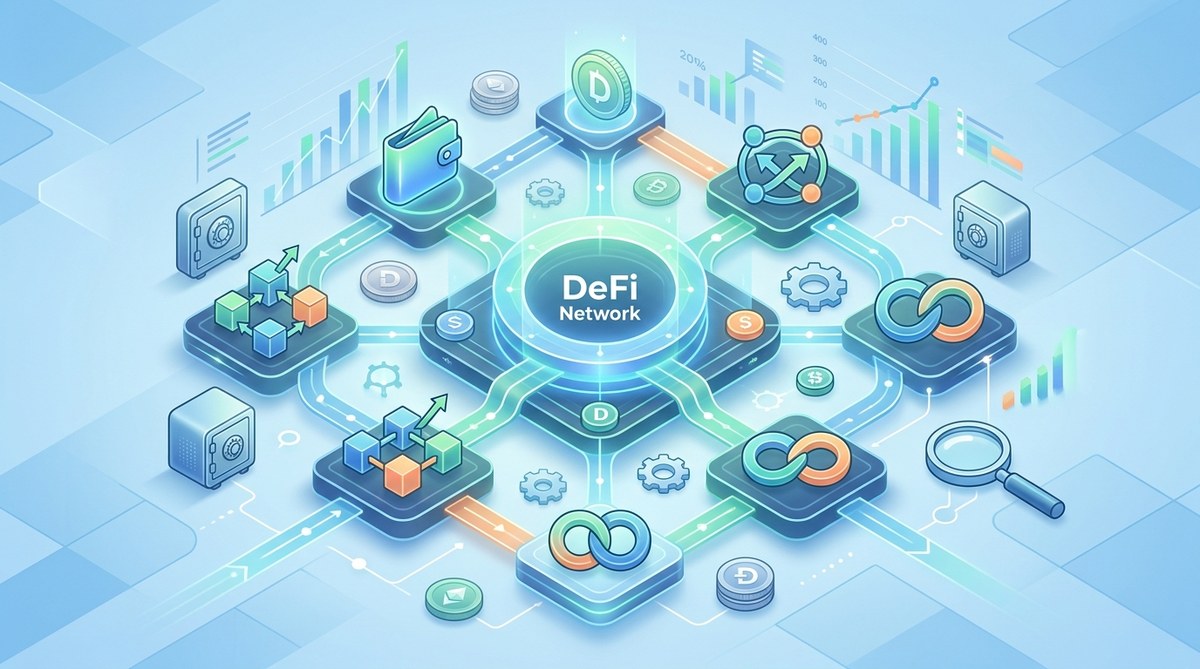
If the term “DeFi” sounds like a foreign language to you, you are not alone. Most explanations dive straight into words like “liquidity pools” and “automated market makers” before you even know what the big picture looks like. That stops here. Think of decentralized finance as a financial system that runs on code instead of bank branches. It lets you lend, borrow, trade, and earn interest without asking a manager for permission. The goal of this guide is to connect the dots so you can see how all the pieces fit together, without the headache.
DeFi replaces traditional financial middlemen with self-executing code called smart contracts. You keep control of your money using a personal wallet, and you can trade on decentralized exchanges, earn yields by lending or staking, and borrow against your crypto. The system is open to anyone with an internet connection, but it also requires you to take responsibility for your own security.
The Core Idea: Finance Without a Front Desk
Traditional banks act as gatekeepers. They decide who gets a loan, how much interest you earn on savings, and whether your transaction goes through. DeFi removes that gatekeeper. Instead of a bank manager, you interact with smart contracts. These are pieces of code that automatically execute actions when certain conditions are met. For example, a smart contract might hold your deposit and automatically pay you interest every week. No paperwork, no phone calls, no waiting for approval.
This system runs on blockchain networks, with Ethereum being the most popular one. Every transaction is recorded on a public ledger that anyone can verify. You do not need to trust a bank. You trust the code and the network.
The Building Blocks of DeFi
To understand how it all fits together, you need to know the main pieces. Think of them as the tools in a toolbox.
Your Digital Wallet
Your wallet is your entry point. It holds your private keys, which are like the password to your money. Unlike a bank account, you control these keys completely. If you lose them, no customer service line can get them back. That is why wallet security is so important. You can read more about how to choose between hot wallets and cold wallets for your crypto to decide what works for you.
Smart Contracts
These are the automatic helpers that power everything. When you lend money on a DeFi platform, a smart contract handles the terms. It releases interest payments, tracks the duration, and returns your principal when the term ends. No human involvement needed. If you want to understand the mechanics better, check out our guide on what are smart contracts and why do they matter in DeFi.
Stablecoins
Crypto prices can swing wildly. A coin worth $100 today might be worth $60 tomorrow. That makes it hard to use for everyday transactions or saving. Stablecoins solve this by pegging their value to a stable asset, usually the US dollar. USDC and DAI are two common examples. They give you the benefits of crypto (speed, low fees, global access) without the price volatility. For a deeper look, see our comparison of USDT vs USDC vs DAI: which stablecoin should beginners trust.
Decentralized Exchanges (DEXs)
A DEX lets you trade one token for another directly with other users. There is no central company holding your funds. Instead, trades happen through liquidity pools. These are pools of tokens that users deposit, and the exchange uses them to facilitate trades automatically. If you have ever used a vending machine, you already understand the basic idea. You put something in, and you get something out. For a step-by-step process, read about how to swap tokens on a DEX: complete walkthrough for first-timers.
Lending and Borrowing Protocols
These platforms let you earn interest on your crypto or take out a loan using your crypto as collateral. The rates are often higher than what a bank offers because there is less overhead. But there are risks too. If the value of your collateral drops, the protocol may sell it automatically. This is called liquidation. Learn more about what happens during a DeFi liquidation and how to avoid it.
How the Pieces Work Together: A Practical Example
Let us walk through a realistic scenario using a numbered list so you can see the flow.
- You buy $500 worth of USDC on a centralized exchange and transfer it to your personal wallet. This is called an on-ramp.
- You connect your wallet to a DeFi lending protocol like Aave or Compound.
- You deposit your USDC into a lending pool. A smart contract records your deposit and starts calculating interest.
- Someone else borrows your USDC by putting up Ethereum as collateral. They pay interest on the loan.
- That interest flows back to you. You earn a percentage every time the loan is active.
- You can withdraw your USDC plus earned interest at any time, minus network fees.
This entire process happens without a single human approving anything. The code enforces the rules.
What You Can Actually Do With DeFi
Here is a bulleted list of the main activities you can perform right now in 2026.
- Earn passive income by lending your crypto or staking it on proof-of-stake networks.
- Trade tokens without giving custody to an exchange.
- Borrow against your crypto holdings instead of selling them.
- Provide liquidity to a DEX and earn a share of trading fees.
- Participate in governance by voting on protocol changes using governance tokens.
Each of these activities has its own risk profile. For a complete overview, check out the traditional finance vs DeFi: understanding the key differences article.
Common Beginner Mistakes and How to Avoid Them
The table below outlines frequent errors and the correct approach.
| Mistake | Why It Happens | Better Approach |
|---|---|---|
| Storing your seed phrase digitally | Convenience | Write it on paper and store it in a fireproof safe |
| Approving random smart contract requests | Lack of awareness | Only approve contracts you have verified and trust |
| Chasing the highest yield without research | Greed or FOMO | Check the protocol’s audit history and team background |
| Using the same password for all platforms | Laziness | Use a password manager and enable two-factor authentication |
| Ignoring gas fees on Ethereum | Not understanding costs | Use Layer 2 networks like Arbitrum or Optimism for lower fees |
Security Is Your Job Now
In traditional finance, if someone steals your credit card number, the bank usually covers the loss. In DeFi, you are the bank. If you lose your private keys or approve a malicious contract, the money is gone. That is not meant to scare you. It is just reality.
“The most important rule in DeFi is simple: never invest more than you are willing to lose, and never approve a transaction you do not fully understand.” This advice comes from years of watching beginners make the same costly mistakes.
Start small. Use a hardware wallet if you plan to hold more than a few hundred dollars. Always check if a protocol has been audited by a reputable firm. And never share your seed phrase with anyone, ever. For a full walkthrough, read the complete DeFi security checklist for beginners.
Putting It All Into Action
DeFi is not as complicated as it first appears. You have a wallet for access. Smart contracts handle the logic. Stablecoins keep value steady. DEXs enable trades. Lending protocols let you earn or borrow. That is the entire stack.
The best way to learn is to start with a small amount of money you can afford to lose. Connect your wallet to a well-known protocol like Uniswap or Aave and make one trade or one deposit. Watch how the transaction flows. Check the fees. See how the interface works. After that first experience, the jargon will start to make sense because you have seen it in action.
If you feel ready to take the next step, our getting started with DeFi: your complete beginner roadmap will guide you through the first week of using these tools safely.
Your First Step Toward Financial Autonomy
You do not need to understand every technical detail to benefit from DeFi. You just need to know how the pieces connect and where the risks live. Start with one small action. Transfer a small amount of USDC to a wallet. Connect it to a DEX. Make one swap. See how it feels to control your own money without asking for permission. That single experience will teach you more than reading a hundred articles. The system is open. It is waiting for you. Take your time, stay cautious, and explore at your own pace.