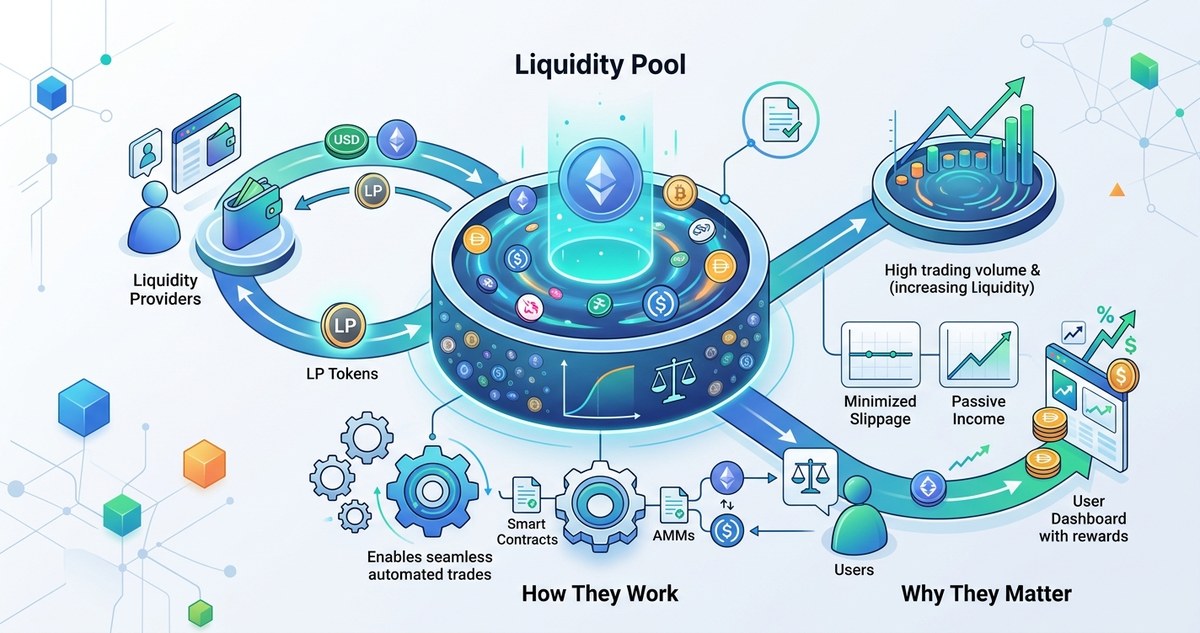
Decentralized finance can feel like a foreign language. Terms like AMM, LP tokens, and impermanent loss get thrown around without much explanation. But at the center of it all sits one simple idea: the liquidity pool. If you have ever traded on a decentralized exchange like Uniswap, you have already used one. You just may not have known it.
This guide breaks down DeFi liquidity pools explained in plain English. You will learn what they are, how they work, why they matter, and what risks to watch for before you add money to one.
What Is a Liquidity Pool?
A liquidity pool is a digital basket of crypto assets locked inside a smart contract. Think of it as a shared pot of money that people can trade against. Instead of matching a buyer with a seller, a decentralized exchange (DEX) uses these pools to make trading possible at any time.
Anyone can add assets to a pool. When you do, you become a liquidity provider. In return, you earn a share of the trading fees from people who use that pool to swap tokens.
The assets in a pool are supplied by everyday users, not a central company. This is what makes DeFi different from a traditional exchange like Coinbase or Kraken. There is no order book. No middleman. Just a smart contract holding funds and an algorithm that prices trades automatically.
Why Liquidity Pools Matter in DeFi
Traditional exchanges match buyers with sellers. If no one wants to buy, your order sits. That creates a problem called low liquidity. Thin markets mean wide spreads and price slippage. Big trades can move prices sharply.
Liquidity pools solve this problem in a clever way. Instead of waiting for a buyer and seller to match, users deposit their assets into a shared pool. That pool acts as the counterparty for every trade. Anyone can swap against it at any time.
This design makes decentralized exchanges (DEXs) possible. Platforms like Uniswap and Curve use liquidity pools to enable trades without a central order book or a company matching orders. The pool always has assets available, so trades happen instantly.
For beginners, the key idea is simple: liquidity pools are shared buckets of crypto. They power the decentralized exchange experience you see on apps like Uniswap, SushiSwap, and Balancer.
What Is a Liquidity Pool?
A liquidity pool is a collection of crypto assets locked inside a smart contract. Users deposit tokens into the pool. Traders then swap against that pool. In return, depositors earn fees.
Think of it like a vending machine. You put snacks inside. Someone else comes and buys them. You earn a small cut of each sale. The vending machine runs on its own, without a cashier. In DeFi, the vending machine is a smart contract.
Instead of matching buyers with sellers, the pool itself acts as the counterparty. That is why decentralized exchanges (DEXs) like Uniswap can run without an order book.
What Is a Liquidity Pool?
A liquidity pool is a collection of crypto tokens locked in a smart contract. These tokens create a market. Traders swap against the pool instead of waiting for another person to take the opposite side of their trade.
Anyone can add funds to a pool. When you do, you become a liquidity provider (LP). In return, you earn a share of the trading fees generated by the pool. The pool’s smart contract tracks each provider’s share and distributes rewards accordingly.
This system solves a classic problem. Without liquidity, trades fail. A pool ensures there is always someone on the other side of your trade, even if no human is actively matching orders.
Why Liquidity Pools Matter in DeFi
Traditional exchanges use order books. Buyers and sellers place orders, and a matching engine connects them. If no one is selling, you cannot buy. That creates friction.
Liquidity pools remove that friction. Instead of matching buyers with sellers, they use pooled funds locked in a smart contract. The contract prices assets automatically using a simple math formula. This means trades happen instantly, even when no direct counterparty exists.
This design powers the entire DeFi ecosystem. Decentralized exchanges like Uniswap and Curve rely on liquidity pools. Lending platforms use them too. Without pools, DeFi would be slow, expensive, and impractical for everyday use.
What Is a DeFi Liquidity Pool?
A DeFi liquidity pool is a collection of crypto tokens locked in a smart contract. It exists to make trading possible without a traditional buyer and seller matching system.
Instead of waiting for a counterparty, traders swap against the pool itself. The pool holds reserves of tokens, and prices adjust automatically based on supply and demand. This design is what allows decentralized exchanges (DEXs) like Uniswap and SushiSwap to operate without order books.
Users who deposit their assets into these pools are called liquidity providers (LPs). They earn fees from trades that happen in the pool. In return, their deposited assets make it possible for others to trade instantly.
Why Liquidity Pools Matter in DeFi
Liquidity pools are the engine room of decentralized finance. Without them, most DeFi applications simply would not function. They power:
- Token swaps on decentralized exchanges
- Lending and borrowing markets
- Yield farming strategies
- Synthetic asset platforms
- Prediction markets
Think of a liquidity pool as a shared pot of funds. Traders use it to swap tokens. Lenders use it to supply assets. Borrowers use it to take loans. All of this happens without a bank or a broker in the middle. The pool replaces the traditional order book.
In traditional finance, a market maker provides liquidity. In DeFi, that role is shared by everyday users who deposit tokens. Those users earn fees in return. This is the heart of DeFi liquidity pools explained simply: people pooling money to make decentralized trading possible, and getting rewarded for it.
What Is a Liquidity Pool?
A liquidity pool is a smart contract that holds two or more crypto tokens. Anyone can deposit tokens into it. The pool then powers trades on a decentralized exchange (DEX). Instead of matching buyers with sellers, the pool acts as the counterparty for every trade.
Think of it like a vending machine. You put a dollar in, choose a snack, and the machine gives you the snack. No human cashier needed. A liquidity pool works the same way. You deposit tokens, and the smart contract automatically handles swaps.
The key difference from a traditional exchange? No order book. No waiting for a buyer to match your sell order. The pool is always available, and that is why DeFi can offer instant trades around the clock.
Why DeFi Needs Liquidity Pools
Traditional exchanges rely on market makers to keep trading smooth. Market makers buy and sell constantly, so there is always someone on the other side of your trade. DeFi has no central company to guarantee that.
Liquidity pools solve this problem. They replace the middleman with math and incentives.
Users called liquidity providers (LPs) deposit tokens into a smart contract. That contract pools the assets together. Traders then swap against this pool instead of waiting for a matching buyer or seller. In return, LPs earn fees from every trade. This creates a simple deal: the pool supplies trading depth, and traders pay a small fee that rewards the people who supplied the assets.
That is the core idea. But the details matter, especially if you are thinking about adding your own funds.
What Is a DeFi Liquidity Pool?
A liquidity pool is a collection of tokens locked in a smart contract. It exists to make trading possible without a traditional buyer and seller matching up in an order book. Instead of waiting for someone to take the other side of your trade, you trade directly against the pool. The pool holds reserves of two or more assets and uses a formula to set prices.
Think of it like a vending machine. You put in a token, the machine gives you another token, and the machine keeps the ratio balanced. That simple idea powers decentralized exchanges such as Uniswap, Curve, and Balancer.
Liquidity providers (LPs) deposit their tokens into these pools. In return, they earn fees from traders who use the pool. This is the engine that lets DeFi apps run without a traditional middleman.
Why DeFi Needs Liquidity Pools
Traditional exchanges use order books. Buyers and sellers place orders, and a matchmaker pairs them. That works, but it needs market makers to keep things moving. If nobody is willing to sell, the market stalls. This is a bigger problem for smaller or newer tokens.
Liquidity pools solve this with a different model. Instead of matching buyers and sellers, the pool itself is the counterparty. You can swap against the pool at any time, day or night, as long as there are tokens inside. This makes trading possible even for low volume assets, and it is one of the main reasons DeFi grew so fast.
When you hear about DeFi liquidity pools explained in simple terms, the core idea is this: users combine their tokens into a shared reserve. Smart contracts handle the math. No bank, no broker, no middleman. Just code, math, and incentives.
What Is a DeFi Liquidity Pool?
A DeFi liquidity pool is a smart contract that holds two or more crypto tokens. It exists to make trading possible without a traditional order book or a centralized exchange.
Instead of matching buyers and sellers, these pools use a mathematical formula to price assets. Anyone can trade against the pool. Anyone can add money to the pool and earn rewards.
Think of it like a shared pot of money. You and other users deposit tokens. Traders swap tokens against that pot. The protocol charges small fees on each trade, and those fees are shared among everyone who deposited funds.
This is the engine behind most decentralized exchanges, or DEXs. Platforms like Uniswap, Curve, and Balancer rely on these pools to function. Without them, there would be no way to trade tokens without a centralized middleman.
What Exactly Is a DeFi Liquidity Pool?
A DeFi liquidity pool is a smart contract that locks up two or more crypto tokens. These tokens create a market. Anyone can trade against the pool, and anyone can add money to it.
Think of it like a shared pot of money. You and other users deposit tokens. Traders use that pot to swap one token for another. In return for locking up your assets, you earn fees from those trades.
The pool is not a bank account. It is a piece of code on a blockchain. No company manages it. No human approves your withdrawal. The rules are written in the smart contract, and they run automatically.
This is why liquidity pools matter. They replace the old model where a centralized exchange matches buyers and sellers. Instead, a pool of tokens sits ready, and traders swap against it directly. That simple idea powers most of decentralized finance.
Why DeFi Needs Liquidity Pools
Traditional exchanges rely on market makers. These are firms or individuals that constantly quote buy and sell prices. They keep the market active. Without them, a trade might wait hours or days for a matching order.
Decentralized exchanges do not have order books in the same way. They use pools instead. A liquidity pool is a collection of crypto assets locked in a smart contract. Traders swap against this pool. The pool always has funds available, so trades happen instantly.
This design is central to why DeFi works. No bank account, no broker, no permission needed. The pool itself acts as the counterparty for every trade. That is why liquidity pools matter so much. They make decentralized trading possible.
What Is a DeFi Liquidity Pool?
A DeFi liquidity pool is a smart contract that holds two or more tokens. Users, called liquidity providers (LPs), deposit their crypto into the pool. In return, they earn fees from traders who swap tokens against the pool.
Think of it like a vending machine for tokens. The machine always has stock. Anyone can walk up and buy. The machine never closes. And the person who filled the machine earns a cut of every sale.
That is the core idea. Instead of matching buyers and sellers in an order book, a DEX uses pooled funds. The pool itself acts as the counterparty for every trade. This is why you can swap tokens at 3 a.m. without waiting for another trader to appear.
Why Liquidity Pools Matter
Before automated market makers (AMMs) and liquidity pools, decentralized exchanges struggled. Early DEXs used an order book model. That meant someone had to match buyers with sellers. If nobody wanted to trade a token, the market simply dried up.
Liquidity pools solved that problem.
A liquidity pool is a smart contract that holds reserves of two or more tokens. Traders swap against these reserves, not against other people. The pool always has tokens available, so trades happen instantly. No waiting. No order book. No counterparty needed.
This design made decentralized exchanges possible. Uniswap, Curve, Balancer, and hundreds of other protocols rely on liquidity pools to function. They are the engine rooms of DeFi.
What Is a DeFi Liquidity Pool?
A DeFi liquidity pool is a collection of crypto tokens locked in a smart contract. It exists to provide liquidity for traders. Anyone can supply tokens to the pool. In exchange, they earn fees and sometimes extra rewards.
Think of it like a shared pot of money. Traders swap against this pot instead of waiting for a buyer or seller. The pool makes trading possible without a traditional order book. That is the core idea behind automated market makers (AMMs).
When you add your tokens to a pool, you become a liquidity provider (LP). You receive LP tokens in return. These tokens represent your share of the pool. They also track how much of the pool you can withdraw later.
Why DeFi Needs Liquidity Pools
Traditional exchanges use order books. Buyers and sellers place orders, and a matching engine pairs them. If no one wants to buy what you are selling, your trade sits there. Thin markets mean slow fills and wide spreads.
Liquidity pools solve this by creating a marketplace without a human counterparty. Instead of waiting for another trader, you trade against a pool of funds supplied by other users. The pool’s smart contract sets the price using a simple math formula. This design lets anyone trade instantly, day or night, without needing a matching buyer or seller on the other side.
For crypto beginners, this is the key idea: a liquidity pool is a shared pot of tokens that powers trades on decentralized exchanges (DEXs) like Uniswap or Curve. People who add their tokens to the pot are called liquidity providers (LPs). In return for depositing, they earn fees from every trade that happens in that pool.
This guide walks through how liquidity pools work, why they matter, what risks to watch for, and how to participate safely. If you are new to DeFi, this is your starting point. If you already trade on a DEX, this will help you understand what happens behind the scenes.
What Is a DeFi Liquidity Pool?
A DeFi liquidity pool is a collection of crypto tokens locked in a smart contract. It exists to make trading possible without a traditional order book. Instead of matching buyers with sellers, the pool holds both assets in reserve. Traders swap against the pool, and the price adjusts based on supply and demand.
Think of it like a vending machine. You put in one item, pick another, and the machine keeps the inventory balanced. A liquidity pool works in a similar way. You deposit tokens, and the smart contract uses a formula to price trades automatically.
This design is the backbone of decentralized exchanges (DEXs) like Uniswap and Curve. Instead of a company matching buyers and sellers, a pool of funds from everyday users powers every trade.
Why DeFi Needs Liquidity Pools
Traditional exchanges rely on market makers. These are firms or individuals who stand ready to buy and sell assets, providing a counterparty for your trade. Without them, your order might sit for minutes, hours, or even longer before someone takes the other side.
Decentralized exchanges do not have a central company managing an order book. They need another way to keep trades flowing. That is where liquidity pools come in.
A liquidity pool is a smart contract that locks up crypto assets. Traders can swap against these pools instantly. In return for supplying those assets, liquidity providers earn fees from every trade.
This design solves a big problem. It means a token can have a market even if there is no traditional buyer or seller waiting at the same moment. The pool acts as the counterparty for every trade.
What Is a DeFi Liquidity Pool?
A DeFi liquidity pool is a collection of crypto tokens locked in a smart contract. These tokens create a shared reserve that powers trading, lending, and other decentralized finance services. Instead of matching buyers with sellers, decentralized exchanges (DEXs) use these pools to let users trade directly against the pool’s assets.
Each pool usually holds two tokens, often a base token and a quote token. For example, an ETH/USDC pool holds Ethereum and USD Coin. When you swap, you trade against the pool, not against another person. The smart contract sets the price using a formula. The most common one is the constant product formula, often written as x times y equals k. This keeps the pool balanced and sets token prices automatically.
Anyone can become a liquidity provider. You deposit your tokens into the pool, and in return you earn trading fees plus sometimes extra rewards. Your share of the pool is tracked with a special token called an LP token, which stands for liquidity provider token.
Why Liquidity Pools Matter in DeFi
Before liquidity pools, decentralized exchanges had a problem. There was no one to buy or sell against. Traditional markets use order books, where buyers and sellers place bids and asks. Onchain, that approach was clunky and slow. Early DEXs struggled with thin order books and wide spreads.
Liquidity pools solved this. Instead of matching buyers with sellers, a pool holds both assets and prices them algorithmically. Anyone can trade against the pool at any time, 24/7. This is why liquidity pools are often called the backbone of DeFi. They make instant swaps possible without a bank, a broker, or a central order book.
What Is a DeFi Liquidity Pool?
A DeFi liquidity pool is a smart contract that holds two or more crypto tokens. Users deposit tokens into the pool. In return, they earn fees from trades that happen inside that pool. The pool enables decentralized exchanges (DEXs) to function without a traditional buyer and seller matching system.
Think of it as a shared pot of money. Instead of waiting for someone to take the other side of your trade, you trade directly against the pool. The pool always has tokens available, which means trades happen instantly, any time of day.
This is why liquidity pools matter. They are the engine behind decentralized exchanges like Uniswap, Curve, and Balancer. They also power lending protocols, prediction markets, and other DeFi apps.
What Is a Liquidity Pool?
A liquidity pool is a smart contract that holds two or more crypto tokens. Users deposit tokens into the pool. In return, they receive liquidity provider (LP) tokens. These LP tokens represent their share of the pooled assets.
The pool uses a mathematical formula to price assets automatically. No order book. No matching engine. No middleman. Traders swap against the pool, and the pool adjusts prices based on supply and demand.
This is different from traditional exchanges. On a centralized exchange, buyers and sellers place orders. On a decentralized exchange (DEX), traders swap directly against the pool. The pool is the counterparty for every trade.
Liquidity providers (LPs) are the people who deposit tokens into these pools. They earn trading fees from every swap. In exchange for their capital, they get a share of the fees plus, in many cases, extra rewards from the protocol.
This guide explains how liquidity pools work, why they matter, and what to watch out for before you add funds.
What Is a DeFi Liquidity Pool?
A DeFi liquidity pool is a smart contract that holds crypto tokens. Users deposit two or more assets into the contract. That combined stash lets other people trade instantly without needing a buyer or seller to match up.
Think of it like a public reservoir of funds. Instead of waiting for someone on the other side of a trade, traders swap directly against the pool. The pool uses a mathematical formula to price assets automatically.
Liquidity pools are the engine behind decentralized exchanges (DEXs) like Uniswap, Curve, and Balancer. They also power lending protocols, prediction markets, and other DeFi apps.
Why Liquidity Pools Matter in DeFi
Traditional exchanges use order books. Buyers and sellers line up their orders. If no one wants to buy, your sell order sits there. If no one is selling, you cannot buy. This creates friction, especially for smaller tokens.
Liquidity pools solve that problem. Instead of matching buyers with sellers, they use pooled assets locked in a smart contract. Anyone can trade against that pool at any time. No waiting. No counterparty needed.
This is why they matter so much. They turn crypto trading into a self service model. You do not need a bank, a broker, or a matching engine. The pool is always open.
What Is a DeFi Liquidity Pool?
A DeFi liquidity pool is a smart contract that holds two or more tokens. Users deposit those tokens to enable trading. In return, they earn fees. This is the engine behind decentralized exchanges like Uniswap, Curve, and Balancer.
Instead of matching buyers with sellers, a pool acts as the counterparty for every trade. You swap against the pool. The pool’s math keeps prices in balance. No order book, no middleman, no waiting.
Liquidity pools are the backbone of DeFi. Without them, decentralized exchanges could not function. They allow instant trades, even for tokens with low trading volume, and they reward the people who supply the funds.
What Is a DeFi Liquidity Pool?
A DeFi liquidity pool is a smart contract that locks up crypto assets. Users called liquidity providers (LPs) deposit tokens into the pool. Traders then swap against that pool instead of waiting for a buyer or seller.
Think of it like a community water tank. Everyone contributes a little water. Anyone can draw from it. The tank stays full because traders pay small fees that flow back to the people who supplied the water.
In technical terms, a liquidity pool replaces the old order book model used by traditional exchanges. Instead of matching buyers with sellers, the pool itself acts as the counterparty. A smart contract handles the math. No middlemen, no waiting, no permission needed.
This is why DeFi liquidity pools are often called the backbone of decentralized exchanges (DEXs). They make instant trades possible around the clock.
What Is a Liquidity Pool?
A liquidity pool is a collection of crypto tokens locked in a smart contract. It exists to make trading possible without a centralized order book. Users called liquidity providers (LPs) deposit tokens into the pool. In return, they earn fees from trades that happen in that pool.
Think of it like a vending machine. You put snacks in the machine. Someone else comes and buys them. The machine takes a small cut and gives it back to you. The same idea applies to crypto. Instead of snacks, you deposit tokens. Instead of a machine, a smart contract handles the math.
The key difference is that no company or bank runs the machine. The smart contract runs on its own, and anyone can add funds or trade against them.
Why DeFi Needs Liquidity Pools
Before DeFi, crypto exchanges relied on order books. Buyers and sellers placed orders, and a matching engine paired them. That works, but it has a weakness. If no one is selling, you cannot buy. Thin markets create wide spreads and slow trades.
Liquidity pools solve this problem. They replace the order book with a pool of tokens. Users called liquidity providers deposit assets into a smart contract. Traders then swap against that pool instantly. No waiting for a counterparty. No centralized exchange holding your funds.
This model powers the biggest decentralized exchanges (DEXs) like Uniswap, Curve, and Balancer. It also supports lending markets, prediction markets, and other DeFi apps. Understanding how pools work helps you use them safely and spot the risks before you commit funds.
What Is a DeFi Liquidity Pool?
A DeFi liquidity pool is a smart contract that holds two or more crypto tokens. It exists to make trading possible without a traditional buyer and seller matching up in an order book. Instead of waiting for someone to take the other side of your trade, you swap against the pool itself.
The people who deposit assets into these pools are called liquidity providers, or LPs. They earn fees from traders who use the pool. This is how decentralized exchanges like Uniswap and Curve operate. No order books. No middlemen. Just math and incentives.
Think of a pool as a vending machine. You put tokens in. Other people come and swap tokens out. The machine always has both sides stocked, so trades happen instantly, even when no single buyer or seller is waiting.
Why DeFi Needs Liquidity Pools
Traditional exchanges rely on order books. Buyers and sellers line up, and a matchmaker (the exchange) pairs them. If no one is selling, you cannot buy. That is called a thin market, and it makes trading slow and unpredictable.
Decentralized exchanges, or DEXs, do not use order books. Instead, they use liquidity pools. A pool is a shared stash of tokens locked in a smart contract. Anyone can trade against that stash at any time. No waiting, no middleman, no order book.
This design solves a core problem: without a centralized company to match buyers and sellers, how do you guarantee there is always someone on the other side of your trade? Liquidity pools answer that question by replacing human market makers with automated formulas. This is why pools matter so much in DeFi. They keep markets alive and trading smooth, even for tokens that few people trade.
What Is a DeFi Liquidity Pool?
A DeFi liquidity pool is a smart contract that holds two or more crypto tokens. It exists so users can trade one token for another without needing a buyer or seller at the same time. Instead of matching orders, the pool acts as the counterparty.
Think of it like a shared pot of money. People deposit their tokens into the pot. Traders swap against that pot. The pool uses a simple math formula to price each trade automatically. No order book, no broker, no middleman.
The people who deposit tokens are called liquidity providers (LPs). They earn fees from every trade that happens in the pool. This is how decentralized exchanges (DEXs) like Uniswap and Curve operate without a traditional order book.
What Is a Liquidity Pool?
A liquidity pool is a smart contract that holds two or more crypto assets. It exists to make trading possible without a centralized exchange. Instead of matching buyers with sellers, the pool acts as the counterparty to every trade.
Think of it like a vending machine. You put in a token, the machine gives you another token based on a formula. No human cashier, no order book, no waiting for a buyer. The math sets the price, and the pool always has tokens available.
Liquidity providers (LPs) deposit assets into these pools. In return, they earn fees from traders who use the pool. This is the engine behind most decentralized exchanges (DEXs) like Uniswap, Curve, and Balancer.
Why Liquidity Pools Matter in DeFi
Before liquidity pools, decentralized exchanges had a problem. Early DEXs used an order book model, just like traditional stock exchanges. But no one wanted to place limit orders on a blockchain with no users. Thin order books meant huge price swings. A trade of a few thousand dollars could move the market dramatically.
Liquidity pools solved this. Instead of matching buyers with sellers, a pool holds both assets and prices them algorithmically. Anyone can trade at any time, even if no counterparty exists on the other side. That simple shift made automated onchain trading possible and laid the foundation for the DeFi ecosystem we see today.
If you are new to this space, think of a liquidity pool as a shared pot of tokens. You add your tokens to the pot. Other people trade against that pot. When they trade, they pay a fee. That fee gets distributed to everyone who added tokens. It is that idea, in its simplest form, that powers decentralized exchanges like Uniswap, Curve, and Balancer.
What Is a DeFi Liquidity Pool?
A DeFi liquidity pool is a smart contract that holds two or more crypto tokens. Users can deposit tokens into the contract, and traders can swap between those tokens directly through the contract. No bank, no broker, no order book. Just math and code running on a blockchain.
Think of it like a shared pot of money. Everyone who adds money becomes a liquidity provider (LP). In return for depositing funds, LPs earn a share of the trading fees generated by the pool.
This model is the engine behind decentralized exchanges (DEXs) like Uniswap, Curve, and Balancer. Instead of matching buyers with sellers the way a stock exchange does, these platforms rely on pools of tokens to enable trades instantly.
The core idea is simple: the pool always has both sides of a trading pair. If you want to swap ETH for USDC, the pool needs both ETH and USDC available. When you swap, you add one token and remove the other. The pool stays balanced through a mathematical formula, not an order book.
Why DeFi Needs Liquidity Pools
Traditional exchanges match buyers and sellers. If no one wants to buy what you are selling, your trade sits there. That is called low liquidity, and it can stall markets.
Decentralized exchanges (DEXs) do not use order books the same way. They rely on pools of tokens locked in smart contracts. These pools let anyone trade instantly, even if there is no direct buyer or seller at that moment.
Liquidity pools solve a core problem. They provide constant, automated access to tokens. No waiting, no matching engine, no middleman. That is why they matter so much in DeFi.
What Is a Liquidity Pool?
A liquidity pool is a collection of crypto tokens locked in a smart contract. It powers trading, lending, and other DeFi services without a traditional order book. Instead of matching buyers with sellers, the pool acts as the counterparty for every trade.
Users called liquidity providers (LPs) deposit assets into these pools. In return, they earn rewards. These rewards usually come from a portion of the trading fees generated by the protocol, plus sometimes extra incentive tokens. The pool itself is governed by an automated market maker (AMM) algorithm, which sets prices based on the ratio of assets in the pool.
Think of it like a vending machine. You do not need a human cashier. The machine holds inventory and adjusts the price based on supply. A liquidity pool works similarly, but the “machine” is a smart contract on a blockchain.
Why DeFi Needs Liquidity Pools
Traditional exchanges use order books. Buyers and sellers place orders, and a matching engine pairs them. If no one is selling, you cannot buy. If no one is buying, you cannot sell. This creates friction.
DeFi has no central matching engine. Instead, automated market makers (AMMs) use liquidity pools to guarantee trades can always happen. The pool itself is the counterparty. You do not need another human on the other side of your trade. The smart contract handles it.
This is why liquidity pools matter so much. They are the plumbing under decentralized exchanges like Uniswap, Curve, and Balancer. Without them, swapping tokens onchain would be slow, expensive, or impossible.
What Is a DeFi Liquidity Pool?
A DeFi liquidity pool is a smart contract that holds two or more crypto tokens. Users deposit those tokens into the contract. In return, they earn fees from traders who swap against the pool.
Think of it like a shared pot of money. Instead of matching buyers with sellers, the pool itself acts as the counterparty. You trade against the pool, not against another person. That design is what allows decentralized exchanges to run without an order book.
The people who deposit tokens are called liquidity providers (LPs). They receive LP tokens in return. Those tokens represent their share of the pool and can be redeemed later for their deposited assets plus any trading fees earned.
Why Liquidity Pools Matter in DeFi
Before automated market makers (AMMs) and liquidity pools, decentralized exchanges struggled. Order books need buyers and sellers to meet at the same time. On thin markets, that rarely happens. You could wait hours for a trade to fill.
Liquidity pools solved that problem. Instead of matching buyers with sellers, a pool holds both assets in reserve. Traders swap against the pool, and the price adjusts automatically based on how much of each token is available. This is called an automated market maker (AMM) model, and it is the engine behind most major DeFi apps.
Liquidity pools matter because they remove the need for a traditional order book. They also make trading possible 24/7, even for small or obscure tokens. Without them, decentralized exchanges like Uniswap or Curve could not function. Every swap on those platforms depends on someone having deposited assets first.
What Is a Liquidity Pool?
A liquidity pool is a collection of crypto tokens locked in a smart contract. These tokens create a marketplace where users can trade one asset for another without waiting for a buyer or seller to match.
Instead of matching orders like a traditional exchange, the pool itself acts as the counterparty. You swap against the pool. The pool’s algorithm sets the price based on supply and demand. This is why decentralized exchanges (DEXs) can run without an order book.
People who deposit their tokens into these pools are called liquidity providers, or LPs. They earn fees from every trade that happens in their pool. In return, they take on some risks, including impermanent loss.
This system is the engine behind most of decentralized finance. Almost every DeFi app you touch, from swapping tokens to lending, relies on liquidity pools in some way. Understanding them helps you see how the whole ecosystem fits together.
What Is a Liquidity Pool?
A liquidity pool is a collection of crypto tokens locked inside a smart contract. These tokens create a marketplace where people can trade without waiting for a buyer or seller to match their order.
Think of it like a shared pot of money. Traders swap against this pot. In exchange for depositing their assets, liquidity providers earn fees from every trade. The pool is open to anyone. No bank account, no permission, no middleman.
This is different from traditional exchanges. On a stock exchange, a market maker matches buyers with sellers. In DeFi, the smart contract acts as the market maker. It uses a simple math formula to price assets automatically.
The most common model is the constant product formula, popularized by protocols like Uniswap. It keeps the product of the two token balances constant. When someone buys token A, the pool has more of token B and less of token A. The price adjusts automatically.
That is the heart of a liquidity pool. It is a shared pot of crypto that lets anyone trade instantly, without waiting for a buyer or seller.
What Is a Liquidity Pool?
A liquidity pool is a smart contract that holds two or more crypto tokens. Users, called liquidity providers (LPs), deposit their tokens into this contract. In return, they earn fees from traders who swap against the pool.
Think of it like a vending machine. You put goods inside. Someone else pays to take them out. The machine never closes, and the prices adjust automatically. A liquidity pool works the same way for crypto trades. It removes the need for a human on the other side of your trade.
Before automated market makers (AMMs) and liquidity pools, crypto exchanges relied on order books. Buyers and sellers had to match with each other. If no one wanted to buy what you sold, your order sat there. Liquidity pools changed this by creating a constant source of assets for trades to happen against, no matter the time of day.
What Is a Liquidity Pool?
A liquidity pool is a collection of crypto tokens locked in a smart contract. It supplies the assets needed for trades, lending, and other DeFi actions. Instead of matching buyers with sellers, a pool lets anyone trade against the tokens already deposited.
Think of it like a vending machine. You do not need to find a person who wants what you have. You put in one token, and the machine gives you another. The machine always has stock because other people, called liquidity providers, keep it filled.
Liquidity providers deposit their tokens into the pool. In return, they earn fees from every trade that happens in that pool. This is the engine behind many decentralized exchanges (DEXs) and lending apps.
What Exactly Is a DeFi Liquidity Pool?
A DeFi liquidity pool is a smart contract that holds two or more crypto tokens. Users called liquidity providers (LPs) deposit their assets into the contract. In return, they receive a special token that represents their share of the pool. When traders swap tokens through that pool, they pay a small fee. That fee is distributed to all liquidity providers based on their share.
You can think of it like a community water tank. Everyone adds water. Everyone can draw from it. The people who add water earn a small reward for keeping the tank full. Without them, the tank would run dry and no one could use it.
That is the core idea. It replaces the old model where a company or a middleman matched buyers and sellers.
Why Traditional Exchanges Need Market Makers
On a centralized exchange like Coinbase or Kraken, buyers and sellers place orders. When a buyer’s bid meets a seller’s ask, the trade happens. But what if nobody is selling? Or nobody is buying? Then nothing happens. The market is thin. Prices move wildly.
To fix this, traditional exchanges rely on market makers. These are firms or individuals who provide buy and sell orders on both sides of the order book. They profit from the spread and keep the market liquid. Without them, trading would feel slow and expensive.
DeFi takes a different route. Instead of matching buyers and sellers, it uses smart contracts that hold pooled funds. These pools replace the order book. This is the core idea behind DeFi liquidity pools explained simply: users pool assets, and traders swap against that pool.
What Is a DeFi Liquidity Pool?
A DeFi liquidity pool is a smart contract that holds two or more crypto tokens. It allows users to trade those tokens without needing a traditional buyer or seller. Instead of matching orders, the pool acts as the counterparty for every trade.
Think of it like a vending machine. You insert token A, the machine gives you token B. No one else needs to be on the other side of your trade. The machine (the pool) always has inventory.
People who deposit their crypto into these pools are called liquidity providers (LPs). They earn fees from every trade that happens in the pool. This simple idea powers most of decentralized finance.
Why Liquidity Pools Matter
Before liquidity pools, decentralized exchanges struggled. Early automated market makers (AMMs) needed buyers and sellers to line up, just like a traditional stock exchange. If no one wanted to buy what you were selling, your trade sat there. That problem is called low liquidity, and it makes trading slow, expensive, and frustrating.
Liquidity pools solve this by removing the need for a matching buyer or seller. Instead of waiting for a counterparty, you trade directly against a pool of funds locked in a smart contract. The pool always has both assets in a trading pair, so trades can happen instantly, any time, even in thin markets.
This design is why DeFi works at all. Without liquidity pools, decentralized exchanges would struggle with empty order books, wild price swings, and failed transactions. Pools keep the machine running.
What Is a DeFi Liquidity Pool?
A DeFi liquidity pool is a smart contract that holds two or more crypto tokens. Users deposit those tokens so others can trade against them. In return, depositors earn fees from each trade. This is the engine behind most decentralized exchanges (DEXs).
Think of it as a shared pot of money. Instead of matching a buyer with a seller, the pool itself acts as the counterparty. Anyone can trade against the pool at any time, day or night. No bank, no broker, no middleman.
Liquidity providers (LPs) are the people who deposit their tokens into these pools. They receive LP tokens in return, which represent their share of the pool. Those tokens can be redeemed later for their portion of the pool plus any trading fees earned.
Why Liquidity Pools Matter in DeFi
Before liquidity pools, crypto exchanges relied on order books. Buyers and sellers had to match with each other. That worked, but it had a problem. New or low volume tokens often had no one on the other side of the trade. You wanted to sell, but nobody wanted to buy at that moment. The market felt empty.
Liquidity pools solved this by creating a constant source of available funds. Instead of waiting for a buyer, you trade against the pool itself. The smart contract holds the assets and sets the price using a simple formula. This is why decentralized exchanges like Uniswap and Curve can operate with no order books at all.
For anyone new to crypto, this is the core idea: a liquidity pool is a shared pot of tokens locked in a smart contract. Traders swap against that pot. In return for depositing tokens, providers earn fees from every trade. It is a simple model, but it powers most of decentralized finance.
What Is a DeFi Liquidity Pool?
A liquidity pool is a collection of crypto assets locked in a smart contract. It exists to make trading possible without a traditional buyer and seller waiting on an order book. Instead of matching orders, a pool uses math to price assets automatically.
Think of it like a vending machine. You do not need a human cashier to sell you a soda. The machine holds the inventory and dispenses items based on a fixed set of rules. A liquidity pool works the same way. It holds tokens, and the smart contract handles the exchange automatically.
Anyone can supply assets to a pool. In return, they receive LP tokens that represent their share. Those tokens can be redeemed later for a portion of the trading fees the pool collects.
Why DeFi Needs Liquidity Pools
Traditional exchanges rely on buyers and sellers matching orders. If nobody is selling, you cannot buy. This creates friction and price slippage. DeFi needed a different model because onchain trading has no middleman to match orders.
Liquidity pools solve this by pre-funding trades. Instead of waiting for a buyer and seller to meet, traders swap against a pool of tokens already supplied by other users. The pool is always ready. That is why decentralized exchanges like Uniswap and Curve can operate without an order book.
This design also allows smaller tokens to trade. New or niche projects often lack enough buyers and sellers to fill order books. A liquidity pool changes that. Anyone can add funds, and traders can swap against the combined balance. The result is a market that exists even for tokens with low daily volume.
What Is a DeFi Liquidity Pool?
A liquidity pool is a collection of digital assets locked in a smart contract. These assets are supplied by users, often called liquidity providers or LPs. The pool exists to make trading possible on decentralized exchanges, or DEXs.
Think of it like a bowl of shared candy. Each person adds a handful. Everyone who adds gets a receipt showing their share. When someone trades, they swap their token for one from the bowl. The person who added candy earns a fee for providing it. That is the core idea.
Liquidity pools power many DeFi services, not just trading. They support lending, borrowing, and yield farming. They also power prediction markets and other onchain apps. In short, they are the plumbing that lets decentralized apps move value without a bank or broker in the middle.
Why DeFi Needs Liquidity Pools
Traditional exchanges use order books. Buyers and sellers place orders, and a matching engine pairs them. If no one wants to buy what you are selling, your order sits. That is fine for stocks, but it creates friction for crypto tokens.
Decentralized exchanges (DEXs) cannot rely on a central company to match orders. They need a different model. That is where liquidity pools come in. Instead of matching buyers with sellers, a DEX uses a pool of tokens. The pool is funded by everyday users, not by the exchange itself. Anyone can trade against the pool at any time. No waiting for a counterparty. No centralized order book. Just a smart contract holding reserves.
This model is the backbone of modern DeFi. It powers Uniswap, Curve, Balancer, and many other protocols. If you have used a decentralized exchange to swap tokens, you have already interacted with a liquidity pool.
What Is a DeFi Liquidity Pool?
A DeFi liquidity pool is a smart contract that holds two or more crypto tokens. Users deposit tokens into the pool. In return, they get a claim on trading fees and sometimes extra rewards. Traders then swap tokens directly against the pool instead of matching orders with other people.
Think of it like a vending machine. You put in one item, you take another. The machine always has stock because someone refilled it. In DeFi, the machine is a smart contract, and the refills come from liquidity providers (LPs). This design removes the need for a traditional order book and a central authority.
This simple idea powers most of decentralized finance. It allows trading without a bank or broker in the middle. It also makes markets for tokens that might otherwise have almost no buyers or sellers.
Why Liquidity Pools Matter
Traditional exchanges match buyers and sellers. If no one wants to buy what you sell, your trade sits there. This is called low liquidity. It leads to big price gaps and slow fills.
Liquidity pools solve that problem. Instead of waiting for a counterparty, traders swap directly against a pool of funds. The pool is always available. No order book, no waiting, no middleman.
This is why DeFi liquidity pools are so important. They are the engine behind decentralized exchanges (DEXs) like Uniswap, Curve, and Balancer. Without them, decentralized trading would not work.
Liquidity pools also power other DeFi services. Lending protocols use them to supply collateral. Yield farming strategies depend on them. Prediction markets, options protocols, and even some stablecoin systems rely on pooled assets.
In short, if you use DeFi, you are likely touching a liquidity pool, even if you never provide liquidity yourself.
What Is a DeFi Liquidity Pool?
A liquidity pool is a smart contract that holds two or more crypto tokens. People deposit those tokens to create a shared reserve. Other users can then trade against that reserve instantly, without waiting for a buyer or seller.
Think of it like a vending machine. You do not need a cashier. The machine holds inventory and gives you the item the moment you pay. A liquidity pool works the same way. You put in tokens, and the smart contract handles the exchange automatically.
The people who deposit tokens are called liquidity providers (LPs). They earn fees from every trade that happens in the pool. This is how decentralized exchanges (DEXs) like Uniswap, Curve, and Balancer operate without a traditional order book.
Why DeFi Needs Liquidity Pools
Traditional exchanges rely on market makers. These are firms or individuals who continuously quote buy and sell prices. They provide the other side of your trade. If nobody is willing to buy, your sell order sits in an order book until a buyer appears.
Decentralized exchanges do not have order books in the same way. They use automated market makers (AMMs). An AMM is a smart contract that holds two or more tokens in a pool. Prices are set by a mathematical formula based on the pool’s ratio of assets. This design allows anyone to trade at any time, even if no other human is on the other side of the trade.
Liquidity pools are the engines behind this system. They are collections of tokens locked in a smart contract that power trading, lending, and other DeFi services. Without them, decentralized exchanges would have empty order books and trades would fail. They are the reason DeFi works around the clock, without a central authority.
What Is a Liquidity Pool?
A liquidity pool is a smart contract that holds reserves of two or more tokens. Users can trade against these reserves without needing a matching buyer or seller. Instead of a traditional order book, the pool itself acts as the counterparty.
Think of it like a vending machine. You put in one item, the machine gives you another based on a preset price. The machine always has stock. That stock is supplied by people who deposit their tokens, and they earn fees for doing so. Those people are called liquidity providers, or LPs.
The pool is the engine. The traders are the customers. The liquidity providers are the suppliers who keep the machine stocked.
This system is the backbone of decentralized exchanges (DEXs) like Uniswap, Curve, and Balancer. Without liquidity pools, there would be no way to swap tokens onchain without a centralized order book. They make DeFi possible.
Why Liquidity Pools Matter
Liquidity pools solve a problem that once seemed impossible for blockchain: matching buyers and sellers without a central authority.
Traditional exchanges use order books. You place a buy order, someone places a sell order, and a matching engine pairs you. If no one is on the other side, your trade sits there. On decentralized exchanges, that model does not work well. Onchain order books are slow, expensive, and often empty for smaller tokens.
Liquidity pools flip the model. Instead of waiting for a buyer or seller, traders swap directly against a pool of tokens that users have deposited. This is why they matter so much. They make instant trades possible, even for tokens with very little trading volume. They also power lending, yield farming, and a large share of the entire DeFi economy.
What Is a DeFi Liquidity Pool?
A DeFi liquidity pool is a smart contract that holds two or more crypto tokens. People deposit those tokens into the contract, and traders use the pool to swap between them. No bank, no broker, no middleman. The smart contract handles everything automatically.
Think of it like a shared pot of money. Everyone who adds money becomes a liquidity provider, or LP. In return for locking up their assets, LPs earn rewards, usually a portion of the trading fees generated by the pool. That reward is the incentive that keeps the system running.
Liquidity pools are the foundation of decentralized exchanges (DEXs). They replace the old order book model used by traditional exchanges. Instead of matching buyers with sellers, a DEX uses a pool of tokens to complete swaps instantly. If a pool holds ETH and USDC, you can trade one for the other any time, as long as the pool has enough of each token. This design is why DeFi can operate without a central authority.
Why Liquidity Pools Matter in DeFi
Before liquidity pools, decentralized exchanges struggled. Early models tried to match buyers and sellers directly, like a traditional stock exchange. That approach failed onchain because there were not enough participants. A buyer and a seller had to arrive at the same time for any trade to happen. If nobody wanted to sell, you could not buy. That made the experience slow, frustrating, and impractical.
Liquidity pools solved this problem. Instead of waiting for a counterparty, users trade against a pool of funds supplied by other users. Those suppliers, called liquidity providers (LPs), deposit assets into a smart contract. In return, they earn fees from every trade that uses the pool. This design is the engine behind decentralized exchanges (DEXs) like Uniswap, Curve, and Balancer.
What Is a DeFi Liquidity Pool?
A DeFi liquidity pool is a collection of crypto tokens locked in a smart contract. It provides the funds needed for traders to swap assets without a traditional order book. Think of it as a shared pot of money. Anyone can add money to the pot. Anyone can trade against it. The smart contract sets the rules for both.
This idea solves a classic problem. Early decentralized exchanges had no buyers or sellers lined up. A pool solves that by always being ready to trade. No waiting, no matching orders, no middleman.
The people who deposit funds are called liquidity providers, or LPs. They earn fees from trades that happen in their pool. In return, they take on some risks, including impermanent loss.
Why Liquidity Pools Matter in DeFi
Liquidity pools are the engine of DeFi. Without them, most decentralized exchanges would have nothing to trade. They replace the old order book model used by traditional stock exchanges with a math based system that runs automatically.
In a traditional exchange, buyers and sellers place orders and wait for a match. A liquidity pool does not need a matching engine. Instead, prices are set by a formula, and traders swap directly against the pool. This is why they are sometimes called automated market makers (AMMs).
Pools also power lending. You can deposit one asset, borrow another, and repay with interest. All of that happens without a bank or a broker in the middle. That is the core promise of decentralized finance: removing gatekeepers.
For a broader look at how DeFi works, check out our DeFi liquidity pools guide for a step by step walkthrough.
What Is a Liquidity Pool?
A liquidity pool is a smart contract holding two or more crypto tokens. It exists to make trading possible without a traditional order book. Instead of matching buyers and sellers, the pool lets users trade directly against the pooled assets.
Think of it like a shared wallet. Many people deposit tokens into the same contract. Traders then swap against that pool. The people who deposit tokens are called liquidity providers (LPs). They earn fees from every trade that happens in the pool.
The pool is not a bank. It has no human tellers, no credit checks, and no closing hours. It is code running on a blockchain, open to anyone with a compatible wallet.
Why Liquidity Pools Matter in DeFi
Before automated market makers (AMMs) and liquidity pools, decentralized exchanges struggled. Early peer to peer trading needed a buyer and a seller to match at the same time. That was slow and unreliable. Liquidity pools solved this problem.
A liquidity pool is a collection of crypto tokens locked in a smart contract. It provides the assets needed for trades to happen instantly. Instead of waiting for a buyer, a trader swaps directly against the pool. The pool always has tokens ready.
This design is the backbone of modern decentralized finance. Without it, swapping tokens onchain would be nearly impossible. You would wait for someone to take the other side of your trade, just like on an old school order book exchange.
Liquidity pools power the biggest DeFi apps. Uniswap, Curve, Balancer, and many others run on this model. They let anyone trade without permission, and they let anyone earn yield by supplying assets. That is why they matter so much.
What Is a Liquidity Pool?
A liquidity pool is a collection of crypto tokens locked in a smart contract. It exists to make trading possible without a traditional buyer and seller matching in an order book. Instead of waiting for someone to take the other side of your trade, you swap against the pool itself. The pool always has tokens ready.
Each pool usually holds two assets. A common example is a pool with ETH and USDC. When you swap ETH for USDC, you add ETH to the pool and remove USDC. The pool’s ratio of the two assets shifts slightly, and the price adjusts automatically.
Liquidity providers, or LPs, deposit their tokens into these pools. In return, they earn trading fees and sometimes extra rewards. This is the engine that powers most decentralized exchanges, or DEXs.
Why Liquidity Pools Matter in DeFi
Liquidity pools solve a problem that used to block decentralized exchanges. Traditional exchanges use order books. Buyers and sellers wait for someone on the other side of their trade. If no one wants to buy what you sell, your trade sits there. This is called thin liquidity, and it makes trading slow and expensive.
Liquidity pools remove the need for a matching buyer or seller. Instead, a pool of tokens sits ready. Traders swap against the pool, not against other people. As long as the pool has enough tokens, a trade can happen instantly, any time of day.
This design is what makes decentralized exchanges (DEXs) like Uniswap and Curve work without a central authority. The pools replace the old order book model with something simpler: an automated market maker (AMM). The AMM sets prices using a mathematical formula, so no human market maker is needed.
What Is a DeFi Liquidity Pool?
A DeFi liquidity pool is a smart contract that holds two or more crypto tokens. Users deposit their tokens into the pool, and traders swap against that pool. In exchange for depositing, liquidity providers earn fees from every trade.
Think of it like a community funded vending machine. People deposit tokens, traders use those tokens to swap, and the deposits earn fees. No bank, no middleman, just code.
The pool is not a person or a company. It is a program running on a blockchain. It follows rules that anyone can read. Those rules decide how trades happen, how prices move, and how fees get shared.
Why DeFi Needs Liquidity Pools
Before automated market makers (AMMs) and liquidity pools, crypto trading relied on order books. An order book matches buyers with sellers. If no one wants to buy what you are selling, your trade sits and waits. Thin markets mean slow fills and bad prices.
Liquidity pools solve this by removing the need for a counterparty. Instead of matching two people, the smart contract itself acts as the counterparty. You trade against the pool, not against another trader. The pool always holds both assets in a pair, so there is always someone on the other side of your trade. This is why decentralized exchanges like Uniswap and Curve can operate without a traditional order book.
What Is a DeFi Liquidity Pool?
A DeFi liquidity pool is a smart contract that holds two or more crypto tokens. Users deposit those tokens to create a shared reserve. Other users then trade against that reserve. No bank, broker, or middleman is needed.
Think of it like a community pot of money. Everyone chips in. Everyone can use it. And everyone who contributes earns a share of the trading fees.
The people who deposit tokens are called liquidity providers (LPs). They receive LP tokens in return. Those tokens represent their share of the pool. When someone swaps tokens on a decentralized exchange, the pool facilitates the trade. The trader pays a small fee, and that fee is distributed to all the liquidity providers.
This simple design powers much of decentralized finance. Without liquidity pools, DeFi platforms could not offer instant swaps, lending, or borrowing. They are the engine behind the entire ecosystem.
Why Liquidity Pools Matter in DeFi
Traditional exchanges rely on order books. Buyers and sellers wait for a match. If no one is selling, you cannot buy. That creates friction. Liquidity pools solve this problem with a different model.
Instead of matching buyers with sellers, a pool holds both assets in reserve. A smart contract sets the price based on the ratio of the two assets. When you swap, you trade directly against the pool. No counterparty is needed. The pool is always open.
This matters because it allows trading 24/7 without an intermediary. It also lets anyone become a market maker. You do not need a license or a trading firm. You just deposit assets into a pool and earn fees.
What Is a DeFi Liquidity Pool?
A DeFi liquidity pool is a smart contract that holds crypto assets. Users deposit tokens into the contract. These tokens create a shared reserve that others can trade against.
Think of it as a vending machine. You put in one token and get another out. The machine always has stock because liquidity providers (LPs) keep it filled. In return for depositing, LPs earn a share of the trading fees.
This is different from traditional finance. On a stock exchange, buyers and sellers match through an order book. A liquidity pool removes that step. Trades happen directly against the pool’s reserves. No counterparty is needed. The smart contract