Gas fees that cost more than your entire trade. That is the moment most DeFi users start thinking seriously about Layer 2 networks. But once you get there, the choice gets complicated. Arbitrum, Optimism, Base, the Lightning Network. They all promise cheaper and faster transactions, but they do not all serve the same purpose. Picking the wrong one for your strategy can mean limited protocol options, poor liquidity, or assets that simply do not bridge where you need them.
Layer 2 Strategy Snapshot
- Ethereum rollups like Arbitrum, Optimism, and Base host the most active DeFi protocols, making them the go-to choice for DEX trading, lending, and liquidity provision.
- Bitcoin’s Layer 2 ecosystem follows a different logic, built for fast value transfer rather than smart contract DeFi.
- Choosing the right L2 comes down to three things: fees, which protocols are actually deployed there, and which assets the chain supports.
Why Gas Costs Drive Traders Away from Mainnet
Ethereum mainnet is the bedrock of DeFi. It is also expensive when congestion rises. A single swap on mainnet can cost anywhere from $15 to over $100 in gas during busy periods. For smaller positions, those fees consume weeks of yield before a strategy has a chance to perform.
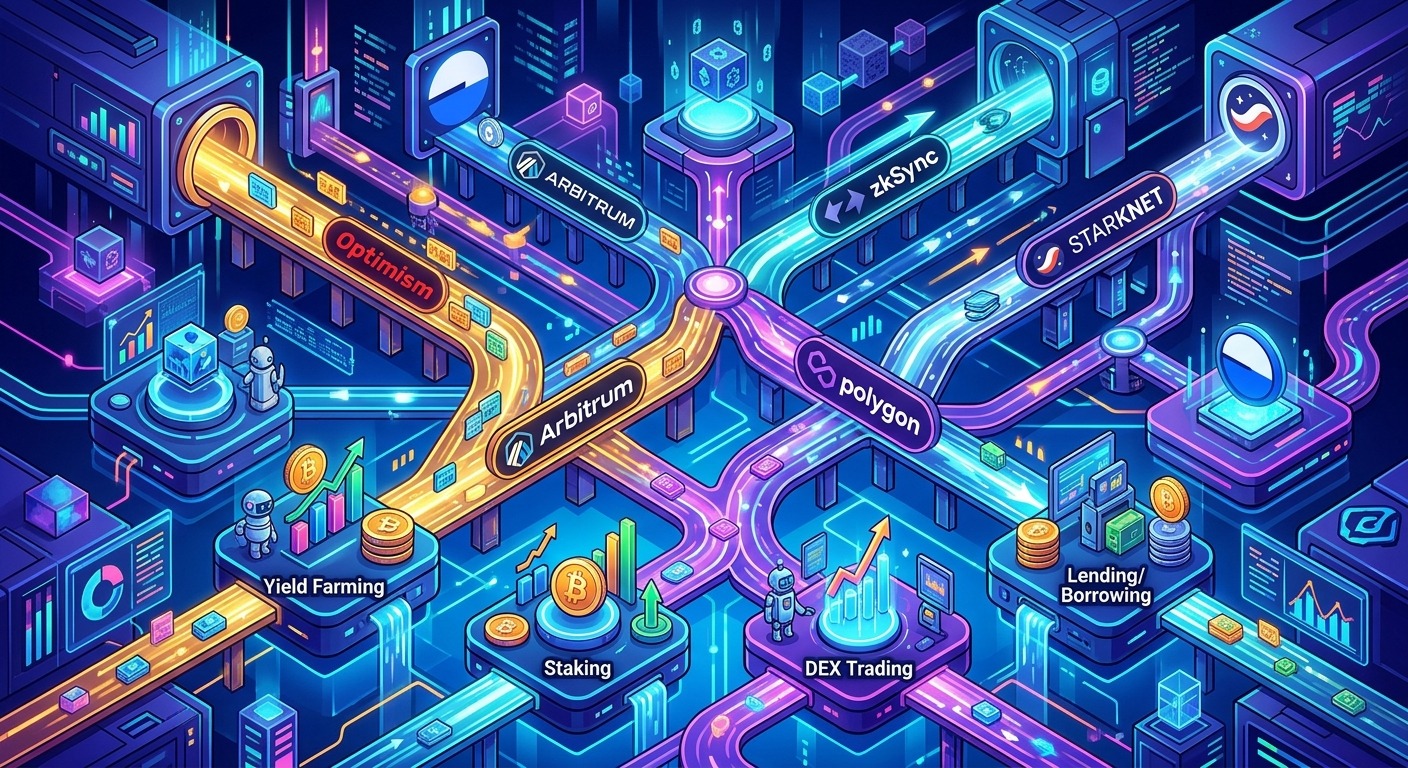
Layer 2 networks address this by processing transactions off the main chain and settling the results back to Ethereum in compressed batches. The two dominant approaches are optimistic rollups, which assume transactions are valid unless challenged within a set window, and ZK-rollups, which use cryptographic proofs to verify every batch before settlement. Understanding layer-2 scaling architecture before committing capital is worth the time, since withdrawal timelines and bridge trust assumptions differ meaningfully between rollup types.
Fees on major Ethereum L2s typically run between $0.01 and $0.30 per transaction. That changes the math on active trading, frequent liquidity management, and any strategy that requires multiple on-chain steps to execute.
Arbitrum for Active Traders and Serious Lending Strategies
Arbitrum is the largest Ethereum L2 by total value locked. It runs as an optimistic rollup and has attracted the deepest roster of DeFi protocols of any L2 currently live. If you trade frequently or run a lending position with collateral that needs active management, Arbitrum is usually the strongest starting point.
For DEX activity, Arbitrum hosts Uniswap, Camelot, and Trader Joe, all with meaningful liquidity on major trading pairs. Slippage on popular tokens tends to stay competitive. GMX, the perpetuals protocol native to Arbitrum, has built a substantial following among traders who favor on-chain derivatives over centralized exchanges.
On the lending side, Aave’s Arbitrum deployment is one of its most liquid outside mainnet. Radiant Capital also operates there with cross-chain borrowing features, letting users take loans on one chain while collateral sits on another. That gives Arbitrum a distinct edge for anyone running a collateralized borrowing strategy.
One practical constraint: the native Arbitrum bridge uses a seven-day challenge window for withdrawals back to mainnet. Third-party bridges like Hop or Stargate can shorten that wait, but each bridge adds its own smart contract risk layer.
Optimism’s Ecosystem and the OP Stack Network
Optimism is the other major optimistic rollup on Ethereum, and it has taken a distinctive strategic direction. The OP Stack is a modular framework that lets teams build their own L2s using the same underlying codebase. Base is built on OP Stack. So are Zora, Mode, and a growing cluster of others. This shared infrastructure forms what Optimism calls the Superchain.
From a DeFi standpoint, Optimism itself runs a healthy ecosystem. Velodrome is the dominant DEX, using a vote-escrow tokenomics model that rewards long-term liquidity providers over short-term yield hunters. Aave and Synthetix both have strong deployments on Optimism as well.
Fees on Optimism dropped significantly after the Ecotone upgrade reduced L1 data posting costs. For liquidity providers focused on stable-pair pools, Velodrome consistently offers competitive yields with more predictable fee income than volatile trading pairs typically provide.
Optimism’s governance token, OP, channels a share of sequencer revenue into public goods funding. That is not directly relevant to most traders, but it shapes which protocols receive long-term development support, which matters when you are evaluating ecosystem health over a multi-year horizon.
Base for Accessible DeFi Entry Points
Base launched in 2023 as Coinbase’s own L2, built on the OP Stack. It has grown quickly, driven partly by Coinbase’s existing user base and partly by a wave of protocols that chose Base as their primary launch chain.
Aerodrome is the flagship DEX on Base, following a similar vote-escrow model to Velodrome. It has attracted significant liquidity and become a core infrastructure layer for the Base ecosystem. Stablecoin yield opportunities on Base often run higher than equivalent options on Arbitrum or Optimism because newer protocol incentive programs push rates up during growth phases.
Bridging to Base from Coinbase is about as smooth as onboarding gets. That makes Base a natural entry point for users moving assets from centralized exchange holdings into their first real DeFi positions. Gas costs are consistently low, and the network has handled surging activity without the congestion problems that have hit other chains during high-traffic periods.
One caveat worth stating plainly: Base is operated by Coinbase. The sequencer is centralized in a way that differs from an independently operated validator set. That is not necessarily disqualifying, but it is a trust assumption worth knowing about before deploying capital there.
How Bitcoin’s Layer 2 Ecosystem Works Differently
The Bitcoin Layer 2 conversation starts from a fundamentally different premise. Bitcoin’s base layer was not designed for smart contracts. Bitcoin L2 solutions approach scalability through different mechanisms than Ethereum rollups, and most of them serve different use cases entirely.
The main types of Bitcoin Layer 2 solutions currently in use include:
- Payment channel networks like the Lightning Network, built for high-speed, low-cost Bitcoin transfers without touching the base chain for every transaction.
- EVM-compatible sidechains like Rootstock (RSK), which run their own smart contract environments and let users bridge BTC over to participate in DeFi-style protocols.
- Validity-proof networks like Stacks, which settle state to Bitcoin and aim to bring programmability without relying on a fully federated bridge model.
- Federated sidechains like Liquid Network, used primarily by institutions and exchanges for faster BTC settlement between trusted counterparties.
Each of these serves a different purpose. The Lightning Network does not support arbitrary smart contracts. It is built for one thing: fast, low-cost transfers of Bitcoin value between parties. Routing value via Bitcoin payments on Lightning is often the most cost-efficient first move when you need to transfer BTC before it reaches a DeFi-compatible chain like RSK or a cross-chain bridge destination.
For DeFi participation with BTC exposure, most users still end up working with wrapped BTC (WBTC or cbBTC) on Ethereum L2s rather than native Bitcoin Layer 2 protocols. Liquidity on Bitcoin-native DeFi platforms remains thin relative to what Arbitrum or Optimism can offer. That gap is narrowing, but it is real today.
A Framework for Choosing the Right L2 Network
Rather than picking an L2 based on brand recognition or recent news cycles, run through these steps before bridging capital:
- Define the primary activity first. Active trading, lending, liquidity provision, and passive yield farming each have different fee and protocol sensitivities. Clarify which one you are optimizing for before anything else.
- Check protocol deployment on each candidate chain. Not every protocol is live on every L2. Aave is on Arbitrum, Optimism, and Base, but market parameters and available collateral types vary by deployment.
- Estimate your transaction frequency. At low activity levels, fee differences between chains are negligible. At high activity, even a $0.05 difference per transaction compounds meaningfully over weeks of active management.
- Review asset support and bridge options. Some tokens bridge cleanly to all major L2s. Others have limited support or require multi-hop routes that introduce latency and additional counterparty risk.
- Assess withdrawal timelines. Optimistic rollups carry a challenge window before funds are finalized back on mainnet. ZK-based chains like zkSync or StarkNet often have faster finality but may have less mature protocol ecosystems.
Ethereum and Bitcoin L2 Networks Side by Side
| Network | Type | Best DeFi Use Case | Avg. Fee Range | Protocol Depth |
|---|---|---|---|---|
| Arbitrum | Optimistic Rollup | DEX trading, perpetuals, lending | $0.02 to $0.30 | Very high |
| Optimism | Optimistic Rollup | Stable-pair liquidity, yield farming | $0.01 to $0.25 | High |
| Base | OP Stack Rollup | New DeFi positions, stablecoin yield | $0.01 to $0.20 | High and growing |
| Lightning Network | Payment Channel Network | Fast BTC transfers, value routing | Sub-cent per hop | None (payments only) |
| Rootstock (RSK) | Bitcoin Sidechain | BTC-backed DeFi, EVM smart contracts | $0.01 to $0.15 | Moderate |
Matching Chain to Strategy: Where the Real Work Happens
Most active DeFi participants end up using two or three L2s depending on what they are trying to do. Arbitrum for deep liquidity and on-chain derivatives. Base for newer yield opportunities and stablecoin pools. Optimism for stable-pair strategies with vote-escrow incentives. Lightning as a fast, cost-efficient corridor when routing BTC value before it reaches a DeFi-compatible destination.
There is no universally superior Layer 2. The network that works best for a derivatives trader will frustrate a passive liquidity provider hunting incentivized stable pairs. The chain that makes sense for a BTC holder routing toward DeFi has nothing in common with what a stablecoin lender on Arbitrum needs.
The real work is getting specific. Write down your activity. Check which protocols are deployed and liquid on each candidate chain. Run fee estimates against your realistic transaction volume. Then pick the chain where the numbers work for your strategy, not the one generating the most attention at any given moment.
DeFi rewards precision. Layer 2 networks have made that precision dramatically cheaper to act on. The tools are live, the protocols are mature, and the choice is clearer than it looks once you frame it around what you are actually trying to do.