Gas fees can turn a profitable DeFi trade into a losing proposition faster than you can say “transaction confirmed.” You’ve probably watched in frustration as a $50 swap costs $30 in fees, or worse, attempted a yield farm deposit only to pay more in gas than you’d earn in a month. The good news? You don’t have to accept these costs as inevitable. With the right strategies and timing, you can dramatically reduce what you pay to interact with decentralized protocols.
Gas fees drain DeFi profits, but you can minimize them by choosing Layer 2 networks, timing transactions during off-peak hours, batching operations together, and selecting gas-efficient protocols. Understanding how blockchain networks price transactions lets you make smarter decisions about when, where, and how to interact with decentralized finance platforms while keeping more money in your wallet.
Understanding Why Gas Fees Fluctuate
Gas fees aren’t fixed prices. They change based on network demand, similar to surge pricing for rideshare apps.
When thousands of users rush to buy a new token launch or claim an airdrop, they compete for limited block space. Miners or validators prioritize transactions that pay higher fees. Your transaction sits in the mempool waiting unless you outbid others.
Ethereum’s gas system measures computational work in units called “gwei.” One gwei equals 0.000000001 ETH. A simple token swap might require 150,000 gas units. If the gas price hits 50 gwei, you’d pay 0.0075 ETH (around $15 to $20 depending on ETH’s price).
Complex operations cost more. Providing liquidity on Uniswap requires multiple contract interactions, pushing gas usage to 300,000 units or higher. Smart contract complexity directly impacts your wallet.
Network congestion follows predictable patterns. Weekday mornings in North America and Europe see heavy activity. Weekends, especially Saturday and Sunday mornings UTC, typically offer lower fees. Major events like NFT drops or protocol launches create temporary spikes.
Practical Strategies to Cut Your Gas Costs
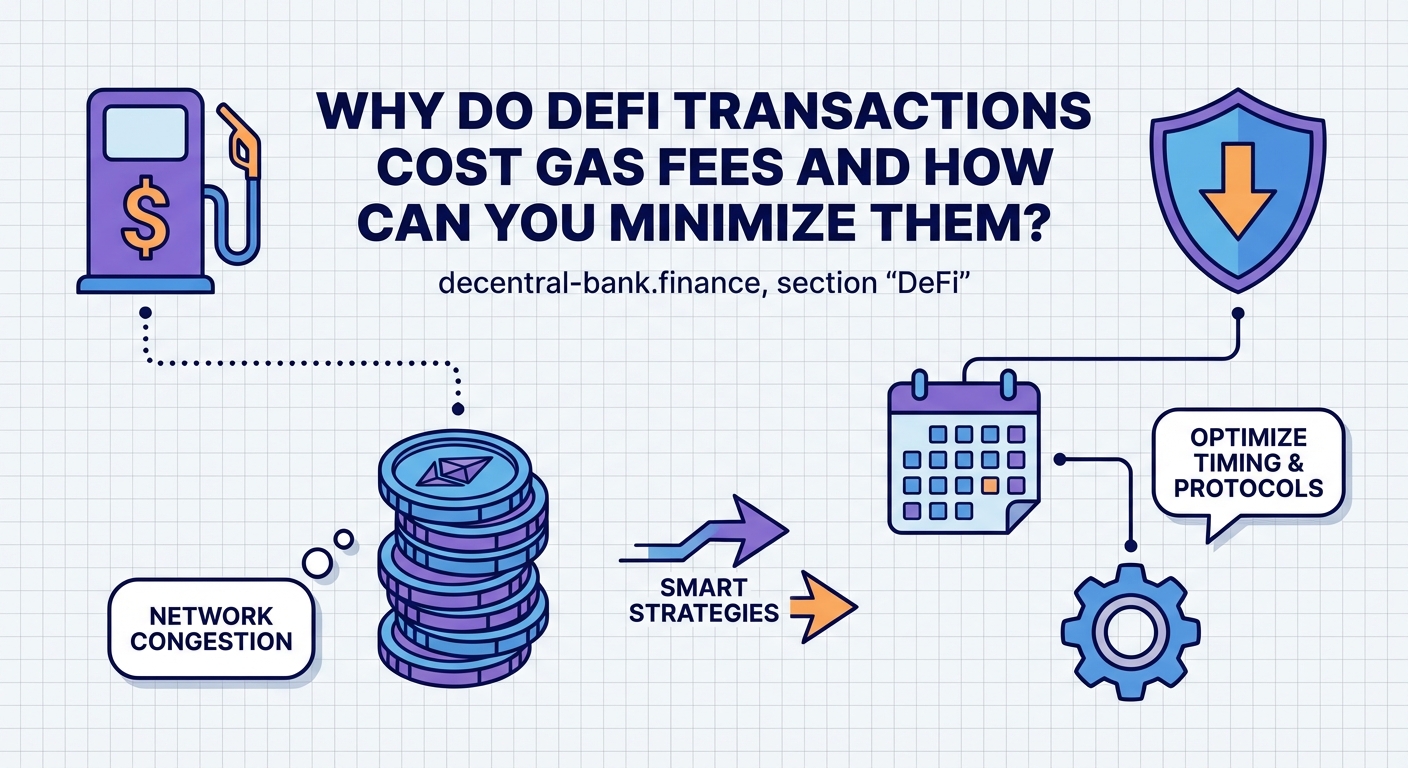
Here are proven methods to minimize what you pay for DeFi transactions:
Switch to Layer 2 Networks
Layer 2 solutions process transactions off the main Ethereum chain, then batch them together for final settlement. This approach cuts costs by 90% or more.
Arbitrum, Optimism, and Polygon offer nearly identical DeFi experiences at a fraction of the cost. A Uniswap swap that costs $25 on Ethereum mainnet might run $0.50 on Arbitrum.
Most major protocols now support Layer 2. Aave, Curve, and SushiSwap all operate on multiple networks. You’ll find familiar interfaces with dramatically lower fees.
The tradeoff? Moving assets between Layer 1 and Layer 2 costs gas. Bridge your funds during low-fee periods and plan to stay on Layer 2 for multiple transactions. Don’t bridge back and forth for single operations.
Time Your Transactions Strategically
Gas prices fluctuate throughout the day and week. Monitoring these patterns saves real money.
Use gas tracking tools like Etherscan’s gas tracker or Blocknative’s real-time feed. These show current prices and historical trends. Many display color-coded indicators for cheap, normal, and expensive periods.
The best times to transact:
– Late Friday through Sunday (UTC timezone)
– Between 2 AM and 6 AM UTC on weekdays
– During major holidays when trading activity drops
The worst times:
– Weekday afternoons in US and European time zones
– During anticipated protocol launches or airdrops
– When major market movements trigger panic trading
Set up price alerts. Many wallets and browser extensions notify you when gas drops below your target threshold. Wait for these windows instead of transacting immediately.
Batch Multiple Operations Together
Each transaction pays a base fee regardless of complexity. Combining actions into a single transaction spreads this cost across multiple operations.
Some protocols offer native batching. Zapper and DeBank let you enter multiple positions, claim rewards, and rebalance all in one transaction. Instead of five separate $10 gas fees, you pay one $15 fee.
Smart contract wallets like Gnosis Safe support transaction batching at the wallet level. Queue up several operations and execute them together.
Consider these batching opportunities:
– Claim all yield farm rewards at once instead of daily
– Rebalance multiple liquidity positions together
– Approve tokens and execute swaps in the same transaction
– Harvest and reinvest in a single action
Choose Gas-Efficient Protocols
Not all DeFi platforms consume gas equally. Protocol architecture matters.
Automated market makers like Uniswap V3 generally cost less than order book exchanges. Lending protocols with simpler logic (Compound) often beat feature-rich alternatives (Aave) on gas, though Aave’s extra features might justify the cost.
Check gas costs before committing to a platform. DeFi aggregators often display estimated gas for each option. A slightly worse rate with 50% lower gas might deliver better net returns.
Some protocols optimize specifically for gas efficiency:
– 1inch splits trades across multiple pools but calculates whether gas savings justify the complexity
– Yearn Finance batches user deposits to minimize per-user costs
– Curve optimizes for stablecoin swaps with minimal computational overhead
Step-by-Step Process for Minimum Gas Spending
Follow this sequence every time you plan a DeFi transaction:
-
Check current gas prices using Etherscan or your wallet’s gas tracker. If prices exceed your comfort level, wait unless the transaction is time-sensitive.
-
Evaluate Layer 2 alternatives for your intended action. Search for the same protocol on Arbitrum, Optimism, or Polygon. Compare the total cost including any bridging fees.
-
Calculate your breakeven point by dividing potential profits by gas costs. If a yield farm offers 20% APY but gas costs eat 15% of your deposit, you need to stay invested for months to break even.
-
Set a gas price limit in your wallet settings. Most wallets let you customize the maximum you’ll pay. The transaction might take longer to confirm, but you won’t overpay during temporary spikes.
-
Bundle related actions into a single session. If you need to swap tokens, provide liquidity, and start staking, do all three during the same low-fee window.
-
Use gas tokens strategically if you’re a power user. Chi gas tokens let you pre-purchase gas during cheap periods and redeem during expensive ones, though this advanced technique requires careful calculation.
Common Gas-Wasting Mistakes to Avoid
| Mistake | Why It’s Expensive | Better Approach |
|---|---|---|
| Daily reward claims | Each claim costs $5 to $20 in gas | Claim weekly or when gas is under 20 gwei |
| Small transaction amounts | Gas costs the same regardless of size | Wait until you have larger amounts to move |
| Ignoring failed transactions | Failed transactions still consume gas | Test with small amounts or use transaction simulators |
| Staying on Ethereum mainnet | Mainnet gas runs 10x to 100x higher | Move to Layer 2 for regular activity |
| Using default wallet settings | Wallets often suggest higher-than-needed fees | Customize gas settings based on urgency |
| Approving tokens separately | Each approval costs gas | Use infinite approvals (with trusted protocols only) |
Failed transactions deserve special attention. They burn gas without accomplishing anything. Before executing complex operations, use tools like Tenderly to simulate the transaction. These simulators predict success or failure before you spend real money.
“The biggest mistake I see newcomers make is treating gas fees as unavoidable. Every transaction should pass a simple test: will this action generate more value than it costs? If you’re paying $30 in gas to claim $25 in rewards, you’re not doing DeFi, you’re doing charity for miners.” (Common advice from experienced DeFi users)
Advanced Techniques for Power Users
Once you’ve mastered the basics, these advanced strategies can further reduce costs.
Gas tokens let you tokenize gas during cheap periods. When gas prices spike, you burn these tokens to subsidize your transactions. Chi and GST2 are popular options, though their effectiveness varies with network conditions.
Flashbots allow you to submit transactions directly to miners, bypassing the public mempool. This prevents front-running and lets you pay exact gas amounts without overpaying for priority. The learning curve is steep but worthwhile for large transactions.
Smart contract wallets like Argent and Gnosis Safe offer features like social recovery and transaction batching. They cost more gas to deploy initially but save money long-term through efficient operations.
Cross-chain bridges sometimes offer better rates than swapping on-chain. If you need to convert USDC to DAI, bridging USDC to Polygon, swapping there, and bridging back might cost less than a single Ethereum mainnet swap. Calculate total costs including bridge fees.
How Network Choice Impacts Your Bottom Line
Different blockchains price transactions differently. Understanding these differences helps you choose the right platform.
Ethereum mainnet offers the most security and liquidity but charges premium fees. Use it for large transactions where security matters more than cost, or when you need access to protocols not yet available elsewhere.
Arbitrum and Optimism reduce costs by 90% to 95% while maintaining Ethereum’s security guarantees. They’re ideal for regular DeFi activity like borrowing against your assets or yield farming.
Polygon offers even cheaper transactions (often under $0.01) with slightly different security tradeoffs. It’s perfect for testing strategies or making frequent small transactions.
Alternative Layer 1s like Avalanche, Fantom, and BNB Chain provide low fees and fast confirmations. The tradeoff comes in ecosystem maturity and decentralization. Research each network’s security model before committing significant funds.
Consider total costs, not just gas. A network with $0.01 gas but 2% worse swap rates might cost more overall than Ethereum with $5 gas but optimal pricing. Calculate the complete picture.
Security Considerations When Minimizing Gas
Cutting costs shouldn’t compromise security. Keep these principles in mind:
Never sacrifice security for savings. Using an untested Layer 2 bridge to save $10 in gas makes no sense if it risks your entire portfolio. Stick to established solutions with proven track records.
Choosing the right wallet matters for gas optimization. Hardware wallets offer maximum security but require manual transaction signing, making batching harder. Hot wallets enable automation but increase risk. Balance security needs against convenience.
Be cautious with infinite approvals. Approving a protocol to spend unlimited tokens saves gas on future transactions, but it also grants permanent access to your funds. Only use infinite approvals with well-audited, trusted protocols. Revoke approvals you no longer need.
Watch for rug pulls and scams that exploit gas-saving techniques. Malicious contracts might batch your intended transaction with hidden token transfers. Always verify transaction details before signing.
Test new strategies with small amounts first. That $2 gas fee to test a new batching tool costs far less than losing hundreds to a failed experiment.
Calculating Whether a Transaction Makes Financial Sense
Before executing any DeFi operation, run this simple calculation:
Expected profit or benefit minus total costs (gas plus fees) equals net gain.
If the result is negative or barely positive, reconsider.
Example: You want to provide liquidity to earn trading fees.
– Deposit amount: $500
– Expected APY: 25%
– Annual earnings: $125
– Gas to deposit: $20
– Gas to withdraw: $20
– Protocol fees: 0.3% of deposit ($1.50)
First-year net profit: $125 minus $40 (gas) minus $1.50 (fees) equals $83.50, or 16.7% actual return.
If gas prices double, your return drops to 8.7%. If you’re only planning to provide liquidity for a month, you’d need 300% APY just to break even.
This math explains why small accounts struggle with Ethereum mainnet. A $100 investment paying $40 in gas needs 40% returns just to recover costs. The same investment on a Layer 2 with $1 total gas needs only 1% to break even.
Scale matters. Larger transactions spread gas costs across more capital, improving percentage returns. Consider waiting until you have sufficient capital to make gas costs negligible relative to your position size.
Tools and Resources for Gas Optimization
These tools help you minimize fees:
Gas price trackers:
– Etherscan Gas Tracker (real-time prices and historical charts)
– Blocknative Gas Estimator (predictive pricing)
– Owlracle (multi-chain gas prices)
Transaction simulators:
– Tenderly (detailed simulation and debugging)
– Ganache (local blockchain testing)
– Hardhat (developer-focused simulation)
DeFi aggregators:
– 1inch (finds best rates including gas costs)
– Matcha (compares prices across DEXs)
– ParaSwap (optimizes for total cost)
Wallet extensions:
– MetaMask (customizable gas settings)
– Rainbow (gas predictions and alerts)
– Frame (advanced transaction control)
Analytics platforms:
– DeBank (portfolio tracking with gas analysis)
– Zapper (multi-protocol position management)
– Zerion (transaction history and cost tracking)
Set up alerts through these tools. Getting notified when gas drops below 15 gwei lets you execute planned transactions at optimal times without constant monitoring.
Making Gas Optimization Part of Your DeFi Strategy
Reducing gas costs isn’t a one-time action. It’s an ongoing practice that compounds over time.
Track your gas spending monthly. Most wallet apps and portfolio trackers show total fees paid. Seeing that you spent $200 in gas last month motivates better habits.
Create a gas budget. Decide how much you’re willing to spend monthly on transactions. When you hit that limit, wait for the next month or switch to cheaper networks.
Adjust strategies based on account size. If you’re working with under $1,000, Layer 2 networks aren’t optional, they’re essential. Above $10,000, occasional mainnet transactions become more justifiable.
Stay informed about network upgrades. Ethereum’s ongoing development aims to reduce base layer costs. Understanding how DeFi protocols adapt to these changes helps you anticipate future cost structures.
Remember that gas optimization serves your larger financial goals. Don’t let the pursuit of minimal fees prevent you from executing profitable strategies. A $30 gas fee on a transaction that generates $300 in profit is money well spent.
Your Path to Smarter DeFi Spending
Gas fees will always exist in decentralized systems. Validators need compensation for processing transactions and securing networks. But you control how much you pay through informed choices about timing, networks, and transaction structure.
Start with one change today. Move your next transaction to a Layer 2 network, or wait for weekend gas prices instead of transacting immediately. Track the savings. That small win builds momentum for developing comprehensive gas optimization habits.
The strategies covered here work for everyone from DeFi beginners making their first swap to experienced users managing complex positions. Apply them consistently and you’ll keep more of your profits while still accessing the full power of decentralized finance.