
Stablecoins are supposed to be the safe harbor of crypto. They promise a steady $1.00 value while everything else swings wildly. But that promise breaks more often than you’d think. When a stablecoin loses its peg, the consequences ripple through entire ecosystems, wiping out billions in value and leaving holders scrambling to understand what went wrong.
When stablecoins lose their peg, they trade below $1.00 due to liquidity crises, collateral failures, or confidence collapse. Holders face immediate losses, DeFi protocols trigger cascading liquidations, and recovery depends on the stablecoin’s backing mechanism. Understanding different depegging scenarios helps you recognize warning signs and protect your portfolio before panic selling begins.
Understanding what a stablecoin peg actually means
A stablecoin’s peg is its target price of $1.00.
The mechanism maintaining this peg varies by design. Fiat-backed stablecoins like USDC hold dollar reserves. Crypto-collateralized options like DAI use overcollateralization. Algorithmic stablecoins rely on supply adjustments and arbitrage incentives.
The peg isn’t a fixed lock. It’s a dynamic balance maintained through market forces and backing mechanisms. Small deviations of 1-2 cents happen regularly during high volatility. These minor fluctuations usually self-correct within hours.
Major depegging occurs when the price drops 5% or more below $1.00 and stays there. This signals fundamental problems with the backing mechanism, liquidity, or market confidence.
How do stablecoins maintain their $1 peg during market crashes explains the various mechanisms that keep prices stable under normal conditions.
The immediate market impact of depegging
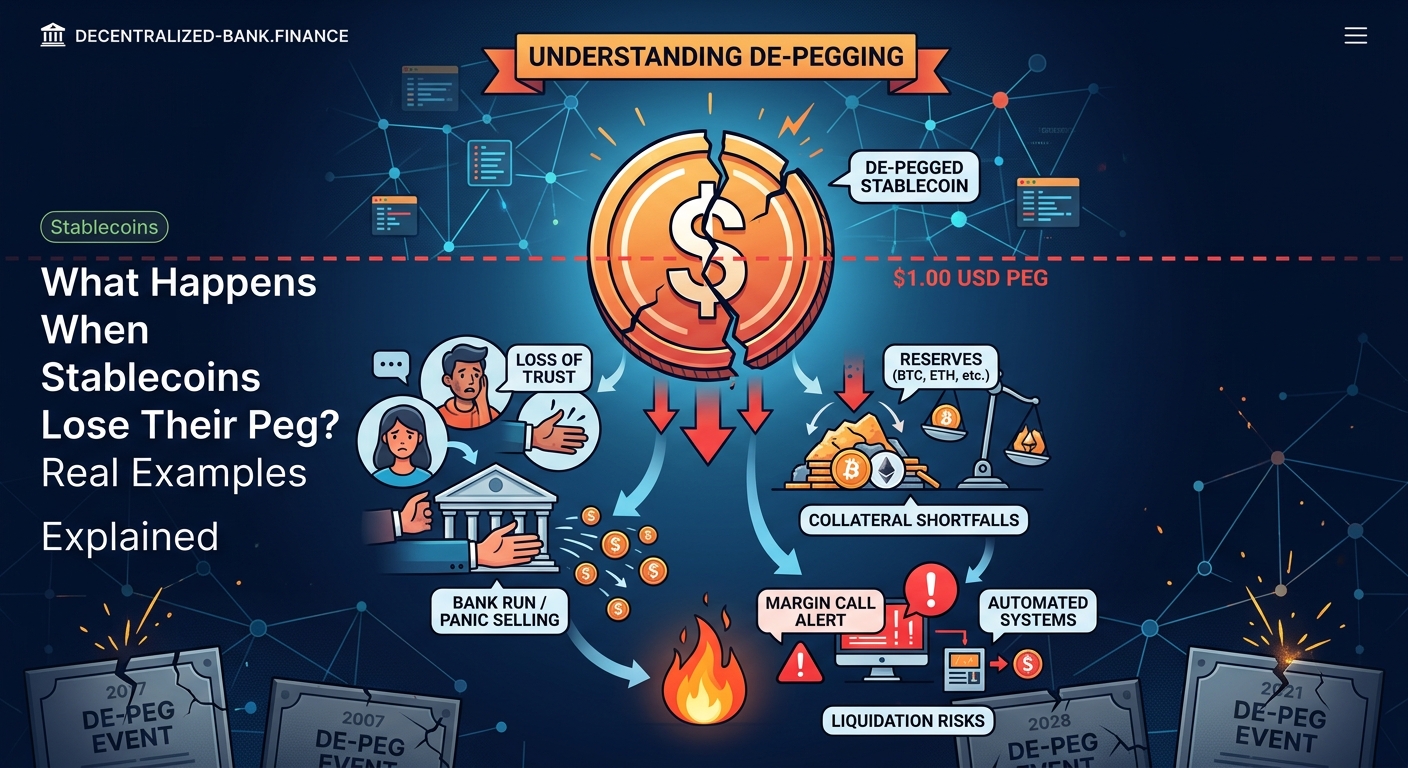
When a stablecoin starts trading at $0.95, holders lose 5 cents per dollar immediately.
That might sound minor until you consider scale. A portfolio holding $100,000 in a depegged stablecoin just lost $5,000 in purchasing power. The loss compounds if you need to exit positions urgently.
Trading volume explodes during depegging events. Panic sellers rush to exit, creating downward pressure. Arbitrage traders try to profit from price discrepancies. Liquidity pools on decentralized exchanges drain rapidly as users swap out.
Price discovery breaks down. The gap between buy and sell orders widens dramatically. What is slippage and why does it eat your profits becomes painfully relevant as traders face 10-20% slippage trying to exit large positions.
Exchange listings freeze. Centralized platforms often suspend trading and withdrawals during severe depegging to prevent further chaos. This traps holders who can’t move their funds to safety.
Three types of stablecoin depegging events
Different stablecoin designs fail in different ways.
Collateral failure depegging happens when backing assets lose value or become inaccessible. USDC briefly depegged to $0.87 in March 2023 after Silicon Valley Bank collapsed, holding $3.3 billion of Circle’s reserves. The stablecoin recovered once Circle confirmed alternative banking arrangements.
Liquidity crisis depegging occurs when redemption mechanisms can’t handle demand. Even well-collateralized stablecoins depeg if users can’t quickly convert tokens to dollars. This creates temporary price drops until liquidity returns.
Structural failure depegging represents complete mechanism breakdown. Terra’s UST collapsed from $1.00 to $0.10 in May 2022 because its algorithmic design couldn’t maintain the peg during extreme selling pressure. No recovery occurred because the fundamental model failed.
Here’s how these scenarios compare:
| Depegging Type | Recovery Likelihood | Typical Duration | Holder Risk Level |
|---|---|---|---|
| Collateral failure | High if reserves exist | Hours to days | Medium |
| Liquidity crisis | Very high | Minutes to hours | Low to medium |
| Structural failure | Very low | Permanent | Extreme |
The Terra UST collapse explained
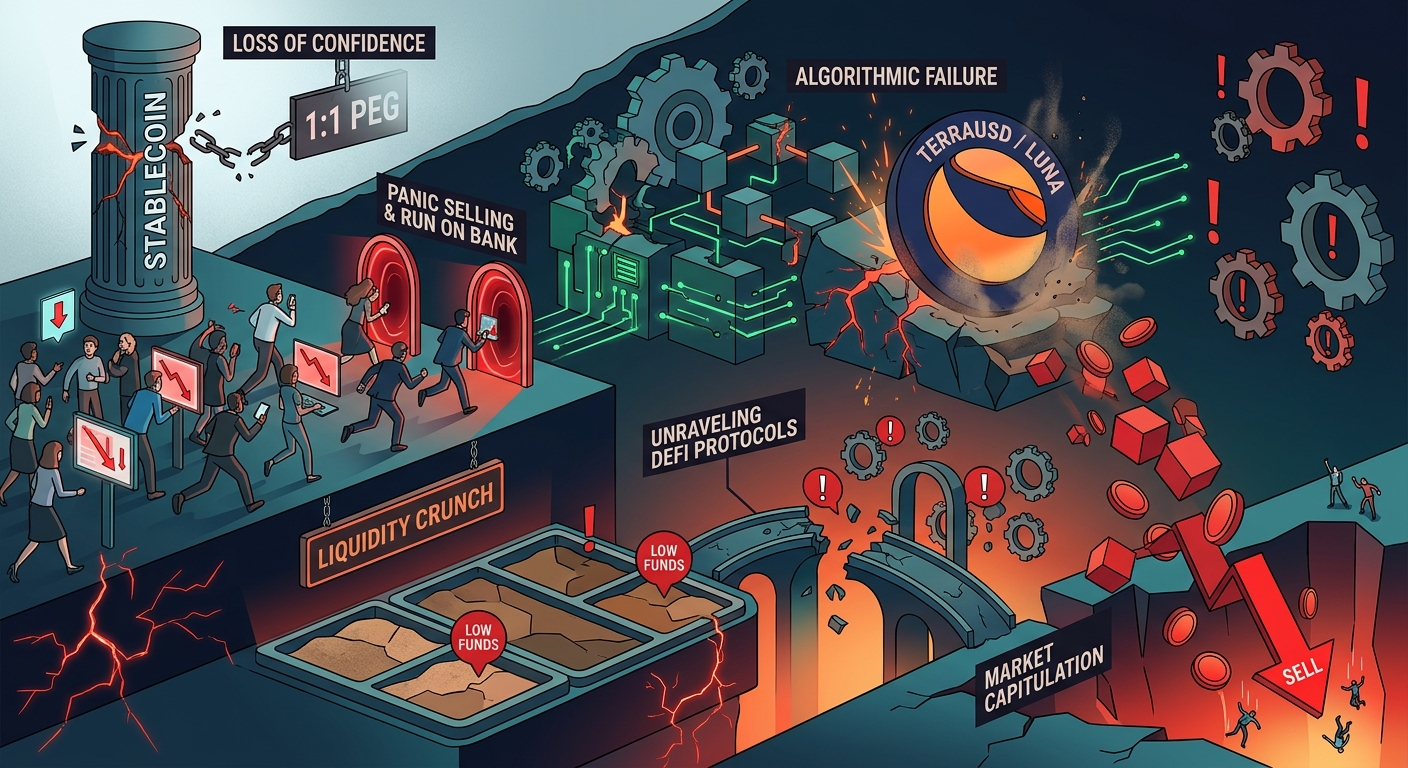
UST was an algorithmic stablecoin paired with LUNA, its volatile sister token.
The mechanism worked through arbitrage. If UST traded at $0.98, you could burn $0.98 of UST to mint $1.00 of LUNA, pocketing the difference. This buying pressure theoretically pushed UST back to $1.00.
The system required constant demand for LUNA. When that demand disappeared, the death spiral began.
On May 7, 2022, large UST withdrawals from Anchor Protocol created selling pressure. UST dropped to $0.985. Arbitrageurs started burning UST for LUNA, flooding the market with new LUNA tokens. LUNA’s price crashed from $80 to under $1 in three days.
As LUNA collapsed, the arbitrage mechanism broke. Burning UST no longer produced valuable LUNA. UST holders couldn’t redeem for $1.00 of value. The stablecoin fell to $0.10, then effectively zero.
The total destruction of value exceeded $40 billion. Holders of both UST and LUNA lost nearly everything. DeFi protocols holding UST as collateral faced massive bad debt.
The Terra collapse taught the market that algorithmic stablecoins without hard collateral backing are fundamentally fragile. No amount of clever mechanism design can substitute for real reserves when confidence evaporates.
How DeFi protocols react to depegging
Lending platforms face immediate crisis when collateral depegs.
Imagine you borrowed $5,000 against $10,000 of UST collateral at 150% collateralization. If UST drops to $0.90, your collateral is now worth $9,000. Your loan becomes undercollateralized, triggering liquidation.
What happens during a DeFi liquidation and how to avoid it covers the mechanics, but depegging accelerates everything. Liquidation bots sell your collateral at depressed prices. You lose your principal and still owe the loan.
Liquidity pools suffer impermanent loss on steroids. If you provided liquidity to a USDC/UST pool, depegging means you’re left holding more of the depegged asset. Your position value drops significantly below what you deposited.
Protocol treasuries holding depegged stablecoins face solvency questions. Many DAOs keep operational funds in stablecoins. A major depeg can threaten their ability to pay contributors or maintain operations.
Smart contracts don’t automatically recognize depegging. They continue treating the stablecoin as $1.00 until oracle price feeds update. This creates arbitrage opportunities and additional risks during the lag period.
Warning signs before major depegging events
Stablecoins rarely depeg without warning signals.
Redemption delays are the clearest red flag. If users report waiting days to convert stablecoins to dollars, the issuer likely faces liquidity problems. Tether experienced this during several 2018-2019 controversies.
Audit opacity suggests potential reserve issues. Legitimate stablecoin issuers publish regular attestations from reputable firms. Vague statements about reserves or delayed audits indicate problems.
Yield anomalies signal market concern. When a stablecoin suddenly offers 2-3% higher yields than alternatives, protocols are paying extra to attract liquidity. This premium reflects increased risk perception.
Social media panic often precedes depegging. Monitor crypto Twitter and Reddit for sudden spikes in redemption concerns or reserve questions. Where there’s smoke, there’s often fire.
Trading below $1.00 consistently is the final warning. Small dips are normal. Sustained trading at $0.98-$0.99 for days means market makers doubt full redemption.
USDT vs USDC vs DAI: which stablecoin should beginners trust helps you evaluate which stablecoins show fewer warning signs.
Step-by-step: what to do during a depegging event
Speed matters when stablecoins start sliding.
-
Check the price across multiple sources immediately. Don’t rely on a single exchange. CoinGecko and CoinMarketCap aggregate prices from many platforms. A 2% drop on one exchange might be a glitch. A 2% drop everywhere is real.
-
Assess your total exposure across all platforms. Check every wallet, exchange account, and DeFi protocol. You might have forgotten stablecoin deposits in lending platforms or liquidity pools. Calculate your total at-risk amount.
-
Prioritize withdrawals from riskiest positions first. Exit undercollateralized loans before liquidation hits. Remove liquidity from DEX pools experiencing high volatility. Transfer funds from smaller exchanges to major platforms with better liquidity.
-
Avoid panic selling at maximum discount. If the stablecoin dropped to $0.95 and you’re not facing liquidation, consider waiting. Many depegging events recover partially. Selling at the bottom locks in maximum loss.
-
Document everything for tax purposes. Depegging creates taxable events. Screenshot your positions, transaction hashes, and timestamps. You’ll need this information to calculate losses accurately.
Comparing recovery outcomes from past depegging events
Not all depegging events end the same way.
USDC (March 2023) depegged to $0.87 after the SVB collapse. Recovery took 48 hours once Circle clarified reserve access. Holders who waited recovered fully. Those who panic sold at $0.87 lost 13%.
USDT (multiple events 2018-2022) experienced several minor depegs to $0.95-$0.98. Each recovered within days as Tether processed redemptions. The stablecoin never fell below $0.88 and always returned to peg.
UST (May 2022) never recovered. The algorithmic mechanism failed completely. Holders who exited at $0.90 saved 90% of value compared to those who waited. The stablecoin eventually became worthless.
USDN (April 2022) depegged to $0.75 and oscillated between $0.80-$0.95 for months. Partial recovery occurred but never reached full peg. Holders faced extended uncertainty.
The pattern is clear. Fiat-backed stablecoins with real reserves typically recover. Algorithmic stablecoins without hard collateral rarely do. Crypto-collateralized vs fiat-backed stablecoins: which is more secure examines why backing type matters so much.
Risk mitigation strategies for stablecoin holders
Diversification protects against single-point failure.
Never hold 100% of your stable value in one stablecoin. Split holdings between USDC, USDT, and DAI. If one depegs, you’ve limited exposure. This strategy saved many holders during the USDC SVB crisis.
Understand the backing mechanism of every stablecoin you hold. Fiat-backed options require trust in the issuer and their banking relationships. Crypto-collateralized stablecoins depend on oracle reliability and liquidation systems. Algorithmic designs carry the highest risk.
Monitor your collateralization ratios in lending protocols. Maintain 200-250% collateralization instead of the minimum 150%. This buffer protects against temporary depegging without immediate liquidation. How to calculate your liquidation price before taking a DeFi loan shows you the math.
Keep some holdings in centralized exchanges with direct fiat off-ramps. When depegging occurs, you can convert to actual dollars immediately. This beats trying to swap through depegged markets.
Set price alerts at $0.98 for stablecoins you hold. This gives you early warning before major depegging develops. Most portfolio tracking apps support custom alerts.
Consider the opportunity cost of yield. An extra 3% APY isn’t worth it if the stablecoin carries significantly higher depegging risk. Can you really earn yield on stablecoins without losing the peg helps evaluate risk-adjusted returns.
The regulatory response to stablecoin failures
Governments noticed when $40 billion vanished overnight.
The Terra collapse accelerated regulatory scrutiny worldwide. The U.S. Treasury released a stablecoin framework calling for bank-like oversight. The European Union’s MiCA regulation includes specific stablecoin provisions.
New rules focus on reserve requirements and transparency. Issuers must hold high-quality liquid assets matching circulating supply. Regular audits become mandatory. Redemption rights need clear documentation.
Some jurisdictions banned algorithmic stablecoins entirely. The EU’s MiCA framework prohibits stablecoins without adequate reserves. Algorithmic designs without backing can’t operate legally.
These regulations aim to prevent future Terra-style collapses. They also raise compliance costs, potentially reducing stablecoin innovation. The tradeoff between safety and flexibility continues evolving.
How smart contracts handle stablecoin price feeds
DeFi protocols don’t check Coinbase prices directly.
They rely on oracles like Chainlink to provide price data. These oracles aggregate prices from multiple sources and deliver them on-chain. The system introduces delay by design to prevent manipulation.
During rapid depegging, this delay creates problems. A stablecoin might trade at $0.85 on exchanges while smart contracts still see $0.98. This mismatch enables arbitrage but also increases liquidation risk.
Some protocols implement circuit breakers. When price feeds show extreme deviation, the protocol pauses operations. This prevents cascading liquidations but also traps user funds temporarily.
Oracle manipulation becomes possible during depegging chaos. Attackers can exploit price feed delays to extract value from lending protocols. What are flash loan attacks and how do they threaten your DeFi holdings covers these advanced attack vectors.
Psychological factors driving depegging severity
Fear spreads faster than facts in crypto markets.
Bank runs happen because everyone fears everyone else will withdraw first. Stablecoin depegging follows identical psychology. Rational individual behavior creates collective disaster.
Social media amplifies panic. A single tweet from a respected figure questioning reserves can trigger mass redemptions. The 2023 USDC depeg accelerated when crypto influencers advised immediate exits.
Confirmation bias makes recovery harder. Once people believe a stablecoin will fail, they interpret every piece of news negatively. Positive updates get dismissed as propaganda. This pessimism becomes self-fulfilling.
Herd behavior dominates during crisis. Seeing others sell triggers more selling. The rational move becomes “exit before everyone else,” creating the very collapse everyone fears.
Understanding these dynamics helps you resist panic. When your brain screams “sell everything now,” remember that depegging often represents temporary liquidity issues rather than fundamental insolvency.
The role of arbitrage in peg recovery
Arbitrageurs are the unsung heroes of stablecoin stability.
When USDC trades at $0.98, arbitrage traders buy it and redeem directly with Circle for $1.00. This 2% profit opportunity creates buying pressure that pushes the price back toward peg.
The mechanism requires functional redemption. If Circle can’t process redemptions, arbitrage doesn’t work. This is why the SVB crisis caused deeper depegging than normal. Traders feared redemption might fail.
Arbitrage capital has limits. If billions need redemption simultaneously, arbitrageurs can’t absorb all the volume. Their capital constraints mean temporary depegging persists until natural demand returns.
Algorithmic stablecoins tried to automate arbitrage through protocol mechanics. Terra’s burn/mint mechanism represented algorithmic arbitrage. When LUNA’s value collapsed, the arbitrage incentive disappeared, and the peg couldn’t recover.
Building a depegging response plan
Preparation beats panic every time.
Create a written plan before crisis hits. Document which stablecoins you hold, where they’re located, and your exit thresholds. Deciding at $0.98 is easier than deciding at $0.85 while your heart races.
Identify your critical positions. Which holdings absolutely cannot face liquidation? Which are in protocols you trust to weather volatility? Rank your positions by risk and urgency.
Establish price triggers for action. Maybe you exit lending positions if price drops below $0.97. You remove liquidity if it hits $0.95. You convert everything at $0.90. Having predetermined thresholds removes emotion.
Test your exit routes quarterly. Make small withdrawals from each protocol. Verify you remember passwords and have gas fees available. Finding out you’re locked out during crisis is too late.
Keep emergency stablecoin reserves in different assets. If you’re worried about USDC depegging, hold some USDT as backup. This gives you options when your primary stablecoin faces problems.
Real lessons from holders who survived major depegging
The Terra collapse taught expensive lessons.
Holders who exited at the first signs of trouble (UST at $0.95) preserved 95% of value. Those who “bought the dip” at $0.70 thinking it would recover lost everything.
Diversification saved portfolios during the USDC SVB crisis. Holders with funds split between USDC, USDT, and DAI could use their unaffected stablecoins while USDC recovered. All-in USDC holders faced forced selling at the bottom.
Protocol selection mattered enormously. Users on platforms with circuit breakers and conservative collateral ratios avoided liquidation. Those on aggressive protocols with 110% minimum collateralization got wiped out.
The speed of response determined outcomes. Holders who acted within the first hour of depegging news generally fared better than those who waited to “see what happens.” Crypto markets move fast. Hesitation costs money.
The real risk of stablecoin de-pegging: what every DeFi user needs to know provides additional perspective on managing these risks long-term.
Why some stablecoins survive depegging while others don’t
Reserve quality determines survival.
USDC survived because Circle held real dollars in real banks. Even with SVB’s collapse, those funds existed somewhere. Recovery required time, not miracles.
UST failed because no reserves existed. The entire system depended on LUNA maintaining value. When confidence broke, nothing backed the stablecoin. No amount of time could fix a fundamentally broken model.
Transparency builds resilience. Stablecoins with regular audits and clear reserve composition recover trust faster. Opaque operations face permanent skepticism after depegging.
Regulatory compliance matters more than crypto purists admit. USDC’s relationship with U.S. regulators meant government had incentive to facilitate recovery. Unregulated algorithmic stablecoins received no such support.
The lesson is straightforward. Stablecoins backed by real, auditable reserves in regulated institutions have recovery paths. Those relying on clever mechanisms and crypto collateral face existential risk during severe stress.
Protecting yourself starts with understanding the risks
Stablecoins aren’t as stable as their name suggests.
You’ve now seen how depegging happens, why some stablecoins recover while others collapse, and what you can do to protect your holdings. The key is recognizing that “stable” means “usually stable under normal conditions,” not “guaranteed safe forever.”
Smart stablecoin holders diversify across multiple assets, understand the backing mechanisms, monitor for warning signs, and have exit plans ready. They don’t panic at minor fluctuations but act decisively when real problems emerge. Most importantly, they never bet their entire portfolio on the assumption that a stablecoin will always trade at exactly $1.00.
Your stable value deserves the same careful risk management as your volatile crypto holdings. Maybe more, since you’re counting on that stability when everything else crashes.