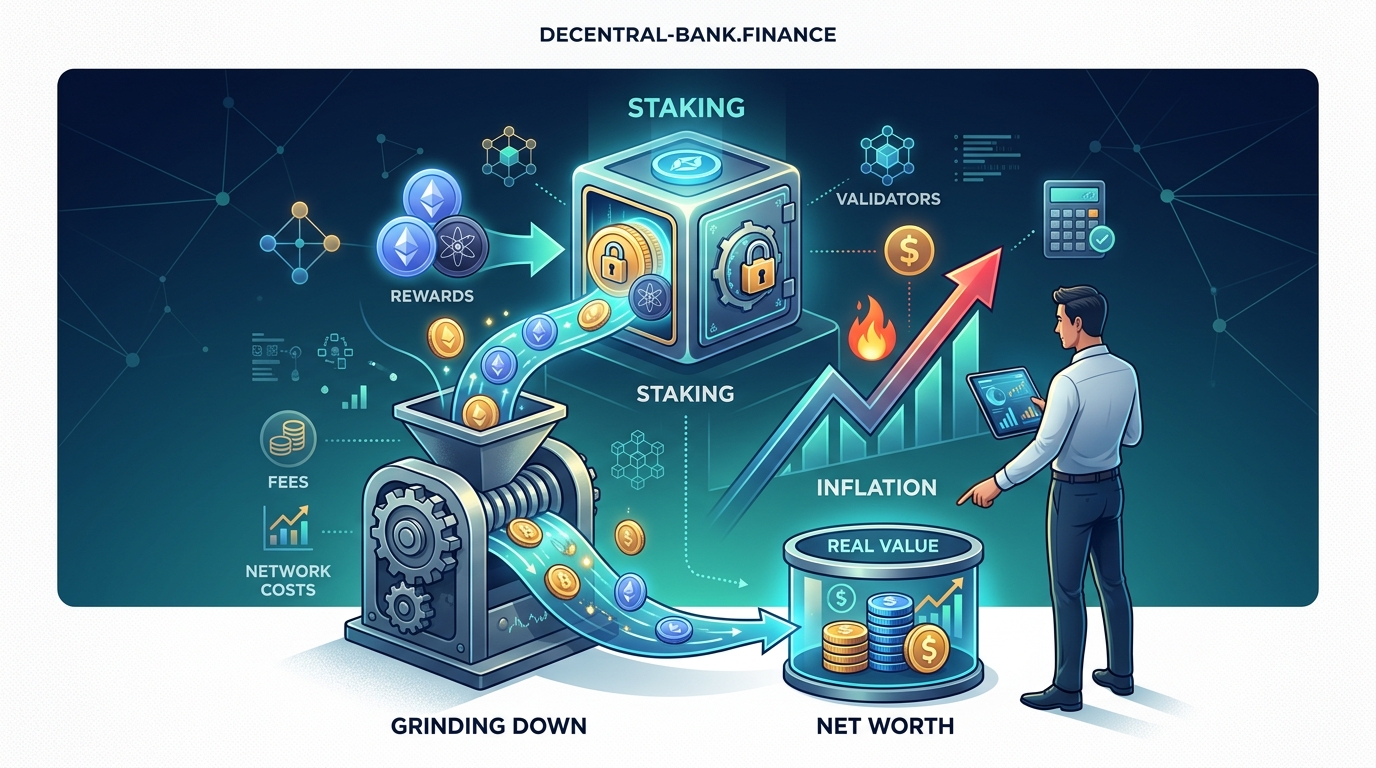
You see a validator advertising 12% APY on your favorite proof-of-stake network. You stake 10,000 tokens, expecting 1,200 tokens in a year. Twelve months later, you’ve earned 950 tokens after commissions, paid 50 tokens in transaction fees, and watched inflation dilute your holdings by another 5%. Your real return? Closer to 4%.
Advertised staking APY rarely reflects your actual returns. Validator commissions, network transaction fees, unstaking costs, and token inflation all chip away at nominal rates. To calculate real yield, subtract all fees from gross rewards, then adjust for inflation and opportunity cost. Networks with lower inflation and transparent fee structures protect your purchasing power better than high-APY chains with uncapped token emission.
Why advertised staking APY misleads most investors
Protocols advertise headline APY numbers to attract stakers. They’re not lying, but they’re showing you gross returns before deductions.
A 15% APY sounds incredible until you realize the validator takes a 10% commission, the network charges 0.5% in gas fees for claiming rewards, and annual token inflation runs at 7%. Your net return drops to roughly 6.75% before accounting for inflation, leaving you with negative real yield.
Most staking dashboards display nominal APY without breaking down where your rewards actually go. You need to manually calculate the impact of every fee layer and inflation rate to understand what you’re really earning.
Here’s what eats into your staking rewards:
- Validator commission (typically 5% to 20% of your gross rewards)
- Network transaction fees for staking, claiming, and unstaking
- Protocol fees on some liquid staking platforms
- Token inflation that increases total supply and dilutes your share
- Opportunity cost from lock-up periods preventing you from selling during price rallies
How validator commissions reduce your gross rewards
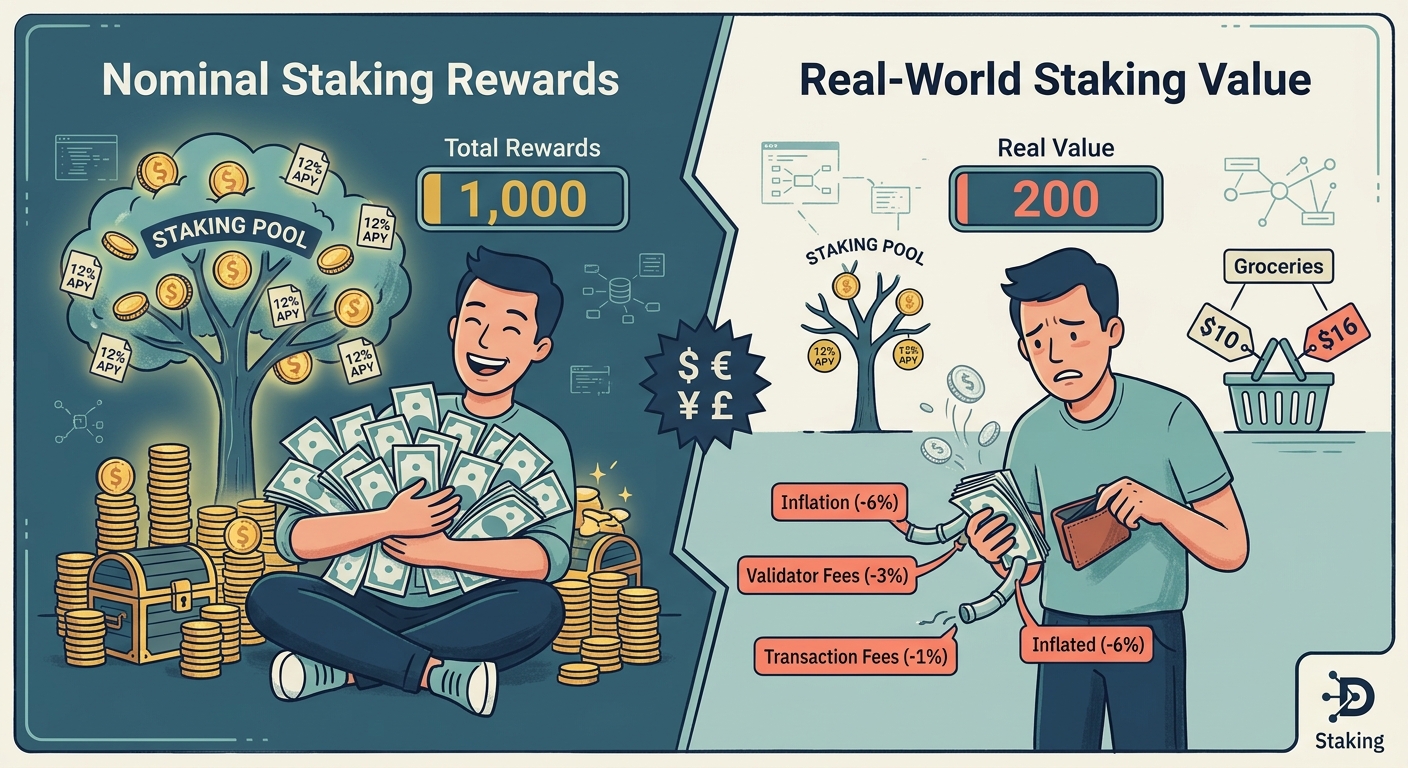
Validators charge a commission for running nodes and securing the network. This percentage comes directly off your gross staking rewards before you receive anything.
If you stake with a validator charging 10% commission on a network offering 12% APY, your effective rate drops to 10.8% immediately. That 1.2% difference compounds over time.
Some validators advertise 0% commission to attract delegators. This can work short-term, but many raise rates after building a delegation base. Always check the commission change rules for each network. Ethereum validators can’t change commission rates without a protocol upgrade, but Cosmos validators can adjust theirs with a few days’ notice.
Lower commission doesn’t always mean better returns. A validator with 5% commission but 99.9% uptime will outperform a 0% commission validator that misses blocks and incurs slashing penalties that reduce your stake.
Breaking down network transaction fees
Every interaction with a staking contract costs gas. Staking your initial deposit, claiming rewards, restaking, and unstaking all trigger on-chain transactions.
On Ethereum, these fees fluctuate wildly. Staking 1 ETH might cost $5 in gas during quiet periods or $50 during network congestion. If you’re staking smaller amounts and claiming rewards weekly, transaction fees can consume 2% to 5% of your annual yield.
Layer-2 solutions and alternative chains offer lower fees, but you still pay something. Polygon charges fractions of a cent per transaction, while Solana fees stay under $0.01 most of the time. These small amounts add up when you’re managing multiple positions or rebalancing frequently.
Calculate your break-even point before staking small amounts. If you’re staking $500 worth of tokens on Ethereum and paying $30 in combined staking and unstaking fees, you need 6% just to cover transaction costs before earning anything.
How token inflation silently erodes purchasing power
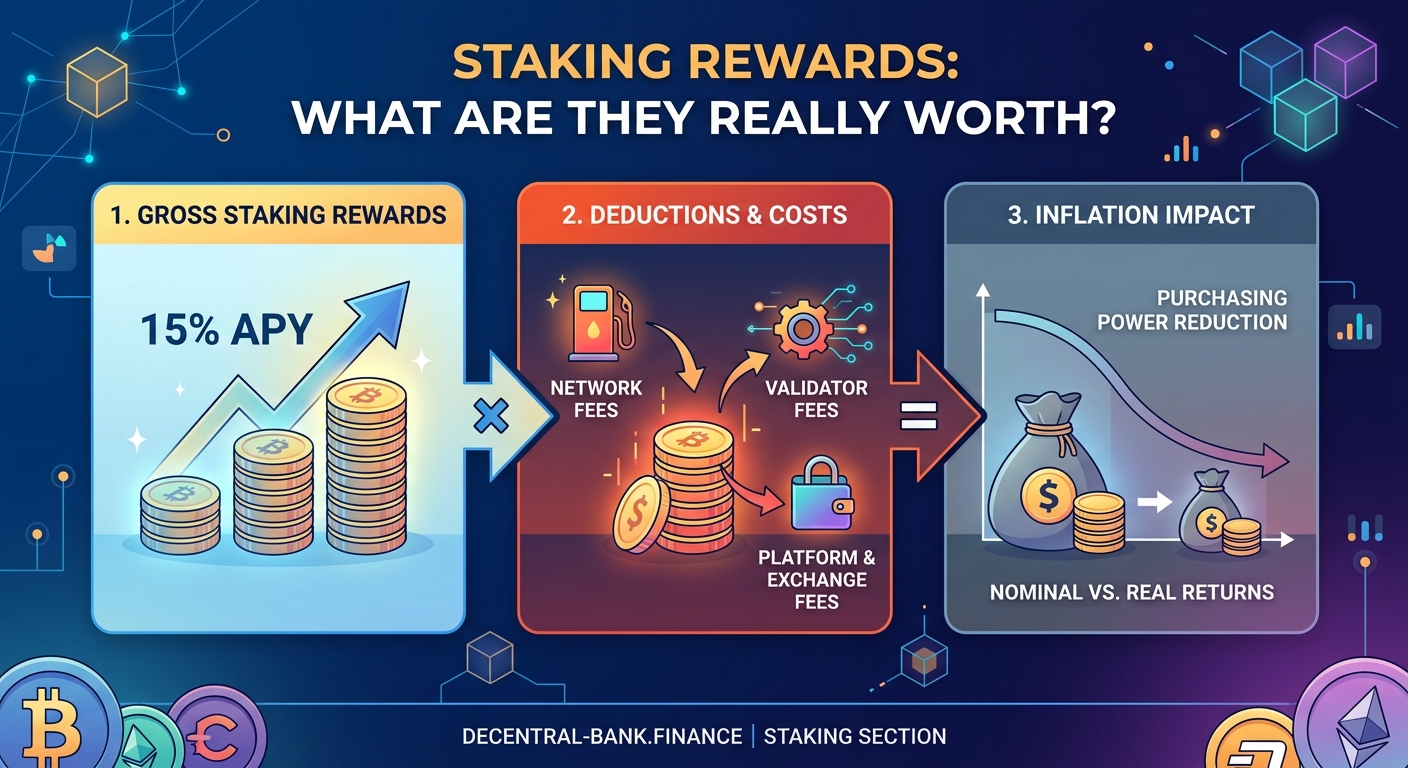
Most proof-of-stake networks inflate their token supply to fund staking rewards. New tokens get minted and distributed to stakers, but this increases total supply and dilutes everyone’s share of the network.
If a network offers 10% staking APY but inflates supply by 8% annually, your real return is closer to 2%. You’re earning more tokens, but each token represents a smaller fraction of the total network value.
Some networks cap inflation. Ethereum’s post-merge issuance targets net-zero or deflationary supply through EIP-1559 fee burns. Other chains like Cosmos have dynamic inflation that adjusts based on the percentage of tokens staked, ranging from 7% to 20%.
Check these metrics before choosing where to stake:
- Current annual inflation rate
- Maximum inflation cap (if any)
- Percentage of total supply currently staked
- Token burn mechanisms that offset inflation
Networks with high inflation and low staking participation dilute non-stakers aggressively. If only 40% of tokens are staked and inflation runs at 15%, non-stakers effectively lose 15% purchasing power annually while stakers barely keep pace.
Calculating your real yield after all deductions
Start with the advertised APY, then subtract every fee layer to find your actual return.
Here’s the formula:
Real Yield = (Gross APY × (1 – Validator Commission)) – Transaction Fee % – Inflation Rate
Example calculation for staking on a hypothetical network:
| Component | Value |
|---|---|
| Advertised APY | 12.0% |
| Validator commission | 10% |
| Net APY after commission | 10.8% |
| Transaction fees (annualized) | 0.5% |
| Net APY after fees | 10.3% |
| Token inflation rate | 7.0% |
| Real yield | 3.3% |
This 3.3% represents your actual increase in purchasing power relative to the network’s token supply. It doesn’t account for price appreciation or depreciation of the token itself.
If the token price drops 20% during your staking period, your dollar-denominated return is still negative despite positive real yield in token terms. Always separate token yield from price speculation when evaluating staking returns.
Why lock-up periods create hidden opportunity costs
Many networks require unbonding periods before you can access staked tokens. Ethereum requires no lock-up for liquid staking derivatives but traditional staking had a queue. Cosmos chains typically enforce 21-day unbonding periods. Polkadot requires 28 days.
During these lock-up windows, you can’t sell even if the token price crashes 30%. This opportunity cost doesn’t appear in APY calculations but represents real risk.
A 10% APY with a 28-day unbonding period might underperform a 7% APY with instant liquidity if you need to exit during market volatility. Factor in your liquidity needs and risk tolerance when comparing staking options across different networks.
Liquid staking protocols solve this by giving you derivative tokens that represent your staked position. You can trade these immediately, but they introduce smart contract risk and typically charge 10% commission on top of validator fees.
Comparing fee structures across major networks
Different proof-of-stake networks handle fees and inflation differently. Here’s how the major chains stack up:
| Network | Typical APY | Avg. Validator Fee | Inflation Rate | Unbonding Period |
|---|---|---|---|---|
| Ethereum | 3-5% | 10% | ~0% (post-merge) | None (liquid) / Queue (native) |
| Cardano | 4-6% | 2-5% | ~4.5% | None |
| Polkadot | 12-15% | 3-10% | ~10% | 28 days |
| Cosmos Hub | 15-20% | 5-10% | 7-20% (dynamic) | 21 days |
| Solana | 6-8% | 8-10% | ~5% | 2-3 days |
Ethereum offers the lowest inflation but also the lowest nominal APY. Your real yield after inflation often beats higher-APY chains once you account for dilution.
Cardano provides moderate returns with low validator fees and no lock-up period, making it attractive for investors who want flexibility.
Polkadot and Cosmos offer high nominal rates but aggressive inflation and longer unbonding periods. These work better for long-term holders who won’t need liquidity and believe in token price appreciation.
How to find validators with transparent fee structures
Not all validators clearly display their total fee structure. Some advertise low commission but run on unreliable infrastructure that leads to missed blocks and reduced rewards.
Look for validators that publish:
- Current commission rate
- Commission change history
- Uptime statistics over the past 90 days
- Total value staked with them
- Whether they participate in governance
Large validators with millions in delegated stake usually offer better uptime but charge higher commissions. Smaller validators might offer 0% commission but lack redundant infrastructure.
Check validator performance on block explorers before delegating. A validator with 98% uptime at 5% commission will underperform one with 99.9% uptime at 8% commission over time.
Some networks penalize delegators when validators get slashed for downtime or malicious behavior. You lose a portion of your stake even though you didn’t do anything wrong. This makes validator selection critical for protecting your capital.
Tools for tracking real returns across multiple positions
Spreadsheets work for tracking one or two staking positions, but most investors stake across multiple networks and validators.
Portfolio tracking tools like DeBank, Zapper, and Zerion show your staked positions and accumulated rewards, but they display gross APY without accounting for fees and inflation. You’ll need to manually adjust their numbers.
Build a simple tracking sheet with these columns:
- Network name
- Amount staked
- Advertised APY
- Validator commission
- Estimated annual transaction fees
- Network inflation rate
- Calculated real yield
- Dollar value at stake time
- Current dollar value
Update this monthly to see whether you’re actually growing purchasing power or just accumulating more tokens while their value erodes.
“Most stakers focus on token accumulation instead of purchasing power. You can earn 20% more tokens annually and still lose money if inflation runs at 25%. Always calculate real yield in terms of your share of network value, not absolute token count.”
When high APY actually signals higher risk
Networks offering 30%, 50%, or 100% APY usually have fundamental problems. Either they’re inflating supply aggressively to bootstrap adoption, or they’re unsustainable yield farming schemes that will collapse.
Legitimate proof-of-stake networks typically offer APY between 3% and 20%. Anything above that range deserves serious scrutiny.
Ask these questions when you see unusually high rates:
- What’s the token inflation rate funding these rewards?
- How long has the network been operating?
- What percentage of total supply is currently staked?
- Are rewards paid in the same token or a different one?
- Does the protocol have actual usage and revenue?
Protocols paying rewards in governance tokens with no utility often see those tokens crash 90% once early farmers exit. You might earn 1,000% APY in tokens that become worthless.
Sustainable staking returns come from networks with real transaction fees, strong security budgets, and inflation rates that balance validator incentives against token holder dilution.
Strategies for maximizing real yield
Once you understand the fee structure and inflation dynamics, you can optimize your staking strategy.
Stake larger amounts to reduce the percentage impact of transaction fees. If gas costs $20 to stake and unstake, that’s 4% of a $500 position but only 0.2% of a $10,000 position.
Choose validators with strong uptime over those with the lowest commission. A reliable validator at 8% commission beats an unreliable one at 3% if the latter misses blocks regularly.
Consider liquid staking for positions you might need to exit during your staking period. The extra 1-2% in protocol fees is worth it if you avoid being locked during a 30% price drop.
Reinvest rewards strategically. On networks with high transaction fees, claim and restake quarterly instead of weekly. On low-fee chains, compound more frequently to maximize returns.
Compare real yield across different DeFi strategies. Sometimes lending stablecoins at 8% APY with no inflation beats staking volatile tokens at 15% nominal APY with 10% inflation.
Tax implications of staking rewards
Most tax jurisdictions treat staking rewards as income when you receive them, not when you sell. This creates a tax liability even if you never convert to fiat.
If you earn $10,000 in staking rewards at current market prices, you owe income tax on that $10,000 regardless of whether you sell. If the token price drops 50% before you sell, you still owe tax on the original $10,000 but only have $5,000 in value.
Track the fair market value of every reward payment you receive. Most staking platforms don’t provide tax reports, so you’ll need to manually record each claim transaction and its USD value at the time.
Some investors delay claiming rewards to defer tax liability, but this only works if your validator automatically restakes unclaimed rewards. Otherwise, you’re leaving money on the table and reducing your compound returns.
Consult a crypto-specialized tax professional before implementing any staking strategy. Tax treatment varies significantly between countries and even between states in the US.
Common mistakes that destroy staking returns
Chasing the highest advertised APY without checking inflation rates leads to negative real returns. A 25% APY with 30% inflation loses purchasing power.
Staking tiny amounts on high-fee networks means transaction costs consume most of your yield. Don’t stake $100 worth of ETH when gas fees will eat 20% of your returns.
Ignoring validator performance metrics and choosing based solely on commission leads to slashing events and missed rewards. A slashed validator can cost you 5% of your stake in a single event.
Failing to account for lock-up periods during volatile markets traps you in losing positions. If you can’t handle 28 days of illiquidity, choose networks with shorter unbonding or use liquid staking derivatives.
Not tracking your cost basis for tax purposes creates nightmares during tax season. Record every reward claim and its fair market value when received.
Reinvesting rewards without considering market conditions can compound losses during bear markets. Sometimes converting staking rewards to stablecoins preserves more value than accumulating more volatile tokens.
Making informed decisions about where to stake
Calculate the real yield for every staking opportunity before committing capital. Don’t rely on advertised APY numbers alone.
Prioritize networks with transparent fee structures, reasonable inflation rates, and strong validator ecosystems. Ethereum, Cardano, and Solana generally offer better risk-adjusted returns than newer chains with unsustainably high rates.
Diversify across multiple validators on the same network to reduce the impact of any single validator’s downtime or slashing event. Most networks let you split your stake across 5-10 validators without significantly increasing transaction costs.
Monitor your positions monthly and recalculate real yield as inflation rates and validator commissions change. Networks adjust their economic parameters regularly, and yesterday’s good deal might become today’s poor return.
Consider your time horizon and liquidity needs. Long lock-up periods work fine for multi-year holdings but create risk for shorter-term positions. Match your staking strategy to your overall portfolio goals and risk tolerance.
Remember that staking is just one DeFi strategy. Compare real yields against lending, liquidity provision, and other opportunities to find the best risk-adjusted returns for your capital.
Building a sustainable staking strategy
Successful staking requires ongoing monitoring and adjustment. Set calendar reminders to review your positions quarterly and recalculate real yields based on current inflation rates and fee structures.
Track your actual returns in a spreadsheet. Compare what you expected to earn against what you actually received after all fees and inflation. This data helps you make better decisions about where to allocate future capital.
Stay informed about protocol upgrades that might change inflation rates or fee structures. Ethereum’s transition to proof-of-stake dramatically reduced inflation and changed the staking economics. Cosmos chains regularly adjust their inflation parameters through governance votes.
Build relationships with reliable validators by participating in their communities and governance discussions. Good validators communicate clearly about commission changes, downtime, and network upgrades that might affect your returns.
Treat staking as one component of a diversified DeFi strategy, not your entire portfolio. Even the best staking opportunities carry smart contract risk, validator risk, and token price risk that can overwhelm your yield if things go wrong.
Your real returns depend on understanding every fee layer, calculating actual inflation-adjusted yield, and choosing validators based on performance rather than marketing. The difference between advertised APY and real yield often exceeds 50%, making this analysis essential for protecting your capital and growing your wealth in DeFi.