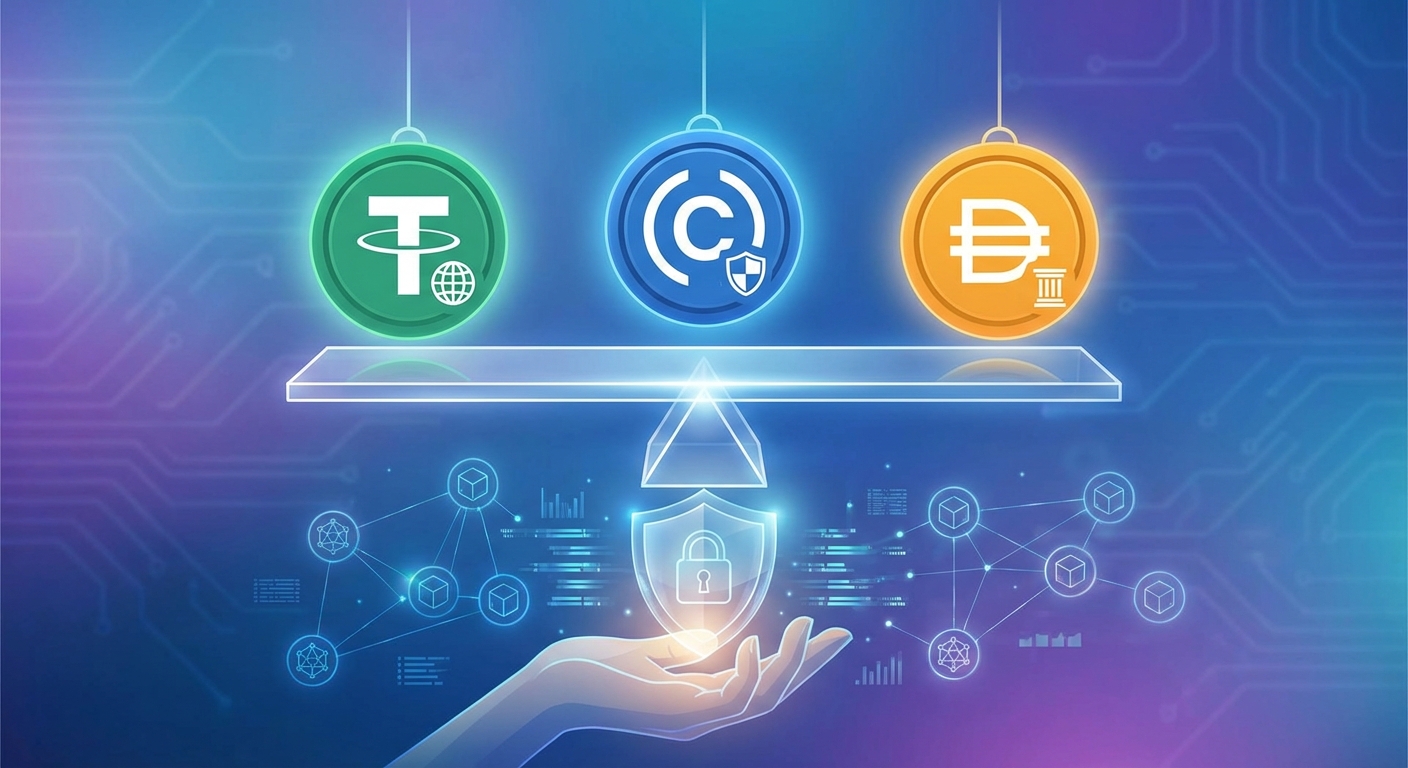
Stablecoins promise something rare in crypto: stability. While Bitcoin and Ethereum swing wildly in price, stablecoins aim to hold steady at one dollar. But not all stablecoins work the same way, and choosing the wrong one can expose you to risks you never saw coming.
USDT dominates by volume but faces transparency concerns. USDC offers regulated clarity with full reserves audited monthly. DAI operates without a central company, using smart contracts and crypto collateral. Your choice depends on whether you prioritize liquidity, regulatory compliance, or decentralization. Each stablecoin serves different needs and carries distinct risks every beginner should understand before buying.
Understanding what makes stablecoins different
A stablecoin tries to maintain a 1:1 peg with the US dollar. You should be able to exchange one stablecoin for one dollar at any time. This stability makes them useful for storing value during market volatility, moving money between exchanges, or earning yield without price risk.
But the methods these coins use to maintain their peg vary dramatically.
Some stablecoins back each token with real dollars or dollar equivalents sitting in bank accounts. Others use cryptocurrency as collateral, locked in smart contracts. A few attempt algorithmic mechanisms that adjust supply based on demand.
The three stablecoins we’re comparing today represent the three largest and most established options. They account for the vast majority of stablecoin trading volume and adoption.
USDT (Tether) launched in 2014 and remains the largest by market cap. USDC (USD Coin) arrived in 2018 with a focus on regulatory compliance. DAI entered the scene in 2017 as the first major decentralized stablecoin.
Each takes a fundamentally different approach to the same goal.
How USDT maintains its dollar peg
Tether issues USDT tokens and claims to back each one with reserves held by the company. When you buy USDT, you’re trusting that Tether holds enough assets to redeem your tokens for dollars if needed.
The company publishes attestations from accounting firms showing their reserves. These reports confirm that Tether holds assets equal to or greater than the number of USDT tokens in circulation.
But here’s where it gets complicated.
Tether’s reserves aren’t just cash sitting in a bank vault. They include commercial paper, corporate bonds, precious metals, and loans to other entities. The exact composition changes over time, and the company doesn’t provide real-time transparency into what they hold.
This lack of clarity has sparked controversy for years. Regulators have fined Tether for misrepresenting reserves in the past. Critics argue that without full audits, users can’t verify the backing exists.
Despite these concerns, USDT remains the most liquid stablecoin. You’ll find USDT trading pairs on virtually every crypto exchange. It dominates trading volume, particularly on platforms serving international users.
The network effect is powerful. More liquidity means tighter spreads and easier trades. For many users, USDT’s ubiquity outweighs transparency concerns.
What sets USDC apart from competitors
Circle and Coinbase jointly issue USDC through the Centre Consortium. This partnership brings institutional credibility and regulatory focus that other stablecoins lack.
USDC holds reserves in cash and short-term US Treasury bonds. The company publishes monthly attestation reports from Grant Thornton, a major accounting firm. These reports verify that reserves match or exceed circulating tokens.
The reserve composition is simpler and more conservative than Tether’s approach. Cash and Treasuries are highly liquid and carry minimal risk compared to commercial paper or corporate bonds.
Circle operates as a regulated financial institution in the United States. This means compliance with banking regulations, anti-money laundering requirements, and oversight from financial authorities.
For users who value regulatory clarity, USDC offers peace of mind. The trade-off is that this regulation comes with restrictions. Circle can freeze USDC addresses in response to law enforcement requests or sanctions compliance.
This centralized control cuts both ways. It provides legal recourse if something goes wrong, but it also means your tokens aren’t truly censorship-resistant.
USDC has grown rapidly among institutional users and DeFi protocols. Major platforms like Coinbase, Kraken, and Binance support it. Many DeFi applications prefer USDC because of its transparent backing and regulatory standing.
Why DAI works without a company behind it
DAI takes a completely different approach. No company issues DAI tokens. Instead, smart contracts on the Ethereum blockchain generate DAI when users lock up cryptocurrency as collateral.
Here’s how it works in practice.
You deposit ETH or other approved crypto assets into a MakerDAO vault. The smart contract lets you generate DAI worth up to a certain percentage of your collateral value. If you deposit $1,000 worth of ETH, you might be able to generate 600 DAI.
This overcollateralization is crucial. Because crypto prices fluctuate, your collateral needs to be worth more than the DAI you generate. If your collateral value drops too low, the system automatically liquidates it to protect the peg.
No company controls this process. The code runs autonomously on Ethereum. MakerDAO governance token holders vote on parameters like collateral types, liquidation ratios, and stability fees, but they can’t freeze your DAI or block transactions.
This decentralization comes with different risks. Smart contract bugs could drain funds. Governance decisions might favor large token holders over regular users. Extreme market volatility could trigger mass liquidations that temporarily break the peg.
DAI has maintained its peg remarkably well through multiple crypto crashes. The system has proven resilient, though it required emergency governance actions during the March 2020 market collapse.
For users who prioritize decentralization and censorship resistance, DAI offers something USDT and USDC cannot match. No company can shut down DAI or freeze your tokens. The system operates according to transparent code that anyone can verify.
Comparing stability mechanisms side by side
| Stablecoin | Backing Method | Transparency | Centralization | Liquidity |
|---|---|---|---|---|
| USDT | Fiat reserves (mixed assets) | Attestations only | Centralized company | Highest |
| USDC | Cash and Treasuries | Monthly audited reports | Centralized, regulated | High |
| DAI | Crypto collateral | Fully transparent on-chain | Decentralized governance | Moderate |
Each stability mechanism creates different risk profiles.
USDT’s centralized reserves mean you’re trusting Tether to maintain adequate backing. The company could theoretically issue more tokens than it has reserves, though attestations suggest they don’t. Regulatory action against Tether could disrupt the peg or freeze operations.
USDC’s regulated structure provides legal protections but introduces censorship risk. Circle must comply with government requests, which means your funds aren’t immune from seizure or freezing. The clear reserve structure reduces financial risk but doesn’t eliminate counterparty risk entirely.
DAI’s collateralization is visible on the blockchain at all times. You can verify that every DAI is backed by overcollateralized crypto assets. But those assets can drop in value rapidly, potentially faster than liquidation mechanisms can respond. Smart contract risk is real, though MakerDAO has operated for years without major exploits.
Practical steps for choosing your first stablecoin
-
Determine your primary use case before selecting a stablecoin. If you’re trading frequently across multiple exchanges, USDT’s superior liquidity might matter most. If you’re holding value in DeFi protocols, USDC or DAI might fit better.
-
Assess your risk tolerance honestly. Can you accept transparency concerns in exchange for maximum liquidity? Does regulatory compliance matter for your situation? Do you need censorship resistance, or is that less important than institutional backing?
-
Check which stablecoins your intended platforms support. Some exchanges or DeFi protocols work better with specific stablecoins. Verify deposit and withdrawal options before committing to one.
-
Consider diversification across multiple stablecoins. Spreading holdings between USDT, USDC, and DAI reduces your exposure to any single point of failure. This strategy makes sense if you’re holding significant value in stablecoins long-term.
-
Monitor your chosen stablecoin’s health regularly. Watch for news about reserves, regulatory actions, or governance decisions. Stablecoin risks can change quickly as regulations and market conditions shift.
Key risks every beginner should understand
Stablecoins aren’t risk-free, even though they aim for price stability.
Depeg risk is the possibility that a stablecoin loses its one-dollar value. This can happen if reserves prove inadequate, if a bank holding reserves fails, or if extreme market conditions overwhelm stability mechanisms. Every major stablecoin has experienced brief depegs during stress events.
Counterparty risk affects centralized stablecoins. You’re trusting the issuing company to maintain reserves and honor redemptions. If that company faces bankruptcy, regulatory shutdown, or fraud allegations, your tokens could lose value or become unredeemable.
Smart contract risk applies to decentralized options like DAI. Bugs in the code could allow attackers to drain collateral or mint unbacked tokens. While audits reduce this risk, they can’t eliminate it entirely.
Regulatory risk looms over the entire stablecoin sector. Governments worldwide are developing frameworks for stablecoin oversight. New regulations could force operational changes, restrict access, or even shut down certain stablecoins.
Choose a stablecoin based on which risks you can accept, not which promises sound best. Every stability mechanism involves trade-offs between decentralization, transparency, and convenience.
Real-world scenarios that reveal differences
Imagine you’re earning yield on a DeFi lending platform. You deposit stablecoins and earn interest from borrowers.
With USDT, you get maximum liquidity and the highest number of platform options. But you’re exposed to Tether’s reserve transparency issues. If concerns about backing intensify, you might struggle to exit your position at full value.
With USDC, you have strong regulatory backing and clear reserves. The platform might offer slightly lower yields because USDC is perceived as safer. You accept that Circle could freeze your tokens if law enforcement requests it.
With DAI, you participate in a fully decentralized system. Your tokens can’t be frozen, and you can verify backing on-chain. But you face smart contract risk and potential depegs during extreme volatility when collateral gets liquidated.
Now consider moving money between exchanges.
USDT offers the most trading pairs and deepest liquidity. You can move between platforms easily and trade into almost any cryptocurrency. The transfer process is straightforward, and fees are typically low.
USDC works well for regulated exchanges and platforms serving US customers. You might find fewer trading pairs on smaller exchanges, but major platforms support it fully. Compliance-focused users prefer this option.
DAI requires Ethereum network familiarity since it operates as an ERC-20 token. Not all exchanges support it, particularly centralized platforms focused on fiat on-ramps. But DeFi protocols embrace DAI enthusiastically.
How market conditions affect each stablecoin
During calm markets, all three stablecoins typically maintain their peg within a fraction of a cent. The differences become apparent during stress.
In March 2020, when COVID-19 fears crashed markets, DAI temporarily traded above $1.05 as users rushed to repay loans and avoid liquidation. The system worked as designed, but the peg deviated significantly. MakerDAO governance responded by adjusting parameters to restore stability.
USDT has experienced brief depegs during banking crises and regulatory concerns. When Tether’s banking relationships faced scrutiny, USDT briefly traded below $0.95 on some exchanges. Arbitrage traders typically restore the peg quickly, but these events create uncertainty.
USDC maintained its peg well through most stress events until March 2023, when Silicon Valley Bank’s collapse revealed that Circle held $3.3 billion in reserves at the failed bank. USDC briefly depegged to $0.87 before recovering when regulators guaranteed SVB deposits. This event showed that even transparent, regulated stablecoins face systemic banking risks.
These real-world tests reveal that no stablecoin is immune to external shocks. The question is which risks align with your situation and risk tolerance.
Making sense of fees and accessibility
Transaction costs vary depending on the blockchain network, not the stablecoin itself.
USDT exists on multiple blockchains including Ethereum, Tron, and Binance Smart Chain. Tron-based USDT offers extremely low fees, often under $0.01 per transaction. Ethereum-based USDT costs more during network congestion, sometimes $5 to $20 in gas fees.
USDC primarily operates on Ethereum but has expanded to Solana, Polygon, and other networks. Ethereum transactions carry similar costs to USDT. Alternative networks offer cheaper options, though with slightly less liquidity.
DAI lives primarily on Ethereum, where gas fees can spike during busy periods. Some wrapped versions exist on other networks, but the canonical DAI requires Ethereum transactions.
For small transactions, network choice matters more than stablecoin selection. Moving $50 worth of value on Ethereum might cost $10 in fees during peak times. The same transaction on Tron or Polygon costs pennies.
Consider the total cost of your workflow. If you’re moving between exchanges frequently, factor in both trading fees and network costs. If you’re holding long-term in a DeFi protocol, one-time deposit costs matter less than ongoing yield and security.
Security practices for holding stablecoins safely
Store significant stablecoin holdings in a hardware wallet or secure software wallet you control. Leaving funds on exchanges exposes you to platform risk, hacks, and potential insolvency.
Enable all available security features on any platform holding your stablecoins. Two-factor authentication, withdrawal whitelists, and address book features reduce theft risk significantly.
Verify smart contract addresses before interacting with DeFi protocols. Phishing attacks often use fake interfaces that drain funds to attacker-controlled contracts. Always double-check URLs and contract addresses against official sources.
Start with small amounts when trying new platforms or stablecoins. Test deposits, withdrawals, and basic functions before committing larger sums. This practice limits your exposure while you learn.
Keep multiple stablecoin options available. If one faces temporary issues, having alternatives prevents you from being stuck. Diversification across USDT, USDC, and DAI provides flexibility during unexpected events.
Where beginners should start today
For most beginners, USDC offers the best balance of transparency, regulatory clarity, and accessibility. The monthly attestations and conservative reserve structure provide confidence that your tokens are fully backed. Major exchanges and DeFi platforms support it widely.
Start with a small amount on a reputable exchange that supports USDC. Coinbase, Kraken, and Gemini all offer straightforward USDC purchases with bank transfers or debit cards. Buy $50 to $100 worth to familiarize yourself with the process.
Once you’re comfortable, consider adding DAI exposure to understand decentralized stablecoins. The MakerDAO system represents an important innovation in crypto, and holding some DAI helps you appreciate how decentralized finance works differently from traditional banking.
USDT makes sense if you need maximum liquidity for active trading. Despite transparency concerns, its market dominance creates practical advantages. Just understand the risks and don’t hold more than you can afford to lose if confidence in Tether wavers.
Your stablecoin choice isn’t permanent. You can swap between them easily on most platforms. As you gain experience and your needs change, you might shift allocations based on new information or different use cases.
The stablecoin landscape continues changing as regulations develop and new options emerge. Stay informed about reserve changes, regulatory developments, and technical improvements. What works today might need adjustment tomorrow.
Finding the right fit for your crypto journey
Choosing between USDT, USDC, and DAI comes down to matching stability mechanisms with your priorities. Traders often prefer USDT’s liquidity. Compliance-focused users lean toward USDC’s regulatory clarity. Decentralization advocates choose DAI’s trustless design.
None of these stablecoins is objectively best. Each serves different needs and accepts different trade-offs. Your choice should reflect your specific situation, risk tolerance, and intended use.
Start with one stablecoin that fits your immediate needs. Learn how it works through small transactions. As you gain confidence, branch out to understand how the alternatives function. This hands-on experience teaches more than any article can convey.
The most important step is getting started with an informed perspective. You now understand how each major stablecoin maintains its peg, what risks they carry, and which situations favor each option. That knowledge puts you ahead of most crypto newcomers who treat all stablecoins as identical.