Staking your crypto sounds like a straightforward way to earn passive income. You lock up your tokens, validators do the work, and rewards flow in. But there’s a catch that many newcomers miss until it’s too late. Validators can lose a portion of your staked funds through something called slashing, and you might not even know it’s happening until you check your balance.
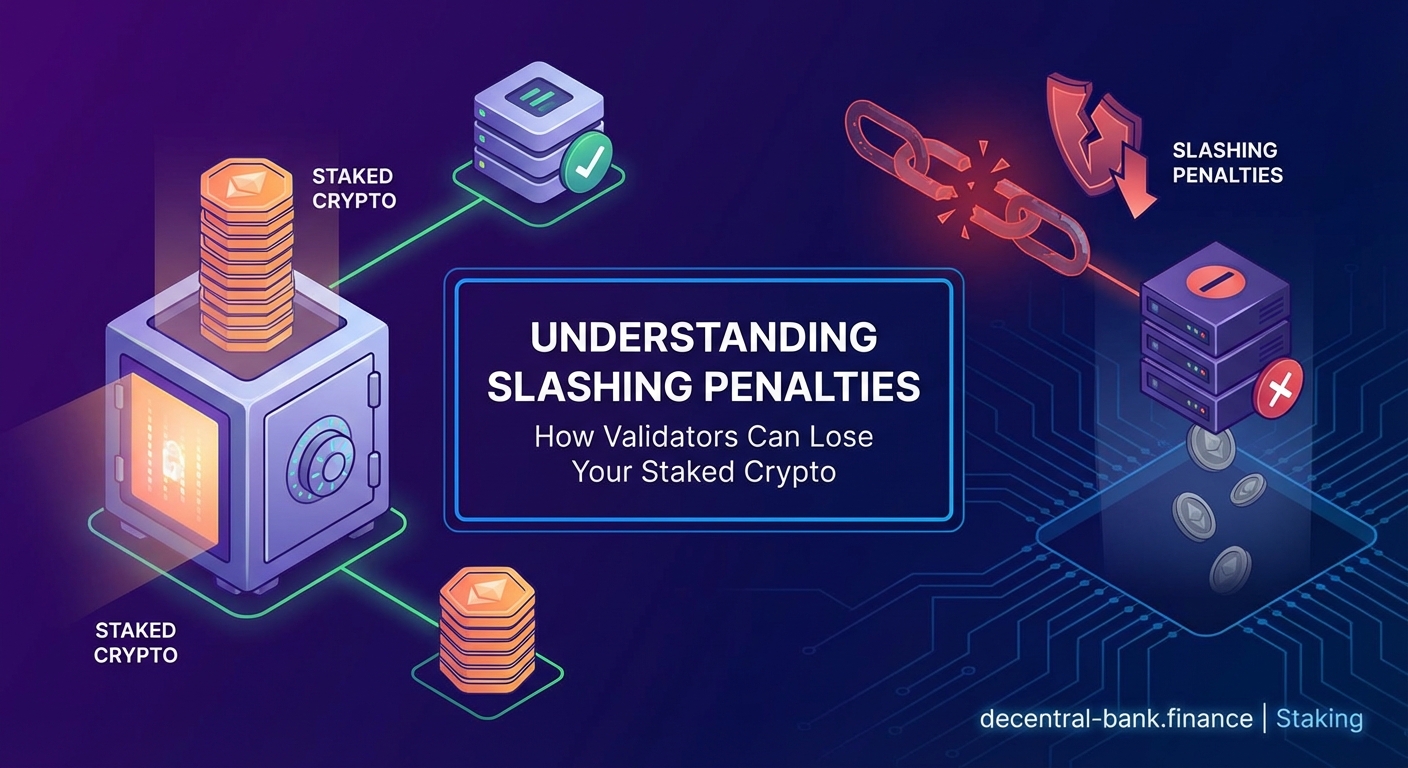
Slashing is a penalty mechanism in proof-of-stake blockchains that destroys a portion of staked crypto when validators break protocol rules. These penalties protect network security by punishing malicious behavior and negligence. Delegators who stake through validators can lose funds even if they didn’t personally misbehave. Understanding slashing risks helps you choose reliable validators and protect your staked assets.
What slashing actually means for your staked crypto
Slashing is a built-in punishment system that proof-of-stake blockchains use to keep validators honest. When a validator breaks specific rules, the protocol automatically burns or removes a percentage of their staked tokens. This isn’t a fine that goes to someone else. The tokens simply disappear from circulation.
The penalty serves two purposes. First, it makes attacks financially painful. If someone tries to manipulate the network, they lose real money. Second, it encourages validators to maintain proper infrastructure and follow best practices.
Here’s what makes slashing particularly important for regular stakers. When you stake your crypto through a validator, you’re trusting them with your assets. If that validator gets slashed, your delegated tokens get slashed too. You share both the rewards and the risks.
Different networks implement slashing with varying severity. Some chains slash small amounts for minor infractions. Others can destroy up to 100% of a validator’s stake for serious attacks. The specific rules depend on how each blockchain prioritizes security versus validator friendliness.
Why proof-of-stake networks need slashing penalties
Traditional proof-of-work blockchains like Bitcoin rely on computational work to secure the network. Attacking the system requires massive amounts of electricity and hardware. The cost is the deterrent.
Proof-of-stake networks work differently. Validators don’t burn electricity. They lock up tokens as collateral. Without slashing, a malicious validator could attack the network, fail, and simply get their stake back. They’d have nothing to lose except opportunity cost.
Slashing changes this equation completely. Now an attack means guaranteed financial loss. The validator risks their entire stake, plus their reputation. This economic incentive keeps the network secure without requiring energy-intensive mining.
The mechanism also solves the “nothing at stake” problem. In theory, a validator could vote for multiple competing blockchain versions simultaneously. This would undermine consensus. Slashing makes this strategy financially suicidal. Validators must commit to one version or face penalties.
Beyond security, slashing enforces operational standards. Validators must maintain reliable infrastructure, proper key management, and consistent uptime. Networks can’t function if validators constantly go offline or run buggy software. Slashing penalties encourage professional operation.
Common behaviors that trigger slashing events
Validators get slashed for specific, detectable rule violations. Understanding these triggers helps you evaluate validator risk before delegating your tokens.
Double signing happens when a validator signs two different blocks at the same block height. This is one of the most serious offenses. It suggests the validator is either running duplicate infrastructure or actively trying to create competing chain versions. Most networks slash heavily for this violation, often removing 5% or more of the stake.
Surround voting occurs when a validator casts conflicting votes about blockchain history. They might vote that block A comes before block B, then later vote the opposite. This attack attempts to rewrite transaction history. Networks treat it as seriously as double signing.
Extended downtime triggers smaller penalties on many chains. If a validator stays offline for too long, they get slashed for failing to participate in consensus. These penalties are usually modest, often less than 1% of stake, but they accumulate over time.
Incorrect attestations happen when validators sign off on invalid blockchain states. This might be accidental due to software bugs or intentional during an attack. The penalty severity depends on whether the network detects coordination among multiple validators.
Some networks also slash for consensus manipulation, where groups of validators coordinate to control block production or censor transactions. These penalties scale with the number of validators involved, making coordinated attacks extremely expensive.
How slashing penalties get calculated and applied
The math behind slashing varies by blockchain, but most systems follow similar principles. The penalty depends on what rule was broken and how many other validators broke it around the same time.
For individual offenses like double signing, networks typically slash a fixed percentage. Ethereum, for example, removes at least 1 ETH from the validator’s stake immediately. Then it calculates an additional penalty based on how many other validators got slashed recently.
This correlation penalty is crucial. If only one validator misbehaves, they might lose 1-2% of their stake. But if hundreds of validators get slashed simultaneously, each one loses much more. This design targets coordinated attacks, where the real danger to the network lies.
Here’s a simplified view of how penalty severity scales:
| Offense Type | Typical Base Penalty | Additional Factors | Maximum Penalty |
|---|---|---|---|
| Double signing | 1-5% of stake | Correlation with other slashing events | Up to 100% |
| Surround voting | 1-5% of stake | Number of conflicting attestations | Up to 100% |
| Extended downtime | 0.01-0.5% per day | Length of offline period | Usually capped at 5% |
| Invalid attestation | 0.1-1% of stake | Whether error was widespread | Up to 10% |
After slashing occurs, most networks also force the validator to exit. They can’t simply continue operating. The validator enters an exit queue, and their remaining stake gets locked for a withdrawal period. This prevents slashed validators from immediately unstaking and escaping further consequences.
Delegators see their share of staked tokens reduced proportionally. If a validator with 1,000 ETH staked (including your 10 ETH) gets slashed 5%, everyone loses 5%. Your 10 ETH becomes 9.5 ETH. You don’t get asked permission or advance warning. The protocol executes the penalty automatically.
What happens to your funds when a validator gets slashed
The moment a validator commits a slashable offense, the blockchain detects it through its consensus rules. The penalty applies immediately and irreversibly. Your staked tokens, if delegated to that validator, decrease by the slashing percentage.
You won’t receive a notification from the blockchain itself. Most networks don’t have built-in alert systems for delegators. You’ll only notice when you check your staking dashboard or wallet and see a smaller balance than expected.
The slashed tokens don’t go to anyone. They’re burned, removed from total supply. This is different from traditional fines where money changes hands. The entire network benefits slightly from reduced token supply, but no individual profits from the slashing.
Your remaining stake continues earning rewards, assuming the validator doesn’t get ejected completely. Small slashing events might not force a validator exit. But serious offenses like double signing typically trigger forced withdrawal.
If the validator does exit, you enter an unbonding period. You can’t immediately withdraw your remaining tokens. Most networks require a waiting period of days or weeks. During this time, your tokens earn no rewards and remain locked.
Some protocols offer slashing insurance or protection mechanisms. These are usually third-party services, not built into the base protocol. They might reimburse delegators if their chosen validator gets slashed. But these services charge fees and have their own terms and limitations.
Steps to minimize your slashing risk as a delegator
You can’t eliminate slashing risk entirely, but you can reduce it significantly through careful validator selection and ongoing monitoring.
-
Research validator track record thoroughly. Check how long they’ve been operating, their total stake, and whether they’ve ever been slashed. Most blockchain explorers show validator history. A validator operating for years without incidents demonstrates competence.
-
Verify their infrastructure and security practices. Professional validators publish information about their setup. Look for redundant systems, secure key management, and geographic distribution. Validators running everything on a single server in their basement carry higher risk.
-
Check their commission rates against industry averages. Extremely low commissions might indicate the validator is cutting corners on infrastructure to stay competitive. Sustainable operations cost money. Rates significantly below market average are a warning sign.
-
Distribute your stake across multiple validators. Don’t put all your tokens with one operator. If you’re staking a significant amount, split it among three to five reputable validators. This limits your exposure if one gets slashed.
-
Monitor your staked balance regularly. Set a calendar reminder to check your staking dashboard weekly or monthly. Catching a slashing event early helps you decide whether to unstake and move to a different validator.
-
Join validator community channels. Many validators maintain Discord servers or Telegram groups. Active communication suggests professional operation. You’ll also get advance warning if the validator plans maintenance or encounters issues.
Choose validators who prioritize security over maximum returns. A validator offering slightly lower rewards but running enterprise-grade infrastructure protects your principal better than one promising top yields while operating on minimal hardware.
How different blockchains implement slashing rules
Each proof-of-stake network designs its slashing mechanism based on its security priorities and validator economics. Understanding these differences helps you assess risk when staking different tokens.
Ethereum implements aggressive slashing for consensus violations. Double signing can cost a validator their entire stake if many others are slashed simultaneously. The network also has inactivity penalties that drain stake during extended downtime. Ethereum prioritizes network security over validator convenience.
Polkadot uses a more nuanced approach. It slashes for unresponsiveness, equivocation (similar to double signing), and invalid transactions. Penalties scale based on the percentage of validators involved. A single validator might lose 0.1% of stake, but coordinated misbehavior can cost everyone involved up to 100%.
Cosmos chains each set their own slashing parameters. Most Cosmos networks slash 5% for double signing and 0.01% for downtime. Individual chains in the Cosmos ecosystem can adjust these values based on their security needs and validator community preferences.
Cardano takes a different approach entirely. It doesn’t implement slashing in the traditional sense. Instead, it uses a reward-based system where poorly performing validators simply earn less. This makes staking safer for delegators but potentially reduces security incentives.
Solana slashes for voting on multiple forks and for producing invalid blocks. The penalties are moderate compared to Ethereum, typically removing 12% of stake for serious offenses. Solana’s fast block times and high throughput make validator infrastructure particularly challenging.
Networks without slashing, or with minimal penalties, might seem attractive to risk-averse stakers. But remember that slashing exists to protect your investment long-term. A network with weak security incentives might be more vulnerable to attacks that could crash token value.
Real examples of major slashing events and their impact
Looking at actual slashing incidents helps understand the real-world consequences beyond theoretical scenarios.
In 2020, several Ethereum 2.0 validators got slashed during the network’s early testnet phase. The incidents mostly involved validators accidentally running duplicate keys on multiple machines. While these were testnet events with no real financial impact, they demonstrated how easily configuration mistakes can trigger slashing.
Polkadot experienced a notable slashing event in 2021 when a validator client bug caused multiple validators to equivocate. The affected validators lost approximately 1% of their stake. The incident highlighted how software bugs, not just malicious intent, can lead to slashing.
A Cosmos validator in 2022 suffered double-signing penalties after a botched infrastructure migration. The validator attempted to move to new servers but failed to properly shut down the old setup. Both instances signed blocks simultaneously, triggering automatic slashing of 5% of the total stake.
These incidents share common themes. Most slashing events result from operational mistakes rather than attacks. Poor key management, inadequate testing during upgrades, and infrastructure failures cause the majority of penalties.
The financial impact varies widely. A 5% slash on a validator with $100,000 staked costs $5,000. For delegators, this might mean losing $50 on a $1,000 stake. Not catastrophic, but painful enough to emphasize the importance of validator selection.
Interestingly, actual malicious attacks resulting in slashing are rare. The economic deterrent works. Would-be attackers see the math and realize that even a successful attack would cost them more than they could gain.
Comparing slashing to other staking risks you should know
Slashing represents just one of several risks when staking crypto. Understanding how it compares to other dangers helps you build a complete risk management strategy.
Market volatility typically poses a bigger threat to your portfolio value than slashing. Your staked tokens might earn 5-10% annual rewards, but the underlying asset could drop 50% during a bear market. Slashing might cost you 1-5% in a worst-case scenario. Price swings can cost much more.
Lock-up periods create opportunity cost and liquidity risk. When your tokens are staked, you can’t sell them immediately if the market crashes. Most networks require an unbonding period of several days to weeks. This illiquidity can hurt more than slashing in volatile markets.
Smart contract vulnerabilities affect liquid staking protocols and staking pools. If you stake through a DeFi protocol rather than directly, you face additional risk from bugs in the smart contract code. These vulnerabilities could potentially drain all staked funds, far worse than typical slashing penalties.
Validator commission changes can reduce your returns without warning. Some validators reserve the right to increase their commission rates. While not as dramatic as slashing, a commission increase from 5% to 15% significantly impacts your earnings over time.
Inflation dilution affects all stakers. Networks issue new tokens as staking rewards. If you don’t stake, your percentage of total supply decreases. This isn’t slashing, but it has a similar effect of reducing your relative position.
Here’s how these risks typically compare in terms of potential impact:
- Highest risk: Market crashes (can lose 50%+ of value)
- High risk: Smart contract exploits (can lose 100% of staked amount)
- Medium risk: Lock-up during volatility (opportunity cost varies)
- Lower risk: Slashing penalties (typically 1-5% for most events)
- Ongoing risk: Inflation dilution (2-10% annual if not staking)
This perspective doesn’t minimize slashing concerns. But it puts them in context. You should worry about slashing, but probably worry more about choosing secure platforms and managing market exposure. Understanding how DeFi systems work without traditional intermediaries helps you evaluate the full risk picture.
Tools and resources for tracking validator performance
You can’t prevent slashing if you don’t monitor your validators. Fortunately, multiple tools help you track performance and catch problems early.
Blockchain explorers provide the most direct information. Etherscan for Ethereum, Subscan for Polkadot, and Mintscan for Cosmos chains all show validator statistics. You can see uptime percentages, recent blocks proposed, and slashing history. Check these at least monthly.
Validator rating platforms aggregate data and provide comparative rankings. Sites like Staking Rewards and Stakingrewards.com compile metrics across multiple networks. They show commission rates, total stake, and performance scores. These platforms help you compare validators before delegating.
Monitoring services send alerts when validators encounter problems. Some services notify you via email or Telegram if your validator goes offline or misses attestations. This early warning helps you decide whether to redelegate before a slashing event occurs.
Validator dashboards offered by professional operators show real-time status. Many validators provide public dashboards displaying their infrastructure health, recent performance, and upcoming maintenance. Bookmark these dashboards for your chosen validators.
Community forums like Reddit, Discord, and validator-specific channels provide qualitative information. Other delegators share experiences and warnings about problematic validators. This social intelligence complements quantitative metrics.
The best monitoring approach combines multiple sources. Check blockchain explorers for hard data, use rating platforms for comparison, and follow community discussions for context. Set calendar reminders so monitoring becomes routine rather than something you forget until problems arise.
Questions stakers ask about slashing and validator penalties
Can I get slashed if I stake through an exchange?
Technically yes, but you won’t see it directly. When you stake through Coinbase, Binance, or similar platforms, they run validators on your behalf. If their validators get slashed, it affects the pool of assets backing your staked balance. However, major exchanges often have insurance or reserve funds to absorb slashing losses. You might see slightly lower rewards but probably won’t see your balance decrease. Still, you’re trusting the exchange’s operational competence.
How often does slashing actually happen?
Slashing events are relatively rare on mature networks. Ethereum sees a handful of slashing incidents per year among thousands of validators. Newer networks or those undergoing major upgrades experience more frequent slashing as validators adapt to new rules. The rarity reflects that slashing works as intended. The threat keeps validators careful, so actual penalties are uncommon.
Can a validator get slashed multiple times?
Yes, but typically not for long. A validator could theoretically get slashed for downtime, fix the issue, then get slashed again later for a different offense. However, serious slashing events like double signing usually trigger forced exit from the validator set. The validator can’t continue operating after major penalties, preventing repeated slashing of the same stake.
Do I lose all my rewards if my validator gets slashed?
No, you only lose the percentage of your stake that the slashing penalty specifies. If you’ve earned 0.5 ETH in rewards on a 10 ETH stake, and the validator gets slashed 5%, you lose 5% of your total 10.5 ETH (about 0.525 ETH). Your accumulated rewards don’t provide any protection, but you don’t lose them separately from your principal.
Can I get my slashed tokens back?
No. Slashing is permanent and irreversible. The tokens are burned and removed from circulation. No appeal process exists. This finality is intentional. It makes the penalty credible and ensures validators take security seriously.
Is slashing more severe on some networks than others?
Absolutely. Ethereum implements some of the strictest slashing rules among major networks. Polkadot also has significant penalties for serious offenses. Cosmos chains vary widely based on individual chain parameters. Some newer networks implement minimal slashing to attract validators during their growth phase. Generally, more established networks with higher security requirements enforce stricter slashing.
Protecting your staked assets beyond validator selection
Choosing good validators is essential, but comprehensive protection requires additional strategies.
Consider liquid staking tokens as an alternative to traditional delegation. Protocols like Lido and Rocket Pool distribute your stake across multiple validators automatically. This diversification reduces the impact if any single validator gets slashed. You receive a liquid token representing your stake, maintaining flexibility while spreading risk.
Keep some assets in secure cold storage rather than staking everything. Staking offers returns but locks up your tokens. Maintaining a portion in cold storage gives you liquidity and removes those funds from slashing risk entirely. A 70/30 split between staked and liquid holdings balances earning potential with flexibility.
Understand the unbonding period for each network before staking. Ethereum requires days to withdraw, while some Cosmos chains need three weeks. If you might need access to funds quickly, factor these delays into your decision. Longer unbonding periods mean higher opportunity cost if you need to exit during a market move.
Review your validator choices quarterly, not just at the initial delegation. Validators that performed well last year might have changed their operations. Regular reviews catch deteriorating performance before it leads to slashing.
Document your staking decisions and validator research. Write down why you chose specific validators, what metrics mattered, and when you last reviewed performance. This documentation helps you make consistent decisions and learn from both successes and mistakes.
Stay informed about network upgrades and protocol changes. Major updates sometimes change slashing parameters or introduce new penalty conditions. Following official channels and validator communications helps you understand how changes might affect your stake.
Making informed decisions about staking and slashing risk
Slashing shouldn’t scare you away from staking entirely. The mechanism exists to protect your investment by keeping validators honest. Understanding how it works transforms slashing from a mysterious threat into a manageable risk.
The key is approaching staking as an active decision, not a passive one. Research validators thoroughly. Monitor performance regularly. Diversify across multiple operators. These habits reduce your slashing risk to minimal levels while letting you earn staking rewards.
Remember that professional validators have strong incentives to avoid slashing. Their business depends on reputation and reliability. Slashing costs them not just the immediate penalty but also future delegations. They’re probably more worried about slashing than you are.
Start small if you’re new to staking. Delegate a modest amount first, watch how it performs, and learn the monitoring tools. As you gain confidence in your validator selection process and understanding of the risks, you can increase your staked position.
Slashing represents one piece of the broader DeFi ecosystem where code enforces rules without human intermediaries. This automation creates both opportunities and risks. The networks that implement thoughtful slashing mechanisms tend to be more secure and valuable long-term.
Your staked crypto can generate meaningful returns while supporting network security. Just go in with your eyes open, choose validators carefully, and monitor your position regularly. The vast majority of stakers never experience slashing losses. With proper precautions, you can be one of them.