Traditional banks close at 5 PM. DeFi protocols never sleep. That single fact captures the fundamental shift happening in finance right now, but the differences run much deeper than operating hours. Whether you’re a banker curious about blockchain or an investor weighing your options, understanding these distinctions matters for your money.
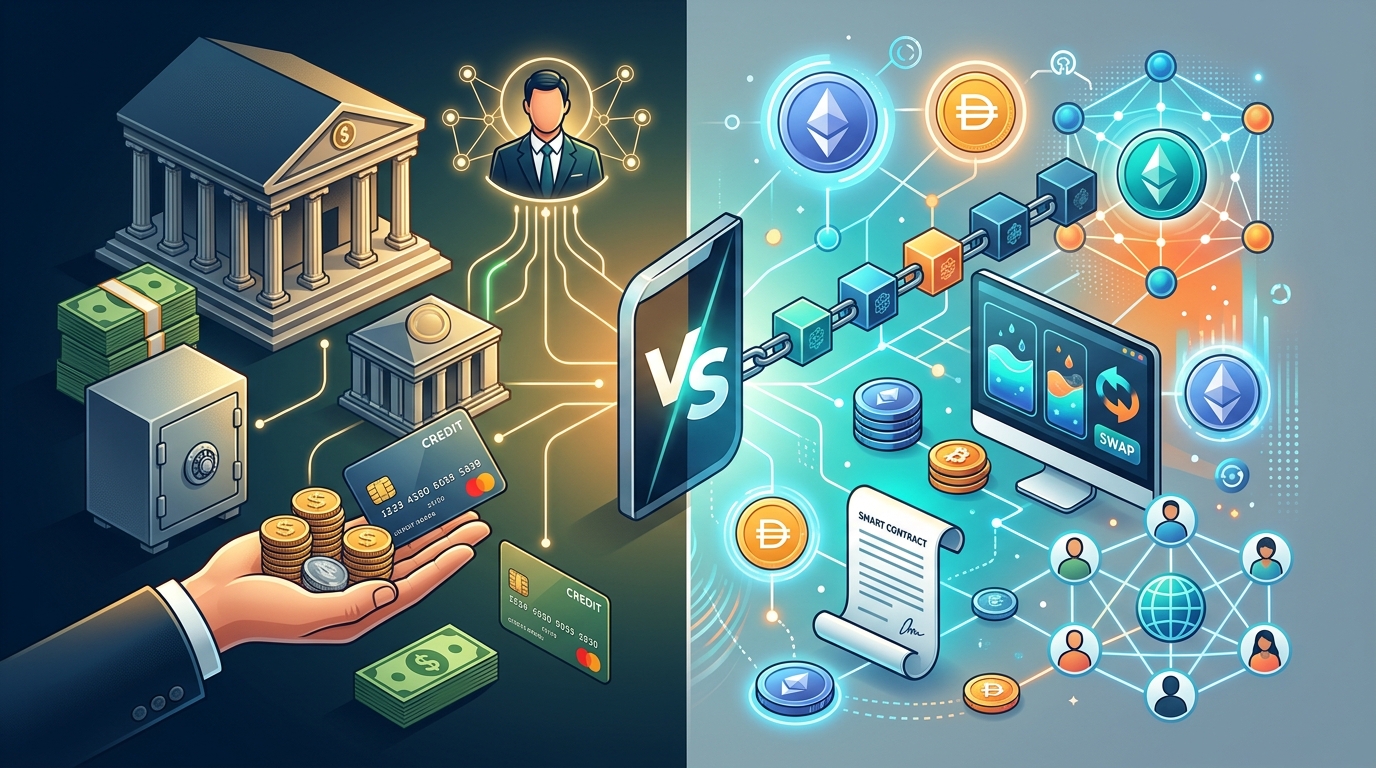
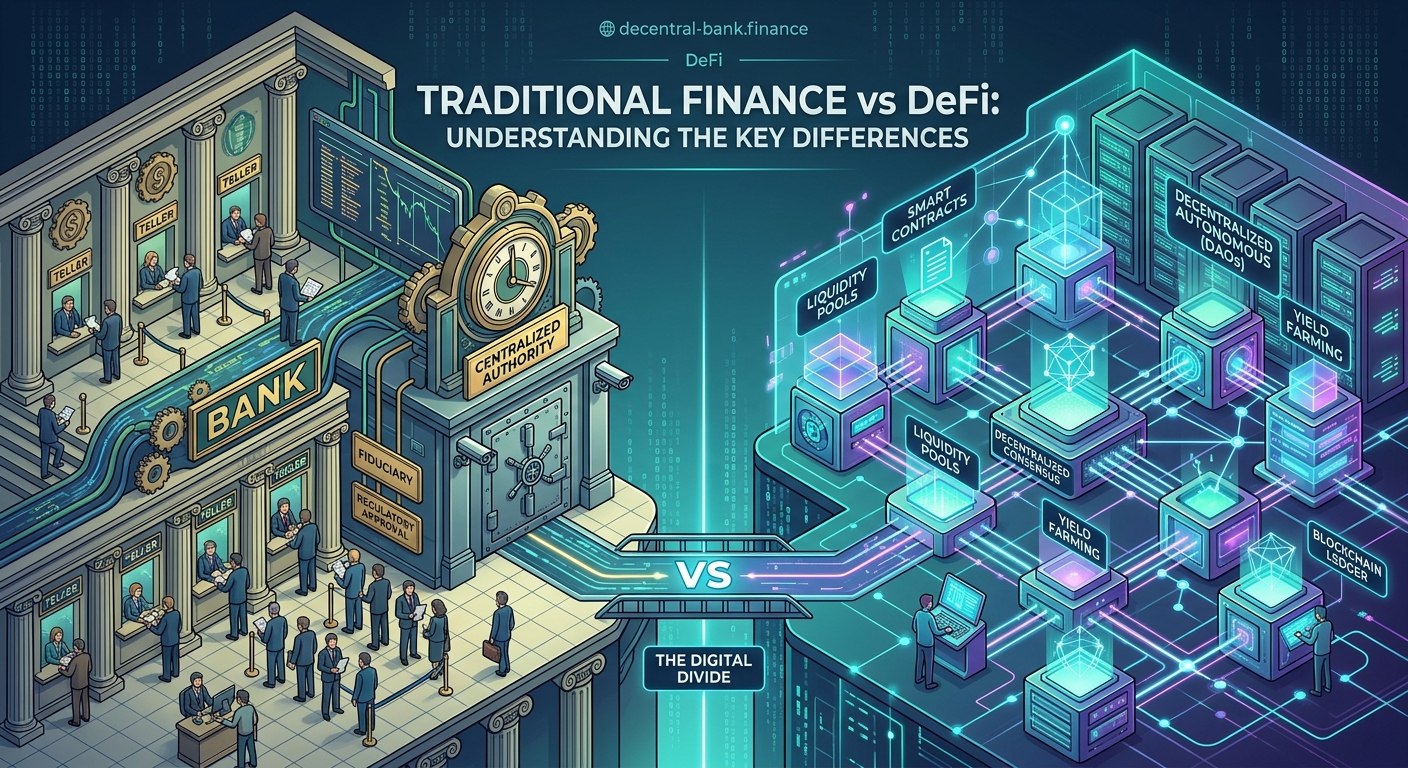
Traditional finance relies on banks, brokers, and intermediaries to process transactions, hold your assets, and enforce rules through legal systems. DeFi uses smart contracts on blockchains to automate financial services, letting you control your assets directly through a wallet. This shift eliminates middlemen but transfers security responsibility to you, creating new opportunities alongside new risks that require different skills to manage safely.
Who Controls Your Money
In traditional finance, your bank holds custody of your funds. You see a number on a screen, but the institution actually possesses your money. They can freeze accounts, reverse transactions, or deny access based on their policies or government orders. Your relationship depends on trust in that institution and the regulatory framework protecting it.
DeFi flips this model completely. You hold your own assets through a private key that only you control. No company can freeze your wallet or prevent you from accessing funds. This sounds liberating until you realize it also means no customer service hotline if something goes wrong. How does DeFi actually work without banks or middlemen explains the technical foundation that makes this possible.
The control difference extends beyond simple access. Traditional banks can see every transaction you make, share data with partners, and use your financial history for their business purposes. DeFi transactions happen on public blockchains where anyone can view the ledger, but your identity isn’t automatically tied to your wallet address. You trade corporate surveillance for public transparency.
Access Requirements and Barriers
Opening a traditional bank account requires identification documents, proof of address, minimum balances, and often a credit history. Many people worldwide can’t meet these requirements. Banks also restrict services based on geography, refusing customers from certain countries or regions.
DeFi protocols don’t ask for your name, address, or credit score. Anyone with internet access and a wallet can participate. A farmer in rural Kenya and a trader in New York City access the same protocols with identical capabilities. No one checks your background or denies service based on where you live.
This accessibility comes with a learning curve. Traditional finance provides user interfaces designed for non-technical users, with clear error messages and support teams. DeFi interfaces assume you understand concepts like gas fees, slippage, and smart contract interactions. 7 common DeFi terms every beginner should know before getting started covers the vocabulary you’ll need.
How Transactions Get Processed
When you send money through a traditional bank, multiple intermediaries process the transaction. Your bank verifies the request, communicates with the recipient’s bank through clearing networks, and settles the transfer through central banking systems. International transfers might pass through correspondent banks in multiple countries. This process takes hours or days and involves fees at each step.
DeFi transactions execute through smart contracts that run automatically when conditions are met. You interact directly with the protocol without intermediaries. A swap on a decentralized exchange happens in minutes, and the settlement is final once the blockchain confirms it. No clearing period, no pending status, no reversals.
The speed difference matters most for complex operations. Getting a loan from a traditional bank requires applications, credit checks, approval processes, and paperwork that might take weeks. A DeFi lending protocol can approve and fund your loan in a single transaction if you provide sufficient collateral. How to borrow crypto without selling your assets walks through this process.
Fee Structures and Costs
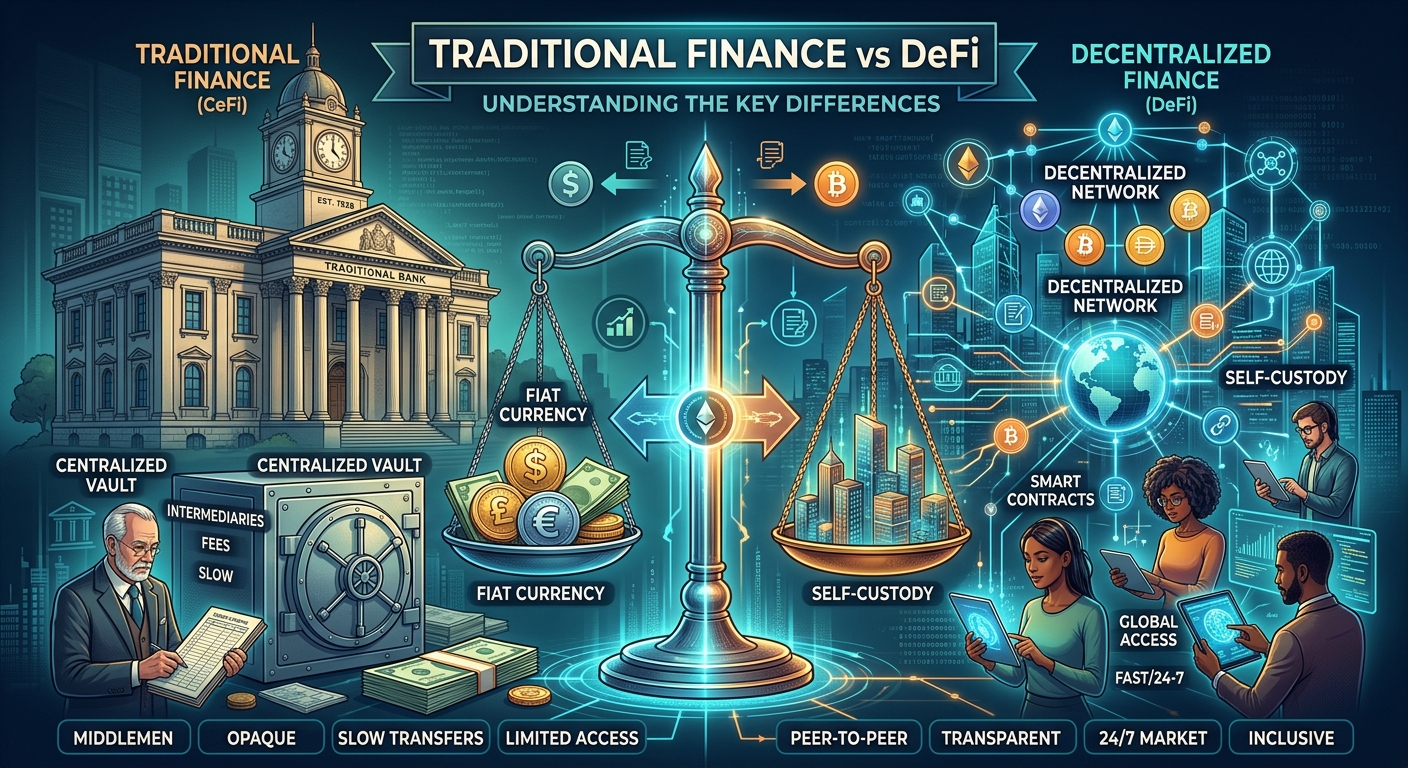
Traditional financial services charge fees in ways that often feel opaque. Account maintenance fees, transaction fees, wire transfer fees, currency conversion spreads, and various service charges add up. Banks also profit from the spread between interest paid to depositors and interest charged to borrowers. These costs support physical branches, employee salaries, regulatory compliance, and shareholder profits.
DeFi protocols charge fees transparently, visible before every transaction. You pay network gas fees to miners or validators who process transactions, plus protocol fees that typically range from 0.01% to 1% of transaction value. These fees fund protocol development and reward liquidity providers rather than supporting corporate overhead.
The cost comparison depends heavily on transaction size and type. Sending $10 through DeFi might cost $5 in gas fees during network congestion, making it uneconomical. Sending $10,000 might cost the same $5, making it far cheaper than a bank wire transfer. Why do DeFi transactions cost gas fees and how can you minimize them helps you understand and optimize these costs.
Operating Hours and Availability
Traditional financial markets operate on schedules. Stock markets open and close at specific hours on weekdays. Banks process transfers during business hours. You can’t execute most financial operations on weekends or holidays. This schedule made sense when humans manually processed every transaction, but it creates artificial limitations in a connected world.
DeFi protocols run continuously. You can trade, lend, borrow, or provide liquidity at 3 AM on Christmas Day with the same efficiency as Tuesday afternoon. Smart contracts don’t take vacations or sick days. This 24/7 availability particularly benefits people in time zones poorly served by traditional market hours.
The constant operation also means constant risk exposure. Traditional markets pause during extreme volatility, giving participants time to reassess. DeFi markets never pause. A protocol can get exploited while you sleep, and you might wake up to find your positions liquidated. What happens during a DeFi liquidation and how to avoid it covers this crucial risk.
Security Models and Responsibility
Traditional finance uses a layered security model. Banks protect your accounts with passwords, two-factor authentication, and fraud monitoring. If someone steals your credit card, you report it and get reimbursed. Deposit insurance protects your savings up to certain limits. Regulatory agencies oversee institutions and can step in when problems arise.
DeFi security depends entirely on you. Your private key controls everything. Lose it, and your funds are gone forever. Share it, and anyone can drain your wallet. No insurance protects you from smart contract bugs, no regulator forces protocols to make you whole after hacks. 5 critical mistakes beginners make when setting up their first DeFi wallet highlights the most dangerous errors.
This responsibility shift terrifies some people and empowers others. You don’t trust institutions to protect you; you trust mathematics and your own security practices. The trade-off becomes clear when protocols get hacked. Traditional bank customers get made whole through insurance and legal remedies. DeFi users often lose everything with no recourse.
Interest Rates and Returns
Traditional savings accounts currently offer interest rates around 0.5% to 5% annually, depending on economic conditions and account types. Banks profit from the spread between what they pay depositors and what they charge borrowers. Your savings earn minimal returns while the bank captures most of the profit.
DeFi lending protocols connect lenders and borrowers directly, eliminating the middleman spread. Supply and demand set interest rates algorithmically. During periods of high borrowing demand, lenders might earn 8%, 15%, or even higher annual returns. These rates fluctuate constantly based on market conditions.
The higher returns come with higher risks. Traditional bank deposits have government insurance. DeFi deposits have smart contract risk, protocol risk, and token price risk. A protocol offering 20% returns might sound amazing until you consider the possibility of losing everything in a hack. Can you really earn passive income with DeFi? Understanding yields and risks provides a realistic assessment.
Regulatory Framework and Protection
Traditional financial institutions operate under extensive regulatory oversight. Securities laws, banking regulations, consumer protection rules, and anti-money laundering requirements create a complex compliance environment. These regulations protect consumers but also limit innovation and exclude people who don’t meet requirements.
DeFi exists in regulatory gray areas. Most protocols claim to be decentralized software rather than financial service providers, arguing they shouldn’t face the same rules as banks. Regulators disagree and are actively working to bring DeFi under existing frameworks or create new rules. The regulatory landscape remains uncertain and varies dramatically by jurisdiction.
This uncertainty creates both opportunity and risk. Early DeFi participants access financial services without regulatory restrictions, but they also lack regulatory protections. If a protocol fails, you can’t sue for damages or appeal to a regulator. You bear the full consequences of your decisions.
Identity and Privacy
Traditional banks know exactly who you are. They collect personal information, verify your identity, monitor your transactions, and report suspicious activity to authorities. This surveillance helps prevent crime but also means your financial life is comprehensively tracked and stored in corporate databases.
DeFi protocols don’t require identity verification. You interact through wallet addresses that aren’t automatically linked to your real identity. This pseudonymity provides privacy from corporations but not from blockchain analysis. Every transaction lives permanently on a public ledger that sophisticated actors can analyze to identify patterns and potentially unmask users.
The privacy comparison isn’t straightforward. Banks keep your data private from other users but share it with governments and partners. DeFi keeps your identity private but makes all your transactions public. Neither system provides complete privacy, just different trade-offs.
Getting Started: Traditional Finance vs DeFi
Here’s how the onboarding process differs:
Traditional Finance Setup
- Visit a bank branch or website with identification documents
- Complete application forms with personal and financial information
- Wait for approval, which might take days or weeks
- Receive account credentials and begin using services within defined limits
- Contact customer support if you encounter problems
DeFi Setup
- Download a wallet application and create a new wallet
- Securely store your seed phrase in a safe location
- Transfer cryptocurrency to your wallet from an exchange
- Connect your wallet to DeFi protocols and begin using them immediately
- Research solutions yourself if you encounter problems
The traditional path offers guidance and support. The DeFi path offers speed and autonomy. Your comfort level with technology and self-reliance determines which feels more accessible.
Comparing Key Features Side by Side
| Feature | Traditional Finance | DeFi |
|---|---|---|
| Custody | Institution holds assets | You control private keys |
| Access | Requires identity verification | Open to anyone with internet |
| Operating hours | Business hours, weekdays | 24/7/365 |
| Transaction speed | Hours to days | Minutes |
| Fees | Multiple hidden charges | Transparent protocol and gas fees |
| Interest rates | 0.5% to 5% typically | Highly variable, often higher |
| Security responsibility | Shared with institution | Entirely yours |
| Reversibility | Transactions can be reversed | Transactions are final |
| Privacy | Private from public, shared with institution | Public transactions, private identity |
| Support | Customer service available | Community support only |
| Insurance | Deposit insurance available | No insurance |
| Regulation | Heavily regulated | Regulatory uncertainty |
Common Mistakes When Transitioning
People moving from traditional finance to DeFi often stumble in predictable ways:
- Treating wallet passwords like bank passwords that can be reset
- Expecting customer service to fix transaction errors
- Ignoring gas fees and losing money on small transactions
- Trusting protocols without researching their security
- Failing to understand that transactions can’t be reversed
- Not securing seed phrases properly
- Assuming high yields are sustainable and risk-free
The biggest mental shift involves accepting personal responsibility for everything. Traditional finance trains you to rely on institutions. DeFi requires you to become your own institution.
The transition from traditional finance to DeFi isn’t just about learning new technology. It’s about accepting a fundamentally different relationship with your money. You gain control and opportunity, but you also accept risks that institutions previously managed for you. This trade-off isn’t right for everyone, and that’s okay. The financial system has room for both models.
Risk Profiles and Safety Nets
Traditional financial institutions spread risk across many customers and maintain reserves to handle losses. When things go wrong, multiple safety nets exist. Deposit insurance, legal recourse, regulatory intervention, and institutional accountability protect customers from total loss in most scenarios.
DeFi concentrates risk on individual users. Smart contract bugs, protocol exploits, and user errors can result in total loss with no recovery mechanism. Some protocols maintain insurance funds or work with DeFi insurance providers, but coverage remains limited and expensive. 5 free tools to check if a DeFi protocol is safe helps you assess risks before committing funds.
The risk comparison isn’t binary. Traditional finance carries systemic risks that DeFi avoids, like bank runs, government seizures, and institutional failure. DeFi carries technical risks that traditional finance avoids, like smart contract exploits and irreversible errors. Different risks, not necessarily more or less.
Which System Fits Your Needs
Traditional finance works better when you:
- Value customer support and institutional accountability
- Prefer regulatory protection over personal control
- Need services that integrate with the existing legal system
- Want stable, predictable returns over higher-risk opportunities
- Feel uncomfortable managing your own security
- Require transaction reversibility and fraud protection
DeFi works better when you:
- Want complete control over your assets
- Need access to financial services without identity verification
- Operate across borders frequently
- Seek higher potential returns and accept higher risks
- Feel confident managing technical security
- Value transparency over institutional trust
- Need 24/7 access to financial services
Many people use both systems for different purposes. You might keep emergency savings in an insured bank account while exploring DeFi protocols with funds you can afford to lose. This hybrid approach lets you learn gradually while maintaining safety nets.
The Future of Both Systems
Traditional finance is adopting blockchain technology for settlement, exploring central bank digital currencies, and studying DeFi innovations. Banks recognize that 24/7 operation, instant settlement, and reduced costs benefit everyone. Expect traditional institutions to incorporate DeFi concepts while maintaining regulatory compliance and customer protection.
DeFi is adding features that bridge toward traditional finance. Protocols are implementing identity layers for regulatory compliance, creating insurance mechanisms, and building user interfaces that feel more familiar. The pure decentralization of early DeFi is giving way to hybrid models that balance autonomy with practical needs.
The two systems will likely converge over time. Traditional finance will become faster, cheaper, and more transparent. DeFi will become safer, more regulated, and more user-friendly. The question isn’t which system will win, but how they’ll coexist and complement each other.
Making Your First Move
If you’re coming from traditional finance and want to try DeFi, start small. Transfer an amount you can afford to lose completely. Use that money to learn how wallets work, execute simple transactions, and understand gas fees. Don’t chase high yields immediately. Focus on understanding the mechanics first.
How to choose between hot wallets and cold wallets for your crypto helps you select appropriate storage for your needs. Security should be your first priority, not your last thought.
If you’re in DeFi and need traditional finance services, research crypto-friendly banks that understand digital assets. Some institutions now bridge both worlds, offering traditional banking services alongside cryptocurrency support. This hybrid approach gives you the best of both systems while you transition.
Why These Differences Matter for Your Money
Understanding DeFi vs traditional finance isn’t about picking sides or declaring one system superior. It’s about recognizing that different financial models serve different needs, carry different risks, and require different skills.
Traditional finance offers stability, support, and regulatory protection at the cost of control, privacy, and accessibility. DeFi offers autonomy, transparency, and open access at the cost of complexity, responsibility, and uncertainty. Your financial goals, risk tolerance, technical confidence, and regulatory environment determine which system serves you better.
The most important step is making informed decisions based on genuine understanding rather than hype or fear. Both systems will continue evolving. Both will remain relevant. Your job is to understand them well enough to use each one safely and effectively for your specific situation.