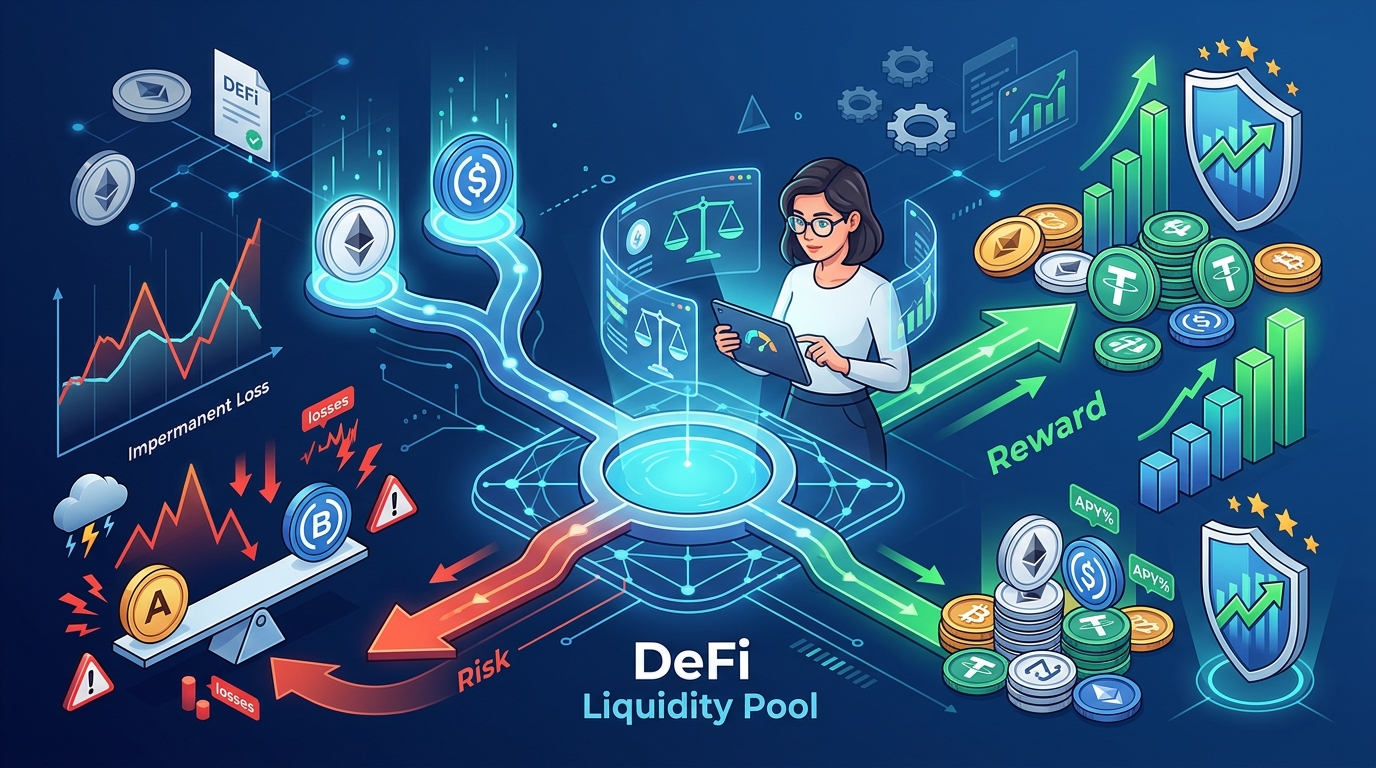
Becoming a liquidity provider sounds like free money at first. You deposit your tokens into a pool, traders use that liquidity, and you collect fees while you sleep. The reality is more complicated. Liquidity providers face risks that can erase their earnings and then some, but they also access income streams that traditional finance can’t match.
This guide breaks down what actually happens when you provide liquidity, which risks matter most, and how to decide if the rewards justify putting your capital at stake.
Liquidity providers earn trading fees by depositing token pairs into decentralized exchange pools, but face impermanent loss when prices diverge, smart contract vulnerabilities, and varying fee structures across protocols. Success requires understanding pool mechanics, calculating break-even points, and matching your risk tolerance to specific pool characteristics before committing capital.
What liquidity providers actually do
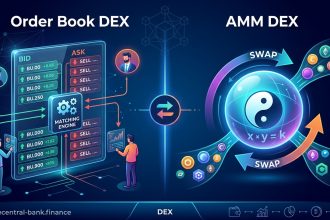
Liquidity providers deposit equal values of two tokens into a pool that enables decentralized trading. When someone swaps ETH for USDC on a decentralized exchange, they’re trading against your deposited tokens, not another person’s order.
You receive LP tokens representing your share of the pool. These tokens track your ownership percentage and accumulate trading fees automatically. The pool uses an automated market maker formula to price trades based on the ratio of tokens in the pool.
Your earnings come from a percentage of every trade that touches your pool. A 0.3% fee on a $10,000 trade means $30 gets distributed among all liquidity providers based on their pool share.
The catch is that token prices rarely stay balanced. When one token’s price changes relative to the other, the pool rebalances automatically. This rebalancing creates impermanent loss, which we’ll cover in detail.
How trading fees generate income
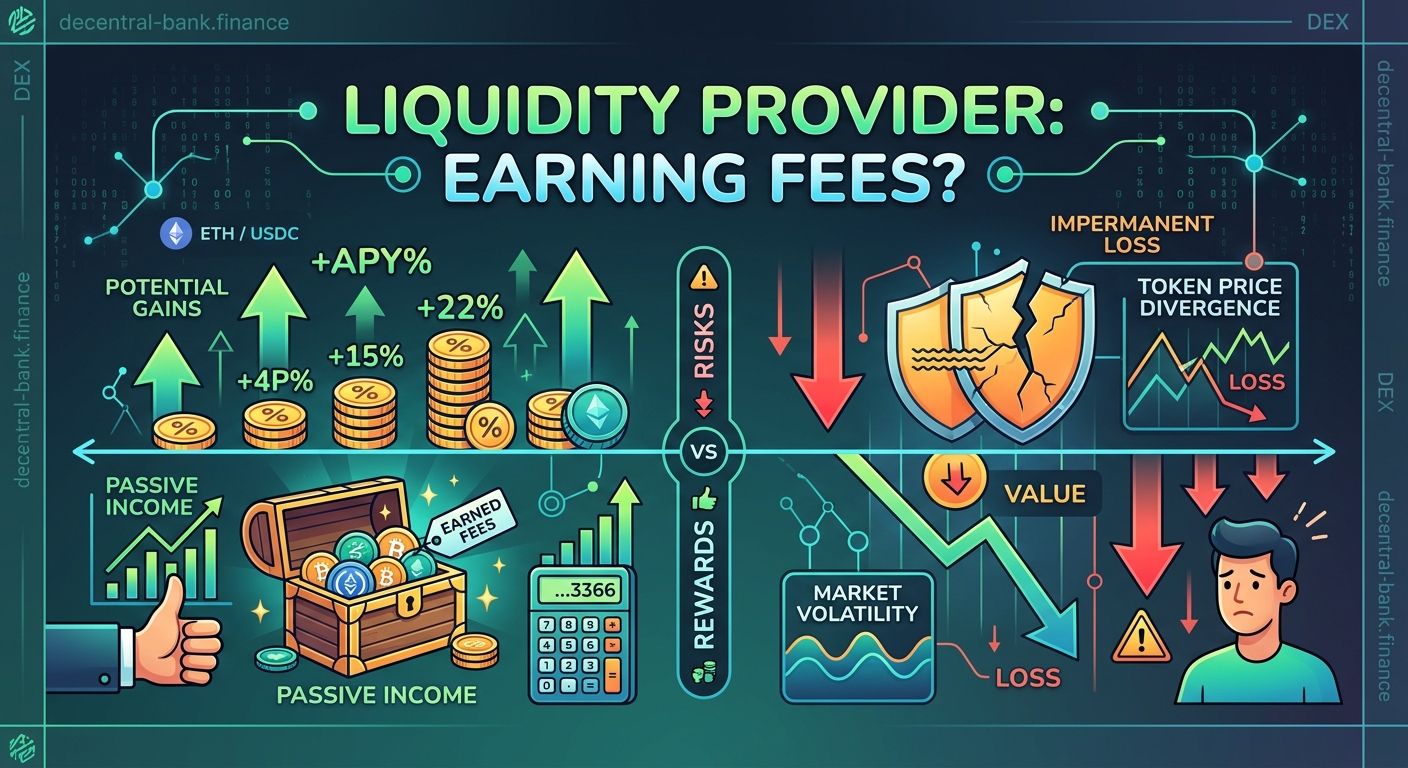
Fee structures vary widely across protocols and individual pools. Most charge between 0.05% and 1% per trade, with higher fees typically applied to riskier or less liquid pairs.
Trading volume determines your actual earnings more than the fee percentage. A pool with 0.3% fees but $100 million daily volume generates far more income than a 1% fee pool with $1 million volume.
Here’s how fees accumulate:
- Traders pay the fee when executing swaps
- Fees get added to the pool reserves automatically
- Your LP token share increases in value proportional to accumulated fees
- You claim fees when withdrawing liquidity or through separate reward mechanisms
Some protocols distribute fees as additional LP tokens, while others let fees compound directly in the pool. The method affects your tax situation and compounding potential.
Fee income calculation example: If you own 2% of a pool that generates $50,000 in daily fees, you earn $1,000 per day before accounting for impermanent loss or other factors.
Understanding impermanent loss mechanics
Impermanent loss happens when the price ratio between your deposited tokens changes. The automated market maker rebalances your position to maintain the pricing formula, leaving you with more of the token that decreased in value and less of the token that increased.
The loss is “impermanent” because it only becomes permanent when you withdraw. If prices return to their original ratio, the loss disappears.
Real example: You deposit 1 ETH and 2,000 USDC when ETH trades at $2,000. ETH price rises to $4,000. The pool rebalances to approximately 0.707 ETH and 2,828 USDC. If you had simply held your original tokens, you’d have 1 ETH worth $4,000 plus 2,000 USDC, totaling $6,000. Your pool position is worth about $5,656. That $344 difference is impermanent loss.
The math gets worse with larger price movements. A 2x price change creates roughly 5.7% impermanent loss. A 5x change results in about 25.5% loss. You can use an impermanent loss calculator to model specific scenarios before committing funds.
Impermanent loss can exceed your fee earnings in volatile markets. Always calculate the break-even point where accumulated fees offset potential price divergence before entering a pool.
Fee income needs to exceed impermanent loss for liquidity provision to be profitable. High-volume pools with relatively stable price ratios offer the best risk-adjusted returns.
Smart contract and protocol risks
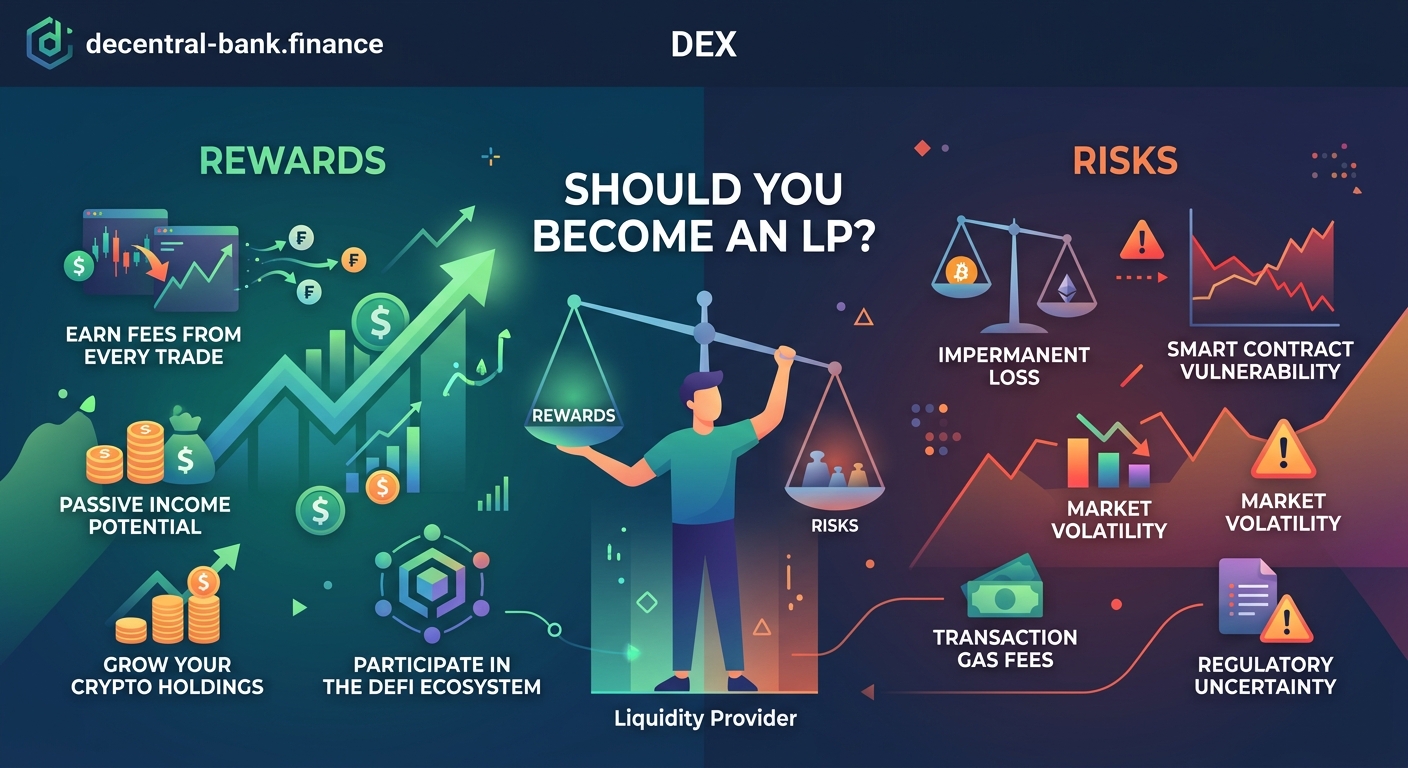
Your deposited funds live in smart contract code. Bugs, exploits, or malicious code can drain pools entirely. Even audited contracts contain vulnerabilities that hackers discover after deployment.
Major DeFi protocols have lost hundreds of millions to exploits. Your funds aren’t insured or protected by any central authority. If the contract gets hacked, your capital is gone.
Protocol risk varies significantly across platforms. Established protocols like Uniswap have years of security testing and billions in total value locked. Newer protocols might offer higher fees but carry substantially more risk.
Check these factors before providing liquidity:
- Multiple independent security audits from reputable firms
- Time in operation without major incidents
- Bug bounty programs that incentivize white-hat hackers
- Insurance options through third-party protocols
- Developer team reputation and track record
Reading audit reports helps, but remember that audits still miss critical bugs regularly. Diversifying across multiple protocols reduces your exposure to any single point of failure.
Token approval risks also matter. When you approve a contract to access your tokens, you’re trusting that contract won’t be exploited. Malicious actors can drain approved tokens if they gain control. Learning what happens when you approve a smart contract helps you manage this exposure.
Comparing different pool types and strategies
Not all liquidity pools work the same way. Your risk and reward profile changes dramatically based on pool type and token selection.
| Pool Type | Risk Level | Typical APY | Best For |
|---|---|---|---|
| Stablecoin pairs | Low | 5-15% | Risk-averse income seekers |
| Major crypto pairs | Medium | 15-40% | Balanced risk-reward |
| New token pairs | High | 40-200%+ | Aggressive speculators |
| Single-sided pools | Variable | 10-30% | Avoiding impermanent loss |
Stablecoin pools like USDC/USDT minimize impermanent loss since both tokens track the same $1 peg. Fees tend to be lower because the pools are less risky. You can earn yield on stablecoins with minimal price risk, though you still face smart contract vulnerabilities.
Major cryptocurrency pairs like ETH/WBTC offer moderate impermanent loss risk since both assets tend to move somewhat together. Fees are higher than stablecoin pools but lower than exotic pairs.
New or low-liquidity token pairs promise massive APYs but carry extreme risks. Price volatility creates severe impermanent loss, and many new tokens eventually trend toward zero. The high fees rarely compensate for the losses.
Concentrated liquidity pools let you provide liquidity within specific price ranges. This amplifies both your fee earnings and impermanent loss. You earn more fees when prices stay in your range but suffer greater losses when prices move outside it. Providing liquidity on Uniswap requires understanding these concentrated liquidity mechanics.
Calculating your actual returns
Advertised APYs mislead more often than they inform. Protocols typically show gross returns without accounting for impermanent loss, gas fees, or token price changes.
Your real return calculation needs these components:
- Trading fees earned based on your pool share and volume
- Impermanent loss from price divergence
- Gas costs for entering and exiting positions
- Additional token rewards if the protocol incentivizes the pool
- Token price changes if rewards come in native protocol tokens
Example calculation: You provide $10,000 in liquidity to an ETH/USDC pool showing 30% APY. Over three months, you earn $750 in fees. ETH price increases 40%, creating $400 in impermanent loss. Gas fees cost $150 for entry and exit. Your net return is $200, or 8% annualized, not the advertised 30%.
Many pools offer governance token rewards on top of trading fees. These bonus tokens boost your apparent returns but introduce new risks. The reward tokens often decline in value faster than you accumulate them, turning a profitable position into a loss.
Understanding what DeFi yields actually represent helps set realistic expectations. Sustainable yields rarely exceed 20-30% annually for established pools. Anything higher usually involves taking on substantially more risk.
Managing liquidity provider positions actively
Passive liquidity provision rarely optimizes returns. Active management means monitoring your positions and adjusting based on market conditions.
Key management practices:
- Rebalance when impermanent loss exceeds fee earnings: Exit positions when price divergence creates losses that fees won’t recover in a reasonable timeframe
- Harvest rewards regularly: Compound fee earnings into larger positions or withdraw to reduce smart contract exposure time
- Adjust ranges for concentrated liquidity: Move your price ranges as market conditions change to maximize fee capture
- Monitor pool health metrics: Watch for declining volume, increasing volatility, or signs of potential exploits
Gas fees on Ethereum mainnet make frequent adjustments expensive. Layer 2 solutions and alternative chains reduce these costs significantly, making active management more practical. Layer 2 solutions have transformed the economics of active liquidity provision.
Setting stop-loss thresholds helps limit downside. If impermanent loss reaches 5% or 10% of your position, automatic exits preserve capital. Some protocols offer tools for this, while others require manual monitoring.
Time horizon matters enormously. Short-term positions face higher gas costs relative to earnings. Longer holding periods let fee income compound but increase exposure to price movements and smart contract risks.
Tax implications you need to know
Liquidity provision creates multiple taxable events that catch providers off guard. Each jurisdiction treats these differently, but most follow similar principles.
Depositing tokens into a pool might trigger a taxable event if authorities consider it a disposition. You’re exchanging your tokens for LP tokens, which some tax agencies view as a sale.
Fee earnings typically count as ordinary income when received. If fees auto-compound in the pool, you might owe taxes on unrealized gains before withdrawal.
Withdrawing liquidity creates another taxable event. You’re exchanging LP tokens back for the underlying assets, potentially at different ratios and values than your initial deposit.
Impermanent loss doesn’t offset fee income for tax purposes in most jurisdictions. You pay taxes on the fees you earned even if impermanent loss left you with a net loss overall.
Token rewards from liquidity mining programs count as income at the value when received. If those tokens later decline in value, you’ve paid taxes on phantom gains.
Keep detailed records of:
- Deposit dates and token amounts
- LP token quantities received
- Fee earnings by date
- Withdrawal dates and received amounts
- Gas fees paid for all transactions
Professional tax advice specific to your jurisdiction is essential. DeFi tax rules remain unclear in many countries, and positions can be interpreted multiple ways.
Common mistakes that destroy returns
New liquidity providers make predictable errors that turn profitable strategies into losses.
Chasing high APYs without understanding risk: Pools advertising 500% APY usually involve tokens in freefall. The fees can’t compensate for holding depreciating assets.
Ignoring gas fees on small positions: Spending $100 in gas to earn $50 in fees makes no sense. Position size needs to justify transaction costs.
Providing liquidity to unaudited protocols: Saving a few percentage points on fees isn’t worth losing your entire position to an exploit.
Failing to monitor positions: Set aside time weekly to check pool health, accumulated fees, and impermanent loss. Passive neglect leads to unexpected losses.
Misunderstanding token economics: Providing liquidity to tokens with infinite inflation or no real utility means holding depreciating assets while earning fees in those same worthless tokens.
Entering positions during high volatility: Price swings create maximum impermanent loss. Wait for relative stability before deploying capital.
Not diversifying across pools: Concentrating all capital in one pool maximizes your exposure to that specific smart contract and token pair risk.
Many of these mistakes stem from not understanding how DeFi actually works at a fundamental level. Taking time to learn core concepts before risking capital pays dividends.
When liquidity provision makes sense
Liquidity provision works best for specific situations and risk profiles. It’s not a universal strategy that fits everyone.
Ideal candidates:
- You hold tokens long-term anyway and want to earn fees on existing holdings
- You have high conviction in both tokens in a pair maintaining value
- Your capital amount justifies gas costs for entry and exit
- You can monitor positions regularly and adjust as needed
- You understand and accept smart contract risks
- You have experience with DeFi security best practices
Poor fit scenarios:
- You’re hoping to turn a small amount into a fortune through high APYs
- You don’t understand impermanent loss mechanics
- You can’t afford to lose your entire position
- You’re uncomfortable with uninsured smart contract risk
- You lack time to monitor and manage positions
- You’re providing liquidity with borrowed funds
The decision ultimately comes down to your specific situation. Calculate realistic returns after all costs and risks. Compare those returns to simpler alternatives like staking or lending that might offer similar yields with different risk profiles.
Protecting yourself as a liquidity provider
Risk management separates successful liquidity providers from those who lose money. Implementing basic protections reduces your exposure to common failure modes.
Start small with established protocols. Test the mechanics with amounts you can afford to lose completely. Scale up only after you understand how everything works in practice.
Use multiple security tools:
- Check protocol safety before depositing funds
- Verify smart contract addresses match official sources
- Review token approval amounts and revoke unnecessary permissions
- Consider insurance protocols for large positions
- Store LP tokens in secure wallets separate from your trading funds
Diversification across protocols and pool types limits your exposure to any single point of failure. If one protocol gets exploited, you haven’t lost everything.
Set clear entry and exit criteria before depositing funds. Decide in advance what level of impermanent loss triggers a withdrawal. Establish minimum fee earnings targets. Having rules prevents emotional decisions during market volatility.
Stay informed about protocol updates, security incidents, and market conditions affecting your pools. Join protocol Discord servers and follow official announcements. Early warning about issues can save your capital.
Understanding what happens when protocols get hacked prepares you to respond quickly if problems arise. Have an emergency plan for rapid withdrawal if needed.
Making your decision with clear eyes
Liquidity provision offers genuine earning potential for those who understand the mechanics and manage risks appropriately. The rewards can exceed traditional finance options significantly, but the risks are also higher and more complex.
Success requires honest assessment of your knowledge, risk tolerance, and time commitment. Don’t let high APY numbers cloud your judgment about the actual risks involved.
Start by providing liquidity to stablecoin pairs on established protocols. This gives you hands-on experience with minimal impermanent loss risk. Track your real returns after all costs and compare them to your expectations.
Scale up gradually as you gain confidence and understanding. The DeFi ecosystem rewards those who learn continuously and adapt their strategies based on changing conditions. Your first positions will teach you more than any guide can cover.
The choice to become a liquidity provider isn’t binary. You can allocate a small percentage of your portfolio to test the waters while keeping the majority in less risky strategies. Finding the right balance for your situation takes time and experimentation.
Calculate your numbers carefully, understand the risks thoroughly, and only commit capital you’re prepared to lose. Liquidity provision can be profitable, but only when you enter with realistic expectations and proper risk management.