
Staking your crypto already earns you passive rewards. But what if you could use those same staked tokens to earn additional yield without unstaking them first? That’s the core promise of restaking, a newer strategy that’s gaining traction among advanced DeFi participants looking to maximize returns.
Restaking lets you reuse already-staked crypto to secure additional protocols and earn extra rewards. While it can multiply your yield, it also compounds your risk exposure through slashing penalties, smart contract vulnerabilities, and liquidity constraints. Understanding these trade-offs is essential before deploying this advanced strategy in your portfolio.
Understanding the basics of restaking
Restaking builds on top of traditional staking mechanisms. When you stake tokens on a proof-of-stake network, you’re helping secure that blockchain and earning rewards in return. Those staked tokens are locked up, but they’re still technically yours.
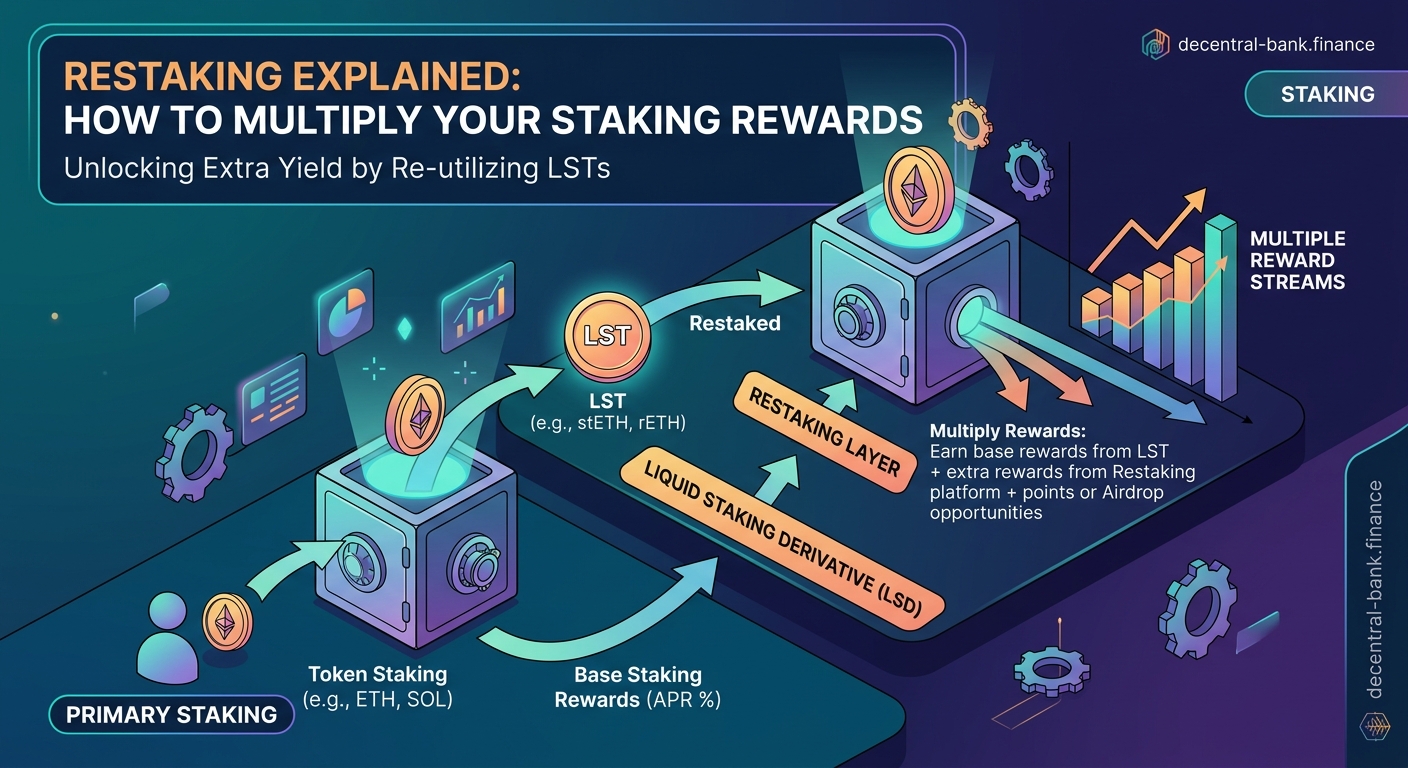
Restaking protocols allow you to take those same staked tokens and use them again to secure other networks, applications, or services. You’re essentially putting your staked assets to work twice.
The technical implementation varies by protocol. Some platforms use liquid staking derivatives, which are tokenized representations of your staked assets. Others use more direct mechanisms that reference your original stake.
Think of it like using the equity in your home to secure a second loan. Your house is already collateral for your mortgage, but you can tap into that value again without selling the property.
How restaking multiplies your yield potential
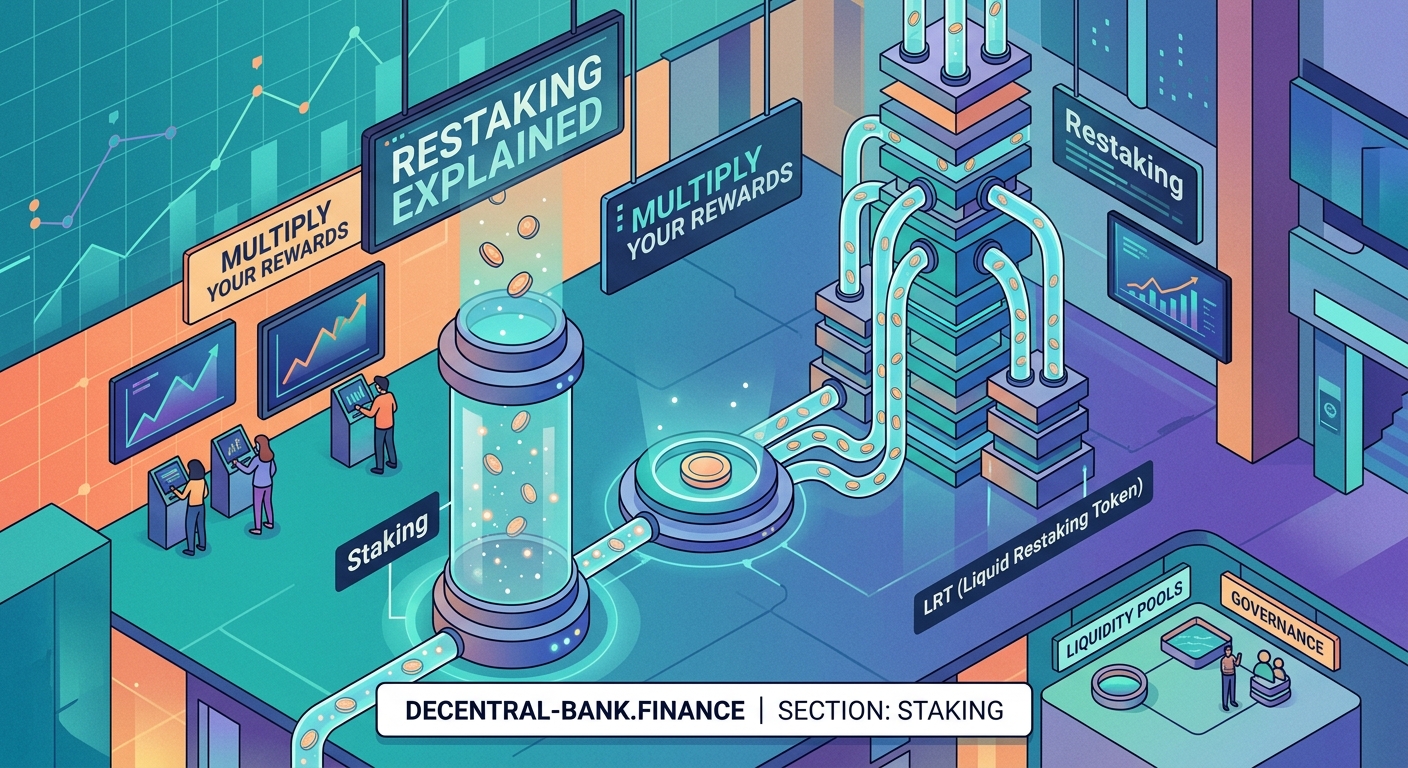
The appeal of restaking comes down to compounding rewards. Instead of earning yield from just one source, you can stack multiple reward streams on the same capital.
Here’s a practical example. You stake 10 ETH on Ethereum and earn a 4% annual return. Through a restaking protocol, you can use those same 10 ETH to secure another service and earn an additional 6% APY. Your total yield becomes 10% instead of 4%.
Different restaking platforms offer varying opportunities:
- Securing oracle networks that feed data to smart contracts
- Validating cross-chain bridges that move assets between blockchains
- Supporting data availability layers for rollups
- Backing decentralized sequencers for layer 2 networks
Each additional service you secure adds another reward stream. Some protocols even let you restake across multiple services simultaneously, though this amplifies both rewards and risks.
The math gets interesting when you consider compounding over time. A 10% yield on restaked assets versus 4% on regular staking creates a significant difference over months or years.
The step-by-step restaking process
Getting started with restaking requires more steps than simple staking. Here’s the typical workflow:
-
Stake your tokens on the base layer. You need to have assets already staked on a proof-of-stake network like Ethereum. This creates your initial position.
-
Choose a restaking protocol. Research platforms that support restaking for your chosen network. Check their security audits, total value locked, and track record.
-
Deposit or reference your staked assets. Depending on the protocol, you’ll either deposit liquid staking tokens or authorize the protocol to reference your existing stake.
-
Select which services to secure. Most platforms let you choose which additional networks or applications you want to help validate. Each comes with its own reward rate and risk profile.
-
Monitor your positions regularly. Restaking requires more active management than set-and-forget staking. You’ll need to track performance, claim rewards, and watch for protocol updates.
-
Understand withdrawal timelines. Exiting a restaking position often takes longer than unstaking normally. You might face multiple unbonding periods stacked on top of each other.
The process sounds straightforward, but each step introduces technical complexity and potential failure points. Make sure you understand the mechanics before committing significant capital.
Comparing restaking to traditional staking strategies
| Strategy | Yield Potential | Risk Level | Liquidity | Complexity |
|---|---|---|---|---|
| Traditional staking | 3-8% APY | Low to moderate | Limited during unbonding | Simple |
| Liquid staking | 4-9% APY | Moderate | High (tradeable derivatives) | Moderate |
| Restaking | 8-20% APY | High | Very limited | Complex |
| Yield farming with staked assets | 10-50% APY | Very high | Varies widely | Very complex |
The table shows how restaking fits into the broader landscape of staking strategies. Higher yields always come with higher risks, and restaking is no exception.
Traditional staking keeps things simple. You lock up tokens, help secure one network, and earn predictable rewards. If you’re comfortable with how to start staking crypto, you already understand the foundation.
Liquid staking adds flexibility by giving you a tradeable token representing your stake. You can use that token in DeFi while still earning staking rewards. Many restaking protocols build on top of liquid staking infrastructure.
Restaking takes things further by letting you earn from multiple sources. But it also means you’re exposed to multiple protocols, each with its own smart contract risk and potential failure modes.
The real risks hiding behind higher yields
Restaking amplifies several risk categories that don’t exist with simple staking. Understanding these is critical before you commit funds.
Slashing risk multiplies across protocols. When you stake normally, validators can lose a portion of their stake for misbehavior or downtime. This is called slashing. With restaking, you face slashing risk from the base layer AND from every additional service you secure. One mistake can trigger multiple penalties.
Smart contract vulnerabilities stack up. Each restaking protocol adds another layer of smart contract code between you and your assets. More code means more potential bugs. A vulnerability in any contract in the chain could compromise your entire position.
Liquidity becomes severely constrained. Unstaking normally takes time. Unstaking from a restaking position can take even longer, as you need to exit each layer sequentially. During market volatility, you might not be able to access your capital when you need it most.
Correlation risk increases. If the base layer network faces issues, it can cascade into problems for restaking protocols built on top. You’re exposed to correlated failures across multiple systems.
Before restaking, ask yourself: am I comfortable potentially losing a larger percentage of my stake than I would with regular staking? If the answer isn’t a clear yes, stick with simpler strategies until you’ve built more experience.
These risks aren’t theoretical. Several restaking protocols have faced challenges, from temporary withdrawal delays to slashing events that affected multiple participants simultaneously.
Common restaking mistakes to avoid
Even experienced stakers make errors when moving into restaking. Here are the most frequent pitfalls:
- Chasing the highest APY without understanding the source. Extremely high yields often come from unsustainable token emissions or exposure to risky experimental protocols.
- Ignoring the total risk exposure. Calculate your maximum potential loss across all slashing conditions, not just the rewards you might earn.
- Failing to diversify across protocols. Putting all your restaked assets into one platform creates single-point-of-failure risk.
- Not accounting for gas costs. Claiming rewards, rebalancing positions, and managing restaking setups can generate significant transaction fees that eat into profits.
- Overlooking tax implications. Restaking rewards might be taxed differently than regular staking rewards depending on your jurisdiction.
The biggest mistake is treating restaking like regular staking. It requires more active management, deeper technical understanding, and higher risk tolerance.
Security considerations for restaking participants
Protecting your restaked assets requires extra vigilance beyond standard DeFi security practices.
Check whether the restaking protocol has undergone professional smart contract audits. Look for audits from reputable firms, not just one-time reviews. The best protocols undergo continuous security assessments.
Understand the protocol’s governance structure. Who can make changes to the smart contracts? What’s the timelock period before updates go live? Can upgrades be executed without warning?
Review the validator or operator set for the services you’re securing. Are they reputable? What’s their historical performance? Have they been slashed before?
Consider starting small. Test the process with a minimal amount before committing significant capital. This lets you understand the workflow and identify potential issues without risking your entire stake.
Use a dedicated wallet for restaking activities. Don’t mix restaked positions with your main holdings. This limits potential damage if something goes wrong.
Monitor your positions daily during the first weeks. Check for unexpected changes in APY, total value locked, or protocol announcements. Set up alerts for significant events.
How restaking fits into your broader DeFi strategy
Restaking shouldn’t be your entire strategy. It works best as one component of a diversified approach to crypto yields.
Consider your overall risk budget. If you’re already providing liquidity on decentralized exchanges or using leveraged positions, adding restaking might push your total risk exposure too high. Balance aggressive strategies with more conservative holdings.
Think about your time horizon. Restaking makes more sense for capital you won’t need to access for at least 6-12 months. The unbonding periods and potential market conditions mean you need patience.
Evaluate how restaking complements your other positions. If you’re already earning yield on stablecoins through lending platforms, restaking your staked ETH creates diversification across both asset types and yield strategies.
Don’t forget about opportunity cost. The capital locked in restaking can’t be deployed elsewhere. During bull markets, other strategies might offer better risk-adjusted returns.
Restaking protocols and platforms to watch
The restaking ecosystem is still young, but several platforms have emerged as leaders.
EigenLayer pioneered the restaking concept on Ethereum. It lets ETH stakers secure additional services called Actively Validated Services (AVS). The platform has attracted significant capital and developer interest.
Other protocols are building similar mechanisms for different blockchains. Some focus on specific use cases like oracle networks or data availability, while others aim for general-purpose restaking infrastructure.
When evaluating platforms, look beyond just the APY. Consider:
- Total value locked and growth trends
- Number and quality of services you can secure
- Team transparency and communication
- Community size and engagement
- Integration with other DeFi protocols
The landscape changes rapidly. New platforms launch frequently, while others consolidate or shut down. Stay informed through protocol announcements, community forums, and security researchers.
Tax and regulatory implications of restaking
Restaking creates complex tax situations that differ from simple staking rewards.
In many jurisdictions, each layer of rewards might be taxable as income when received. If you’re earning from both base layer staking and multiple restaking services, you could have several taxable events from the same underlying capital.
The classification of restaking rewards isn’t always clear. Are they staking rewards? Interest? Something else? Different classifications can lead to different tax treatments.
Track everything meticulously. Record when you enter restaking positions, when you receive rewards from each source, the fair market value at receipt, and when you exit. This documentation becomes critical during tax season.
Consider consulting a crypto-specialized tax professional if you’re restaking significant amounts. The cost of expert advice is usually far less than the cost of filing incorrectly.
Regulatory frameworks for restaking are still developing. What’s allowed today might change tomorrow. Stay informed about regulatory developments in your jurisdiction.
Making smart decisions about restaking
Restaking isn’t for everyone. It works best for participants who already understand traditional staking, have experience with DeFi protocols, and can tolerate higher risk in exchange for potentially higher rewards.
Before you start, make sure you can answer these questions confidently:
- Do I understand how slashing works on the base layer?
- Can I afford to have this capital locked up for extended periods?
- Have I researched the specific protocols I’m considering?
- Do I have a plan for monitoring and managing these positions?
- Am I comfortable with the maximum possible loss scenario?
If any answer is uncertain, spend more time learning before committing funds. The yields will still be there once you’re ready.
Start with a small test position. Learn the mechanics, experience the workflow, and see how the protocol performs before scaling up. This approach limits your downside while you build competence.
Consider your alternatives. Sometimes the extra complexity and risk of restaking isn’t worth the additional yield compared to simpler strategies like liquid staking or conservative DeFi lending.
Building a sustainable restaking approach
The key to successful restaking is treating it as a marathon, not a sprint. Sustainable strategies prioritize capital preservation alongside yield generation.
Diversify across multiple restaking platforms if you’re committing significant capital. This reduces the impact if any single protocol faces issues. Aim for no more than 25-30% of your restaked assets in any one platform.
Rebalance periodically based on changing risk-reward profiles. A protocol offering 15% APY today might drop to 8% as more capital flows in. Be willing to move to better opportunities while managing the transaction costs and time involved.
Build in safety margins. Don’t restake 100% of your staked assets. Keep some in simple staking positions that you can access more easily if needed.
Set clear exit criteria before you enter positions. Decide in advance what would make you unstake and leave. This prevents emotional decision-making during stressful market conditions.
Stay educated as the technology develops. Restaking protocols are improving rapidly, with better security measures, more efficient mechanisms, and clearer risk disclosures. What’s risky today might become safer tomorrow as the ecosystem matures.
Restaking as part of your crypto journey
Restaking represents an evolution in how crypto assets can generate yield. It’s not a replacement for traditional staking, but rather an advanced strategy for participants ready to manage additional complexity and risk.
The concept aligns with broader DeFi principles of capital efficiency and composability. Your assets can serve multiple purposes simultaneously, creating value across different layers of the crypto ecosystem.
But with that efficiency comes responsibility. You need to understand not just how restaking works, but how it can fail. The protocols you choose, the services you secure, and how you manage your positions all matter significantly.
Think of restaking as a tool in your broader crypto toolkit. Sometimes it’s the right tool for the job. Other times, simpler approaches make more sense. Your specific situation, risk tolerance, time horizon, and expertise should guide the decision.
The restaking ecosystem will continue evolving. New protocols will launch, existing ones will improve, and we’ll learn more about best practices through both successes and failures. Staying informed and adapting your approach as the landscape changes will serve you well.
Whether restaking becomes a core part of your strategy or just an occasional tactic, understanding how it works gives you more options for putting your crypto to work. Just make sure those options align with your goals and risk tolerance before you commit.