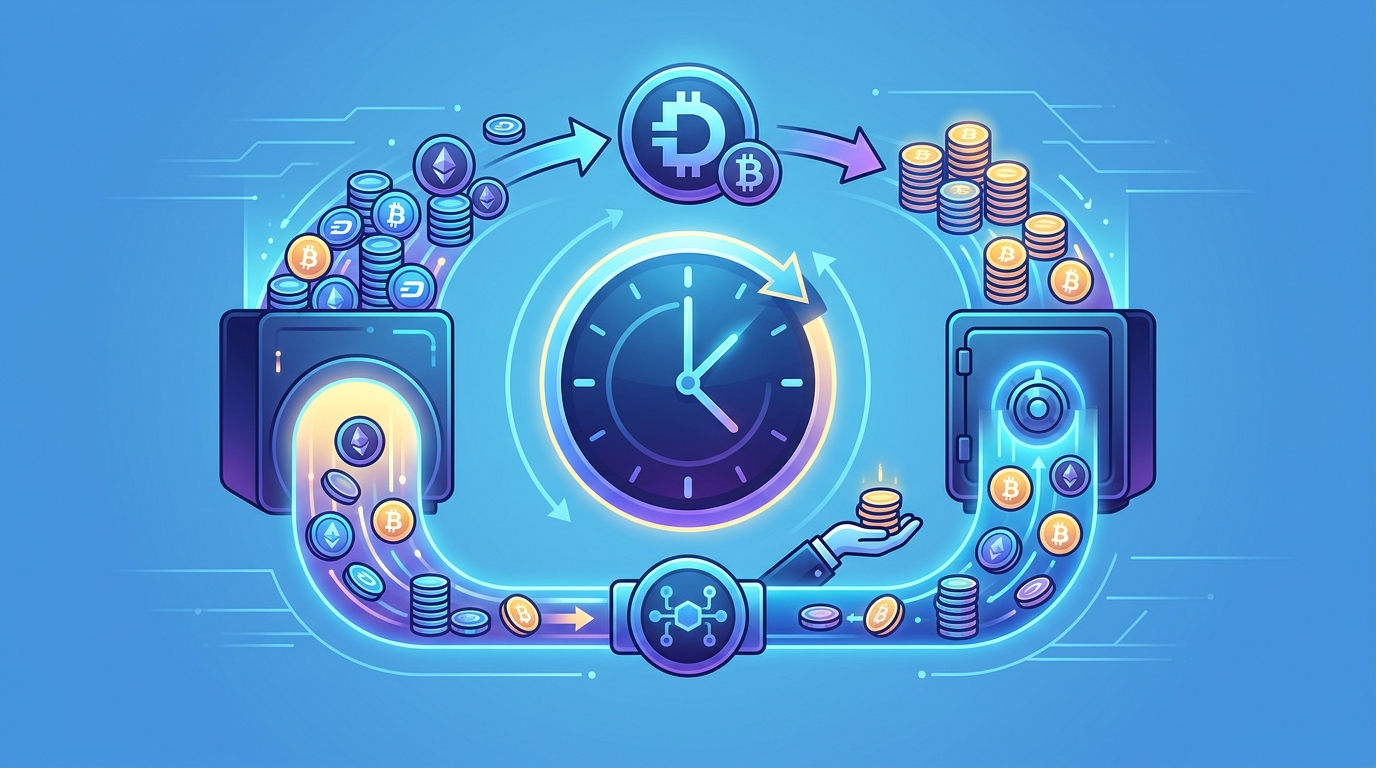
Imagine borrowing millions of dollars without putting up a single cent as collateral. No credit check. No approval process. You get the funds, use them, and pay them back within seconds. If you can’t repay, the entire transaction reverses like it never happened.
This isn’t science fiction. It’s how flash loans work in DeFi.
Flash loans are uncollateralized crypto loans that must be borrowed and repaid within a single blockchain transaction. They enable instant access to millions in capital for arbitrage, collateral swaps, and liquidations. The loan automatically reverses if not repaid, eliminating default risk for lenders. While powerful for experienced users, flash loans carry technical complexity and are frequently exploited in DeFi attacks.
What makes flash loans different from traditional loans
Traditional loans require collateral or a credit history. Banks need assurance you’ll pay them back.
Flash loans flip this model completely.
You borrow funds without any collateral. The catch? You must repay everything plus fees within the same blockchain transaction. If you can’t repay, the smart contract cancels the entire sequence. The loan never actually happens.
This works because blockchain transactions are atomic. Either every step succeeds, or the whole thing fails. There’s no middle ground where you walk away with borrowed funds.
The entire process happens in seconds. Borrow, use the funds, repay. All within one block on the blockchain.
For how DeFi actually works without banks or middlemen, this represents a fundamental shift in lending mechanics.
How flash loans actually work step by step
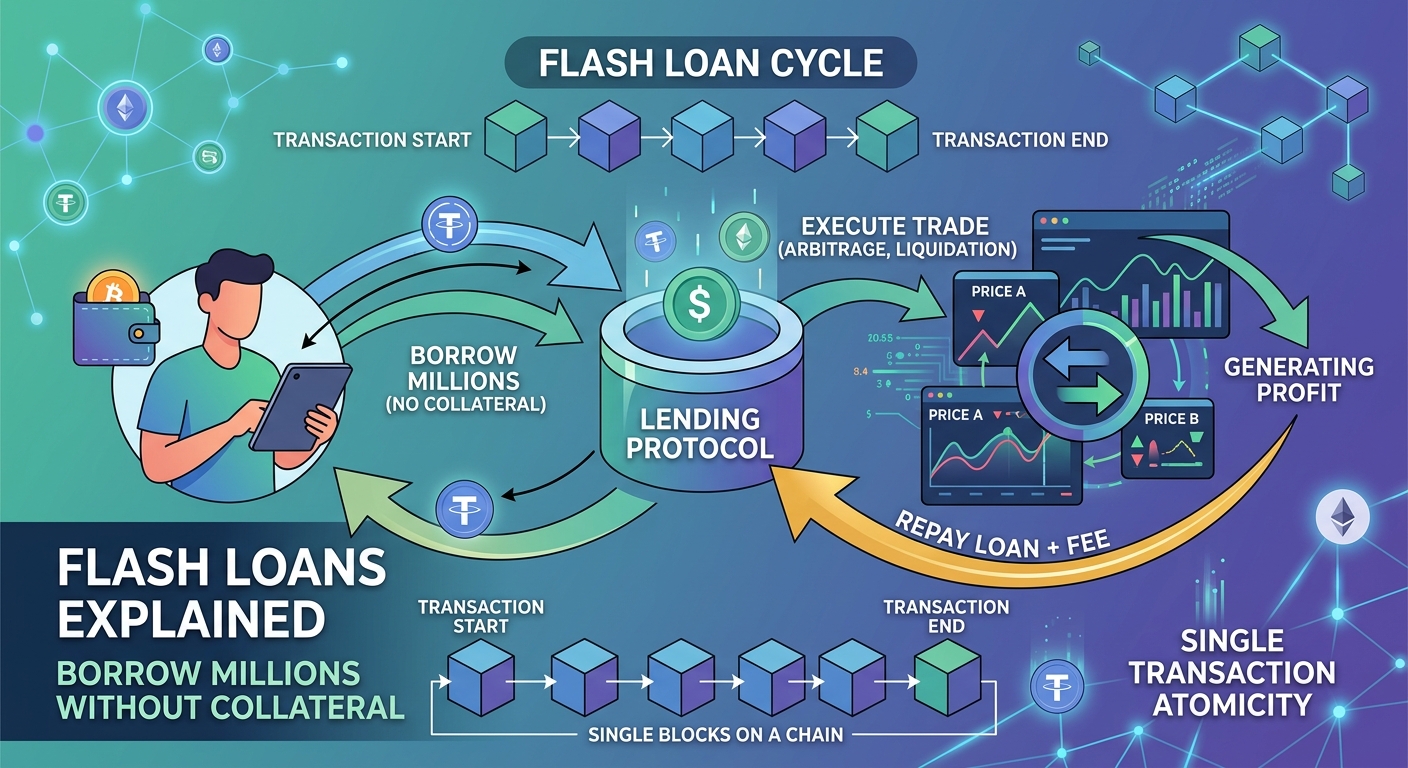
Here’s what happens during a typical flash loan transaction:
- You write a smart contract that requests a flash loan from a lending protocol like Aave or dYdX.
- The protocol sends you the requested amount (could be millions in ETH, USDC, or other tokens).
- Your contract executes whatever operations you programmed (arbitrage trades, collateral swaps, liquidations).
- Your contract repays the original loan amount plus a small fee (typically 0.05% to 0.09%).
- If step 4 fails, the entire transaction reverts and none of the previous steps actually execute on the blockchain.
The beauty is in the atomicity. You either complete all steps successfully or nothing happens at all.
No credit score required. No collateral locked up. Just code execution.
Common use cases for flash loans
Flash loans serve several legitimate purposes in DeFi:
Arbitrage opportunities: You spot that ETH costs $2,000 on one exchange but $2,010 on another. Borrow 1,000 ETH, buy on the cheaper exchange, sell on the expensive one, repay the loan, and pocket the difference. All in one transaction.
Collateral swapping: You have a loan collateralized with Token A but want to switch to Token B without closing your position. Flash loan Token A, repay your original loan, open a new loan with Token B as collateral, repay the flash loan.
Liquidation assistance: When someone’s DeFi loan becomes undercollateralized, liquidators can use flash loans to instantly acquire the assets needed to liquidate the position and claim rewards.
Debt refinancing: Move your debt from one protocol to another that offers better rates, all without needing capital upfront.
These use cases require technical knowledge. You’re not clicking buttons in an app. You’re writing smart contracts that execute complex multi-step transactions.
For those getting started with DeFi, flash loans represent an advanced concept worth understanding but not necessarily using immediately.
The technical requirements you need to know
Flash loans aren’t for casual users. Here’s what you actually need:
- Solid understanding of smart contract programming (usually Solidity for Ethereum)
- Knowledge of how DeFi protocols interact through their APIs
- Ability to calculate gas fees and ensure your arbitrage profit exceeds transaction costs
- Testing environment to verify your contract logic before deploying real funds
- Understanding of MEV (Miner Extractable Value) and how bots might front-run your transaction
You can’t execute a flash loan from a regular wallet interface. You need to deploy a custom smart contract that orchestrates the entire sequence.
The learning curve is steep. One mistake in your code and your transaction fails, costing you gas fees with nothing to show for it.
Real risks that come with flash loans
Flash loans carry unique dangers:
Technical complexity: Code errors mean failed transactions and wasted gas fees. More seriously, bugs can expose your funds to exploits.
Gas fee volatility: Network congestion can spike gas costs above your profit margin. Your arbitrage opportunity evaporates before you can execute.
Front-running: Bots monitor the mempool for profitable transactions and copy them with higher gas fees, stealing your opportunity.
Smart contract vulnerabilities: If the protocol you’re interacting with has bugs, your flash loan transaction might trigger unintended consequences.
Regulatory uncertainty: As authorities examine DeFi more closely, flash loan activities might face new restrictions or reporting requirements.
The biggest misconception? That flash loans are “free money.” They’re sophisticated financial instruments that require expertise to use safely.
For context on why DeFi is called permissionless and what that means for you, flash loans exemplify both the power and responsibility of unrestricted financial tools.
Flash loan attacks you should understand
Flash loans have been weaponized in numerous DeFi exploits. Understanding these helps you recognize protocol vulnerabilities:
| Attack Type | How It Works | Notable Example |
|---|---|---|
| Price manipulation | Borrow massive amounts, manipulate oracle prices, profit from mispriced assets | bZx attack (2020) |
| Governance exploitation | Borrow governance tokens, vote on malicious proposals, return tokens | Various DAO attacks |
| Reentrancy attacks | Call vulnerable contracts repeatedly before state updates complete | Multiple AMM exploits |
| Collateral manipulation | Artificially inflate collateral value, borrow against it, let it crash | Cream Finance (2021) |
These attacks don’t represent flaws in flash loans themselves. They expose vulnerabilities in the protocols being attacked.
The lesson? Flash loans amplify existing weaknesses. A protocol with poor oracle design or inadequate access controls becomes far more dangerous when attackers can borrow unlimited capital for free.
For more on what are flash loan attacks and how do they threaten your DeFi holdings, understanding the attack vectors helps you evaluate protocol security.
Which protocols offer flash loans
Several major DeFi platforms provide flash loan functionality:
- Aave: The largest flash loan provider by volume, supporting multiple assets across various networks
- dYdX: Offers flash loans primarily for margin trading and derivatives
- Uniswap V2/V3: Flash swaps allow temporary token borrowing within swap transactions
- Balancer: Provides flash loans from liquidity pools with customizable parameters
- PancakeSwap: BSC’s leading DEX with flash loan capabilities
Each protocol has different fee structures, supported assets, and technical requirements. Aave charges around 0.09%, while others might charge less or more depending on market conditions.
The protocol you choose depends on which assets you need, which blockchain you’re operating on, and what specific operations you’re performing.
Comparing flash loans to traditional DeFi lending
Here’s how flash loans stack up against standard crypto lending:
Traditional DeFi lending:
– Requires over-collateralization (typically 150% or more)
– Loans can stay open indefinitely
– Interest accrues over time
– Lower technical barrier to entry
– Suitable for long-term strategies
Flash loans:
– Zero collateral required
– Must repay within one transaction (seconds)
– Fixed fee regardless of time
– High technical barrier
– Only for instant arbitrage and swaps
For most users, understanding collateral ratios matters more than flash loan mechanics. Traditional lending serves everyday needs. Flash loans serve specialized trading strategies.
If you’re learning how to borrow crypto without selling your assets, standard collateralized loans make more sense for holding positions over time.
Should beginners attempt flash loans
Probably not. Here’s why:
Flash loans require programming skills most crypto users don’t have. You’re writing smart contracts, not clicking buttons in an app.
The profit margins are often razor-thin. Gas fees can easily exceed your arbitrage gains, especially on Ethereum mainnet.
Experienced traders with sophisticated bots dominate the space. They’ll front-run your transactions before you can blink.
One coding mistake costs you real money in gas fees. There’s no “undo” button.
Expert perspective: “Flash loans are professional tools for professional traders. If you’re still learning basic DeFi concepts, focus on understanding simpler mechanisms first. Master spot trading, lending, and liquidity provision before attempting flash loan strategies.” — DeFi security researcher
That said, understanding flash loans helps you grasp how DeFi protocols interact and where vulnerabilities might exist. You don’t need to use them to benefit from knowing how they work.
For those exploring 7 common DeFi terms every beginner should know before getting started, flash loans represent advanced territory worth understanding conceptually.
How to protect yourself from flash loan exploits
Even if you never use flash loans, you’re affected by them. Here’s how to stay safe:
Check protocol security measures:
– Does the protocol use time-weighted average prices (TWAP) instead of spot prices?
– Are there transaction limits or rate limiters?
– Has the code been audited by reputable firms?
– Does the protocol have a bug bounty program?
Diversify your DeFi exposure:
– Don’t put all funds in one protocol
– Spread risk across different types of platforms
– Keep significant holdings in cold storage
Monitor your positions:
– Set up alerts for unusual price movements
– Check your collateralization ratios regularly
– Understand liquidation thresholds
Use protocols with proven track records:
– Longer operating history generally means more battle-tested code
– Larger TVL attracts more security attention
– Active development teams respond faster to threats
For comprehensive guidance, review the complete DeFi security checklist for beginners to understand all the precautions you should take.
The future of flash loans in DeFi
Flash loans continue evolving. Several trends are shaping their future:
Cross-chain flash loans: Protocols are developing ways to execute flash loans across multiple blockchains simultaneously, opening new arbitrage opportunities.
Improved security standards: DeFi platforms are implementing better oracle designs and circuit breakers to resist flash loan attacks.
Regulatory scrutiny: Authorities are examining whether flash loan activities constitute market manipulation or require licensing.
Democratization tools: Some platforms are building no-code interfaces for flash loan strategies, though these come with their own risks.
Integration with MEV: Flash loans are becoming part of larger MEV strategies, bundled with other transaction types for maximum efficiency.
The technology itself is neutral. Flash loans can enable efficient markets or facilitate exploits, depending on how they’re used and how well protocols defend against misuse.
Understanding how major DeFi protocols are responding to new regulatory frameworks in 2024 provides context for how flash loan availability might change.
Common mistakes people make with flash loans
Even experienced developers stumble. Here are frequent errors:
- Underestimating gas costs: Your arbitrage profit looks great until gas fees eat it all
- Ignoring slippage: Large trades move markets more than you expect
- Failing to account for fees: Protocol fees, swap fees, and flash loan fees add up fast
- Not testing thoroughly: Mainnet is expensive. Test on testnets first
- Copying code blindly: Old tutorials might reference deprecated functions or vulnerable patterns
- Forgetting about front-running: Public mempools expose your strategy to bots
The most expensive mistake? Assuming you understand the entire transaction flow when you don’t. One unexpected state change can cause your carefully planned sequence to fail.
For related pitfalls, check out 7 common staking mistakes that could cost you your crypto to see how complexity creates risk across DeFi.
When flash loans make sense for your strategy
Flash loans suit specific scenarios:
You’re a developer building DeFi tools and need to test liquidation mechanisms or arbitrage logic.
You’re a professional trader with infrastructure to monitor multiple DEXs and execute sub-second strategies.
You’re conducting security research and need to demonstrate protocol vulnerabilities responsibly.
You’re managing a large position and need to rebalance or migrate collateral without temporary exposure.
They don’t make sense if you’re learning DeFi basics, don’t have programming skills, or are looking for passive income strategies.
The threshold question: Can you write, test, and deploy a smart contract that coordinates multiple protocol interactions? If not, flash loans aren’t for you yet.
Tools and resources for learning more
If you’re serious about understanding flash loans technically:
Development frameworks:
– Hardhat for Ethereum smart contract development
– Foundry for advanced testing and fuzzing
– Tenderly for transaction simulation and debugging
Educational resources:
– Aave’s flash loan documentation and code examples
– OpenZeppelin’s secure contract libraries
– Blockchain security courses from Trail of Bits and ConsenSys
Testing environments:
– Ethereum testnets (Goerli, Sepolia)
– Mainnet forking for realistic simulations
– Local blockchain instances for rapid iteration
Monitoring tools:
– Etherscan for transaction analysis
– DeFi Llama for protocol metrics
– Gas trackers for fee optimization
Start with reading code. Examine successful flash loan transactions on block explorers. Understand each step before attempting to write your own.
For foundational knowledge, begin with traditional finance vs DeFi to understand what makes DeFi lending fundamentally different.
Why flash loans matter for DeFi’s evolution
Flash loans represent something revolutionary in finance. They prove that collateral isn’t always necessary when transactions are atomic and programmable.
They’ve exposed countless vulnerabilities in DeFi protocols, forcing the industry to build more robust systems. Every flash loan attack teaches developers what not to do.
They’ve enabled market efficiency by allowing anyone with coding skills to capture arbitrage opportunities, not just well-capitalized institutions.
They’ve demonstrated the power and danger of composability. DeFi protocols interact in ways traditional finance never could, creating both opportunity and risk.
Most importantly, they show what’s possible when you rethink financial primitives from first principles. Flash loans couldn’t exist in traditional finance. They’re native to blockchain.
Whether you ever use a flash loan or not, they’re shaping how DeFi evolves. Understanding them helps you navigate this ecosystem more safely and recognize both innovation and risk when you see it.
The next time you hear about a DeFi exploit, there’s a good chance flash loans played a role. Now you’ll understand how and why.