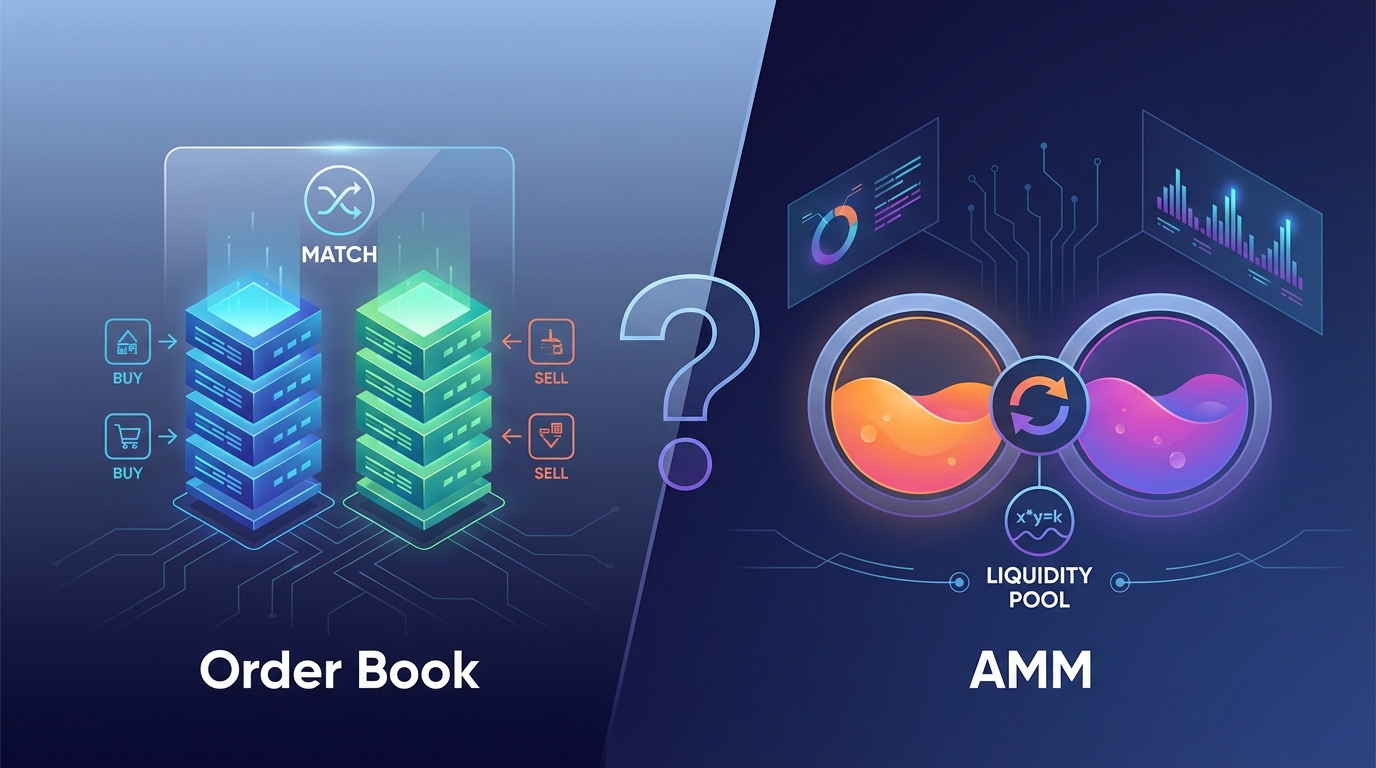
Choosing between a decentralized exchange built on order books versus one powered by automated market makers can feel like picking between two different languages. Both get you from point A to point B, but the route, the speed, and the costs look completely different. If you’ve ever wondered why some DEXs feel more like traditional trading platforms while others seem to run on autopilot, you’re about to find out.
Order book DEXs match buyers and sellers directly through limit orders, offering precise pricing and deep market data but requiring active liquidity providers. AMM DEXs use algorithmic pools where anyone can deposit tokens, enabling instant trades with guaranteed execution but exposing users to slippage and impermanent loss. Your choice depends on trade size, token popularity, and whether you value price control or simplicity.
What makes order book DEXs different from traditional exchanges
Order book exchanges have been the backbone of financial markets for centuries. A buyer places an order at a specific price. A seller does the same. The exchange matches them when the numbers align.
Decentralized order book platforms bring this model onchain. Instead of a centralized entity holding your funds and executing trades, smart contracts manage the matching process. Your wallet stays in your control the entire time.
The order book displays all open buy and sell orders. You see the exact price levels where other traders want to transact. This transparency lets you place limit orders at your preferred price and wait for the market to come to you.
Traditional centralized exchanges like Binance or Coinbase use this model with custodial wallets. Decentralized versions like dYdX and Serum offer the same structure but without giving up custody of your assets.
The challenge? Onchain order books can struggle with speed and cost. Every order placement, cancellation, and modification requires a blockchain transaction. On networks with high gas fees, this becomes expensive fast.
Some platforms solve this by keeping the order book offchain and only settling final trades onchain. This hybrid approach reduces costs while maintaining most of the decentralization benefits.
How automated market makers changed the game
AMMs flipped the script entirely. Instead of matching individual buyers and sellers, they use liquidity pools filled with token pairs.
Here’s the basic mechanism. A pool holds two tokens, say ETH and USDC. The ratio between them determines the price. When you buy ETH, you add USDC to the pool and remove ETH. This shifts the ratio and changes the price.
The formula most AMMs use is simple: x times y equals k. The product of the two token quantities stays constant. As one side grows, the other shrinks, and the price adjusts automatically.
Uniswap pioneered this model in 2018. It solved the cold start problem that plagued early DEXs. You don’t need active market makers or a critical mass of traders. You just need someone to deposit tokens into a pool.
Anyone can become a liquidity provider. You deposit equal values of both tokens and earn a share of trading fees. No special permissions. No minimum capital requirements beyond gas costs.
This democratization of market making opened DeFi to millions of users. Suddenly, obscure tokens could have liquid markets without convincing professional market makers to support them.
The trade-off? Price slippage. Large trades move the pool ratio significantly, giving you a worse price than the one displayed. The smaller the pool, the worse the slippage.
Breaking down the core technical differences
Let’s get specific about how these models diverge under the hood.
Price discovery mechanisms:
- Order books determine price through supply and demand. The spread between the highest bid and lowest ask reflects market sentiment in real time.
- AMMs calculate price algorithmically. The ratio in the pool is the price, regardless of external market conditions.
Liquidity provision:
- Order book DEXs need market makers to place continuous buy and sell orders. These can be professional firms or individual traders.
- AMM DEXs need passive liquidity providers who deposit token pairs. The protocol handles the rest.
Trade execution:
- Order books let you set exact entry and exit prices. Your limit order sits until filled or canceled.
- AMMs execute instantly at the current pool ratio. You specify a maximum slippage tolerance, but you can’t set a precise price.
Capital efficiency:
- Order books concentrate liquidity at specific price points. Your capital only works when the market trades at your order’s price.
- Traditional AMMs spread liquidity across the entire price curve. Most of it sits unused at prices the market will never reach.
Newer AMM designs like Uniswap V3 let you concentrate liquidity in specific price ranges. This hybrid approach improves capital efficiency dramatically but adds complexity.
Following the step-by-step process to trade on each model
Trading on an order book DEX works like this:
- Connect your wallet to the platform and ensure you have both the token you want to trade and enough native tokens for gas fees.
- Navigate to the trading interface and select your token pair from the available markets.
- Choose between a market order for instant execution at the current best price or a limit order to specify your exact entry price.
- Review the order details including fees, and sign the transaction with your wallet.
- Wait for blockchain confirmation, then monitor your order status in the open orders section if you used a limit order.
Trading on an AMM is simpler:
- Connect your wallet and select the token pair you want to swap.
- Enter the amount you want to trade and review the estimated output including slippage.
- Adjust slippage tolerance if needed based on pool depth and your urgency.
- Confirm the swap and sign the transaction.
- Receive your tokens once the transaction confirms onchain.
The AMM process has fewer steps but less control. You get what the pool gives you. The order book process offers precision but requires more decisions and potentially multiple transactions if you’re managing several orders.
Understanding the real costs beyond trading fees
Both models charge fees, but the structure differs significantly.
Order book DEXs typically charge a small percentage of your trade value. This fee goes to the protocol, the market makers, or both. Some platforms also charge gas fees for every order placement and cancellation.
On Ethereum mainnet during peak times, these gas costs can exceed the trading fee itself. Placing five different limit orders might cost $50 or more just in transaction fees.
AMMs bundle everything into a single swap transaction. You pay a protocol fee (usually 0.3% but varies by platform) that goes to liquidity providers, plus the gas cost for one transaction.
The hidden cost in AMMs is slippage. If you’re trading a large amount relative to pool size, you might pay 1%, 5%, or even 10% more than the displayed price. This isn’t a fee, but it’s still money out of your pocket.
When trading more than 2% of a pool’s total liquidity, expect slippage to exceed standard trading fees. Always check the price impact indicator before confirming your swap.
Price impact and slippage are related but different. Price impact is how much your trade moves the pool ratio. Slippage is the difference between expected and actual execution price, which includes price impact plus any price movement during transaction confirmation.
Comparing the two models across key trading scenarios
Let’s look at how each performs in common situations.
| Scenario | Order Book Performance | AMM Performance |
|---|---|---|
| Small trades on popular pairs | Excellent execution with tight spreads | Good execution with minimal slippage |
| Large trades on popular pairs | Good execution if sufficient depth | Poor execution due to high slippage |
| Trading obscure tokens | Often no market or wide spreads | Works if a pool exists, regardless of size |
| Setting specific entry prices | Perfect, use limit orders | Impossible without external tools |
| Trading during high volatility | Can be difficult if liquidity pulls back | Always executable but with extreme slippage |
| Providing liquidity | Requires active management and rebalancing | Passive deposits with automatic rebalancing |
For day traders and those executing precise strategies, order books usually win. You can set stop losses, take profit orders, and build complex position management systems.
For casual swappers and those trading smaller amounts, AMMs offer simplicity. You don’t need to understand order types or market depth. Just enter an amount and swap.
Recognizing the security trade-offs in each model
Both architectures introduce unique risks that traders need to understand.
Order book DEXs using hybrid models (offchain matching, onchain settlement) introduce centralization points. If the entity running the order book goes offline or acts maliciously, you might not be able to trade. However, your funds remain in your wallet until you explicitly sign a settlement transaction.
Fully onchain order books eliminate this risk but face front-running challenges. Miners or validators can see your pending order and place their own orders ahead of yours to profit from the price movement your trade will create.
AMMs face different security concerns. Smart contract bugs in the pool logic can drain all deposited funds. This has happened multiple times across various protocols. Audits help but don’t eliminate risk entirely.
Liquidity providers in AMMs also face impermanent loss. When token prices diverge from your deposit ratio, you end up with less value than if you’d simply held the tokens. This isn’t a security risk in the traditional sense, but it’s a financial risk many users don’t fully grasp.
Understanding how DeFi works without intermediaries helps contextualize these risks within the broader decentralized ecosystem.
Evaluating liquidity depth and how it affects your trades
Liquidity determines whether you can execute your trade at a reasonable price.
On order book DEXs, liquidity appears as the cumulative size of orders at each price level. A deep order book has large orders close to the current market price. A thin one has small orders spread across wide price gaps.
You can see exactly how much you can buy or sell before moving the price significantly. This transparency helps you plan entries and exits.
On AMMs, liquidity is the total value locked in the pool. A pool with $10 million in liquidity can handle larger trades with less slippage than one with $100,000.
But you can’t see where that liquidity is concentrated unless the platform uses concentrated liquidity features. In traditional AMMs, it’s spread uniformly, meaning most of it provides no benefit for typical trade sizes.
Tools like DEX aggregators help by splitting your trade across multiple pools and even multiple AMMs to minimize slippage. They essentially create a meta-order book from AMM liquidity.
Identifying which model matches your trading style
Your preferred model should align with how you actually trade.
Choose order book DEXs if you:
- Execute large trades where precise pricing matters
- Use limit orders and stop losses regularly
- Trade frequently and need detailed market data
- Have experience with traditional exchange interfaces
- Don’t mind paying gas for order management
Choose AMM DEXs if you:
- Make occasional swaps of moderate size
- Prefer simplicity over control
- Trade tokens that lack order book liquidity
- Want to provide liquidity passively for yield
- Prioritize guaranteed execution over price precision
Many experienced traders use both. They might use an AMM for simple swaps of liquid tokens but switch to an order book when executing larger positions or trading less common pairs.
Your wallet security matters regardless of which model you choose. Selecting the right wallet type protects your assets across all platforms.
Watching how hybrid models try to combine strengths
The DEX landscape is evolving beyond the pure order book versus AMM debate.
Several platforms now combine elements of both. They might use AMM pools for liquidity but let traders place limit orders that execute against those pools when prices reach specified levels.
Others use dynamic fees that adjust based on volatility, reducing the advantage of informed traders over liquidity providers.
Concentrated liquidity AMMs like Uniswap V3 let providers choose specific price ranges, effectively creating order book-like liquidity concentration while maintaining the AMM structure.
Some platforms use request-for-quote systems where market makers compete to fill your order, combining the passive liquidity of AMMs with the competitive pricing of order books.
These innovations blur the lines between models. The question shifts from “order book or AMM?” to “which combination of features serves my needs?”
Navigating regulatory considerations for different DEX types
Regulators worldwide are still figuring out how to classify and oversee decentralized exchanges.
Order book DEXs that use offchain matching might face more scrutiny. The entity running the matching engine could be considered an exchange operator under traditional securities law.
Pure AMMs with fully automated, permissionless pools might have stronger arguments for decentralization. No single entity controls the trading mechanism.
But the regulatory landscape remains uncertain. How protocols are responding to new frameworks shows the ongoing adaptation across the industry.
Token classification also matters. Understanding utility versus security tokens helps you assess which platforms might face restrictions in your jurisdiction.
Protecting yourself from common pitfalls on both platforms
Scams and mistakes happen on all DEX types. Awareness is your first defense.
On order book DEXs:
- Verify you’re on the legitimate platform URL before connecting your wallet
- Double-check token contract addresses, especially for newer tokens
- Be cautious of orders with prices far from market rates, they might be bait
- Understand that limit orders might not fill if the market doesn’t reach your price
On AMM DEXs:
- Always review price impact before confirming swaps
- Set reasonable slippage tolerance, too high invites sandwich attacks
- Verify token contracts, fake tokens with similar names populate many pools
- Understand that high APY pools often involve high-risk tokens
Recognizing rug pull warning signs applies to tokens traded on any platform type. The DEX model doesn’t protect you from malicious token contracts.
Additional rug pull protection strategies provide another layer of security regardless of where you trade.
Considering gas costs and network selection
The blockchain you trade on matters as much as the DEX model.
Ethereum mainnet offers the deepest liquidity for both order books and AMMs, but gas costs can make small trades uneconomical. A $100 swap might cost $20 in gas during peak times.
Layer 2 networks like Arbitrum and Optimism reduce gas costs dramatically while maintaining Ethereum security. Many major DEXs have deployed on these networks.
Alternative layer 1 blockchains like Solana, Avalanche, and BNB Chain offer even lower costs but with different security assumptions and often less liquidity.
Your choice of network affects which DEX model works better. On high-cost chains, AMMs make more sense for small trades because you only pay gas once. On cheap chains, order book DEXs become viable even for frequent small trades.
Measuring success beyond just price execution
Good trading outcomes involve more than getting the best price.
Consider total cost including gas, fees, and slippage. An order book might show a better price, but if you pay $30 in gas to place and cancel orders while searching for fills, an AMM with 0.5% slippage might have been cheaper overall.
Think about execution certainty. If you need to exit a position immediately, an AMM guarantees execution. An order book limit order might sit unfilled while the market moves against you.
Factor in time and attention. Managing limit orders requires monitoring and adjustment. AMMs let you swap and move on with your day.
Account for opportunity cost. While you wait for your limit order to fill, the market might move, or you might miss other opportunities. Sometimes good enough right now beats perfect later.
Earning yield through each model’s liquidity provision
Both models let you earn by providing liquidity, but the experience differs substantially.
Order book market making requires active management. You place buy and sell orders around the current price, capturing the spread when both sides fill. As the market moves, you adjust your orders.
This can be profitable but demands constant attention. Automated market making bots help, but they add complexity and risk.
AMM liquidity provision is passive. Deposit tokens, earn fees proportionally to your share of the pool. No order management needed.
The risk is impermanent loss. If one token appreciates significantly against the other, you would have been better off holding. The fees you earn might not compensate for this loss.
Staking mechanisms offer another way to earn yield, often with simpler risk profiles than liquidity provision.
Some platforms let you borrow against your crypto instead of selling, which might be preferable to providing liquidity in volatile markets.
Tracking the evolution and future of DEX design
The order book versus AMM debate isn’t settled. It’s evolving.
We’re seeing convergence. Order books adopt AMM-like passive liquidity features. AMMs add limit order capabilities. The distinction blurs.
Improvements in blockchain scalability make onchain order books more viable. Faster block times and lower costs remove technical barriers that once favored AMMs.
New AMM formulas optimize for specific use cases. Stablecoin swaps use different curves than volatile pairs. This specialization improves efficiency.
Stablecoin mechanisms benefit from specialized AMM designs that minimize slippage for assets that should trade near parity.
Cross-chain DEXs introduce additional complexity. How do you maintain an order book or AMM pool across multiple blockchains? Solutions are emerging but remain experimental.
The future likely holds multiple coexisting models, each optimized for specific use cases, networks, and user preferences. Your job is to understand them well enough to pick the right tool for each trade.
Making the choice that fits your actual needs
Both order book and AMM decentralized exchanges serve important roles in the crypto ecosystem. Neither is universally better.
Order books shine for traders who need precision, work with large positions, or trade frequently enough to justify the complexity. They provide the market depth information and order types that sophisticated strategies require.
AMMs excel at providing liquidity for long-tail assets, offering simplicity for casual users, and enabling passive yield generation. They solved the cold start problem and made thousands of markets viable that would never attract traditional market makers.
Your best approach? Try both. Start with small amounts. Feel how each interface works. Notice which model matches your natural trading rhythm.
Pay attention to the actual costs, not just the advertised fees. Track your total expense including gas, slippage, and failed transactions. Let real data guide your decision.
The DEX landscape will keep changing. New models will emerge. Existing ones will improve. Stay curious, keep learning, and adjust your approach as better options appear. Your trading results will thank you for the effort.