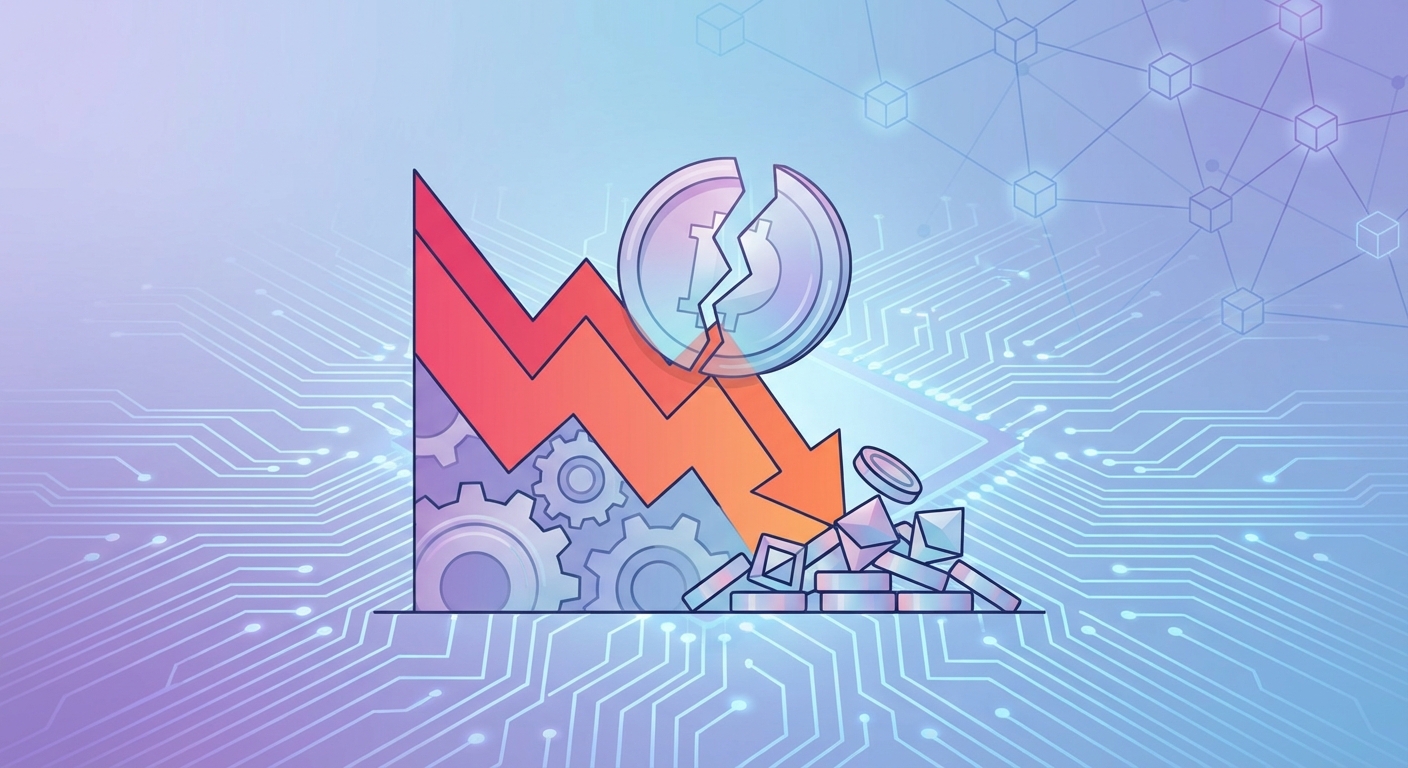
Deflationary tokens sound like a dream investment. Fewer tokens over time means higher prices, right? The marketing makes it seem automatic: hold the token, watch supply shrink, profit from scarcity. But the reality is far more complicated than the pitch. Yes, you absolutely can lose money holding deflationary tokens, and understanding why requires looking past the hype at how these mechanisms actually work.
Deflationary tokens reduce supply through burning mechanisms, but this does not guarantee price increases. You can lose money due to poor project fundamentals, excessive sell pressure, flawed tokenomics, liquidity problems, or scams disguised as legitimate deflationary projects. Supply reduction alone cannot overcome weak demand, bad execution, or market conditions that drive prices down regardless of burning activity.
What deflationary tokens actually do
A deflationary token is designed to decrease its total supply over time. This happens through various burning mechanisms that permanently remove tokens from circulation.
The most common method is transaction burns. Every time someone buys, sells, or transfers the token, a small percentage gets sent to an address that nobody can access. That token is gone forever.
Some projects use buyback and burn programs. The team uses revenue or treasury funds to purchase tokens from the open market, then destroys them. This is supposed to create buying pressure while reducing supply.
Staking burns work differently. Users lock tokens to earn rewards, but the locked tokens might get burned instead of just held. The promise is that reduced circulating supply will push prices higher for remaining holders.
Revenue-linked burns tie destruction to actual platform usage. A decentralized exchange might burn a portion of trading fees. A gaming platform might burn tokens spent on in-game purchases.
The theory sounds solid. Economics 101 says that when supply decreases and demand stays constant, prices should rise. But crypto markets don’t follow textbook economics.
Why supply reduction does not guarantee profits
Here’s the uncomfortable truth: burning tokens means nothing if nobody wants to buy them.
Imagine a project burns 50% of its supply. Sounds impressive. But if the project has no real users, no revenue, and no reason for anyone to hold the token, that burn is worthless. You’re left holding half as many tokens of something nobody wants.
Price depends on both supply and demand. Deflationary mechanisms only address one side of that equation.
Consider this scenario. A token burns 2% per transaction. Sounds deflationary. But if holders are rushing to exit because the project is failing, that selling pressure overwhelms any benefit from the burn. The price drops 30% while the supply drops 2%. You still lose money.
Many projects use deflationary mechanics as a marketing gimmick to attract investors without building actual utility. The burn rate becomes the main selling point instead of what the project actually does. When reality sets in and people realize there’s no substance behind the burns, prices collapse.
Deflationary tokenomics can create a false sense of security. Investors assume scarcity equals value, but value comes from utility, adoption, and execution. A shrinking supply of something useless is still useless.
The hidden risks in deflationary token mechanics
Several specific mechanisms can cause losses even when burns are happening exactly as promised.
Death spiral deflation occurs when price drops trigger more selling, which triggers more burns, which reduces liquidity, which causes bigger price swings, which triggers more panic selling. The deflationary mechanism accelerates the collapse instead of preventing it.
Liquidity traps happen when too much supply gets burned or locked. Trading becomes difficult because there aren’t enough tokens available. Slippage increases. You might own tokens worth $1000 on paper but only be able to sell them for $700 because the liquidity pool is too shallow.
Whale manipulation becomes easier with deflationary tokens. Large holders can trigger burns through transactions, reducing supply while they accumulate more tokens at lower prices. Then they dump on retail investors who bought the deflationary story.
Flawed burn rates can destroy a project. If the burn rate is too aggressive, the token becomes unusable for its intended purpose. If it’s too conservative, the deflationary effect is meaningless and doesn’t justify the investment.
Tax-on-transfer tokens often combine high transaction fees with burns. You might pay 10% every time you buy or sell. Even if the price stays flat, you’re down 20% after a round trip. The burn might be 3% while the team takes 7%. You’re funding their exit, not your profits.
How to evaluate deflationary tokens before investing
Not all deflationary tokens are scams or bad investments. Some legitimate projects use these mechanisms responsibly. Here’s how to separate the real opportunities from the traps.
-
Check if the project has utility beyond the burn mechanism. What problem does it solve? Who uses it? Is there actual revenue or just speculation?
-
Analyze the burn rate math. Calculate how long it would take to burn significant supply at current transaction volumes. If it would take 50 years to burn 10% of supply, the deflationary aspect is marketing noise.
-
Verify burn transactions on the blockchain. Don’t trust announcements. Look at the actual burn wallet. Make sure tokens are going to addresses that are truly inaccessible, not just team-controlled wallets they claim are burned.
-
Assess liquidity depth relative to market cap. A token with $1 million market cap but only $50,000 in liquidity is a red flag. You won’t be able to exit without massive losses.
-
Review the distribution of tokens. If the team and insiders hold 60% while claiming the token is deflationary, they can dump on you faster than burns can reduce supply.
-
Examine the project’s revenue model. Sustainable burns come from real revenue, not from taxing desperate holders trying to sell.
Understanding how to identify utility tokens vs security tokens before investing helps you evaluate whether a deflationary token has genuine utility or just clever marketing.
Common deflationary token mistakes that cost investors money
| Mistake | Why It Causes Losses | How to Avoid It |
|---|---|---|
| Buying based on burn rate alone | High burns mean nothing without demand | Evaluate utility and adoption first |
| Ignoring liquidity depth | Can’t sell without massive slippage | Check liquidity pool size before buying |
| Trusting team announcements about burns | Teams can lie or use fake burn addresses | Verify all burns on blockchain explorer |
| Holding through obvious project failure | Hoping burns will save the price | Set stop losses and exit failing projects |
| Not calculating actual deflation impact | Burn sounds big but is mathematically tiny | Do the math on real supply reduction |
| Falling for rebase token tricks | Supply changes don’t equal price changes | Understand rebase mechanics completely |
The biggest mistake is treating deflationary tokenomics as a substitute for due diligence. Scammers know that “deflationary” sounds sophisticated and attracts investors. They build entire projects around burn mechanics while planning to rug pull from day one.
Real examples of deflationary tokens and their outcomes
Some deflationary tokens have succeeded. Binance Coin uses quarterly burns funded by exchange profits. The burns are predictable, funded by real revenue, and transparent. Holders have done well, but not because of burns alone. BNB has utility across the Binance ecosystem.
Ethereum became deflationary after EIP-1559 introduced fee burning. When network usage is high, more ETH gets burned than issued. But ETH’s value comes from being the foundation of DeFi protocols, not from the burn mechanism itself.
Many smaller deflationary tokens have failed spectacularly. Projects launched with 10% transaction taxes and aggressive burn rates. Early investors made money. Late investors watched prices drop 90% despite millions of tokens being burned. The burns couldn’t overcome lack of utility and selling pressure.
Reflection tokens became popular in 2021. They redistributed transaction taxes to holders while burning a portion. Most are now worth less than 1% of their peak value. The deflationary and reward mechanics couldn’t sustain projects with no real purpose.
The relationship between deflation and actual project value
Token burns are a tool, not a business model. They can complement a strong project but cannot fix a weak one.
Think about traditional companies. Stock buybacks (similar to token burns) can benefit shareholders, but only if the company is profitable and growing. Buybacks don’t save failing businesses.
The same applies to crypto. A deflationary token backed by a thriving platform with real users and revenue can benefit from burns. The reduced supply amplifies genuine demand. But a deflationary token with no users is just a slowly shrinking pile of worthless digital assets.
Price appreciation requires:
- Actual utility that solves real problems
- Growing user base and transaction volume
- Revenue generation or value capture
- Strong community and developer activity
- Competitive advantages over alternatives
- Professional team execution
Deflationary mechanics can enhance these fundamentals but cannot replace them.
Security considerations for deflationary token holders
Beyond economic risks, deflationary tokens carry specific security concerns.
Smart contract bugs in burn mechanisms can be catastrophic. If the burn function has a vulnerability, attackers might burn all tokens or prevent burns entirely. Either scenario destroys value.
Some deflationary tokens use complex smart contracts with multiple interacting mechanisms. More code means more potential vulnerabilities. Before investing significant amounts, check if the contract has been audited by reputable firms.
Storing deflationary tokens requires the same security practices as any crypto asset. Use proper wallet security to prevent theft. A deflationary token that increases in value is an attractive target for hackers.
Scammers specifically target investors interested in deflationary tokens. They know these investors are looking for the next big opportunity. Be extra cautious with new deflationary projects promising unrealistic returns. Most are designed to fail after extracting investor money.
What market conditions mean for deflationary tokens
Deflationary tokens behave differently in various market environments.
During bull markets, deflationary mechanics can amplify gains. Demand is high, supply is shrinking, and prices can rise faster than non-deflationary alternatives. This is when deflationary tokens look brilliant and marketing claims seem validated.
During bear markets, deflation cannot stop price declines. When overall crypto demand drops, deflationary tokens fall just like everything else. Sometimes they fall harder because their liquidity is thinner.
Sideways markets expose the truth about deflationary projects. Without the excitement of a bull run, investors can see whether the project has real substance. Many deflationary tokens bleed slowly during consolidation periods as the burn rate fails to offset gradual selling.
Understanding broader market dynamics matters more than tokenomics. A deflationary token launched at a market peak will likely lose you money regardless of how many tokens get burned on the way down.
Alternative approaches to value accrual
Deflationary mechanics are not the only way tokens can increase in value. Understanding alternatives helps you make better investment decisions.
Revenue sharing distributes actual profits to token holders. This provides tangible value regardless of supply changes. Some protocols share trading fees, lending interest, or other revenue streams.
Governance rights give tokens value through voting power over protocol decisions. As the protocol grows more valuable, governance influence becomes more valuable.
Staking rewards offer yields for locking tokens. This reduces selling pressure without permanently destroying supply. Projects like those offering staking opportunities can maintain value through utility rather than scarcity alone.
Productive use cases create demand through actual usage. Tokens needed to access services, pay for transactions, or participate in ecosystems have inherent demand that doesn’t rely on supply reduction.
Collateral value matters for tokens used in lending protocols. The ability to borrow against crypto creates demand independent of deflationary mechanics.
Making informed decisions about deflationary investments
The question “can you lose money with deflationary tokens” has a clear answer: absolutely yes.
Deflationary mechanics are neutral tools. They can support a good project or disguise a bad one. Your job as an investor is to see past the marketing and evaluate the fundamentals.
Before investing in any deflationary token:
- Research the team and their track record
- Understand the actual utility and user base
- Calculate the real impact of burn rates
- Check liquidity and trading volume
- Verify burns on the blockchain
- Assess competition and market position
- Consider overall market conditions
- Set realistic expectations and exit strategies
Don’t let the promise of scarcity cloud your judgment. Scarcity only creates value when people actually want the scarce thing.
The reality behind the deflationary promise
Deflationary tokens will keep appearing in crypto markets. Some will succeed. Most will fail. The difference won’t be the burn mechanism. It will be execution, utility, and genuine value creation.
You can make money with deflationary tokens if you choose projects with strong fundamentals that happen to use burns as one component of their tokenomics. You will lose money if you chase burns without evaluating what you’re actually buying.
Treat deflationary mechanics as one factor among many, not as the primary investment thesis. Look for projects solving real problems with growing adoption. If they also have sensible deflationary mechanisms, that’s a bonus. But never let burn rates substitute for proper research and risk management.
The best protection against losses is understanding that no tokenomics model, deflationary or otherwise, can guarantee profits. Markets are unpredictable. Projects fail. Scams exist. Your edge comes from careful analysis, not from believing that supply reduction automatically creates wealth.