
Stablecoins promise the stability of dollars with the flexibility of crypto. But what happens when that stability doesn’t come from actual dollars sitting in a bank vault? That’s where algorithmic stablecoins enter the picture, using code and market incentives instead of cash reserves to maintain their peg.
Algorithmic stablecoins use smart contracts and token supply mechanisms to maintain a $1 peg without traditional collateral. They’re innovative but carry significant risks because they rely on market demand and complex incentive structures rather than backed reserves. Understanding how they work helps you evaluate whether these experimental assets fit your risk tolerance.
What makes algorithmic stablecoins different from regular stablecoins
Most stablecoins you’ve heard about work like digital IOUs. USDC holds actual dollars in bank accounts. USDT claims to do the same. Even crypto-collateralized vs fiat-backed stablecoins rely on assets you can point to.
Algorithmic stablecoins take a different approach entirely.
They maintain their $1 peg through code, not collateral. Smart contracts automatically expand or contract the token supply based on price movements. When the price rises above $1, the protocol mints new tokens. When it falls below $1, the protocol burns tokens or creates incentives for users to remove supply from circulation.
Think of it like a central bank, but run by code instead of economists.
The appeal is obvious. No need to custody billions in reserves. No regulatory headaches about banking relationships. No concerns about whether the backing actually exists. Just pure algorithmic elegance maintaining price stability through market forces.
The reality is far messier.
How algorithmic stablecoins actually maintain their peg
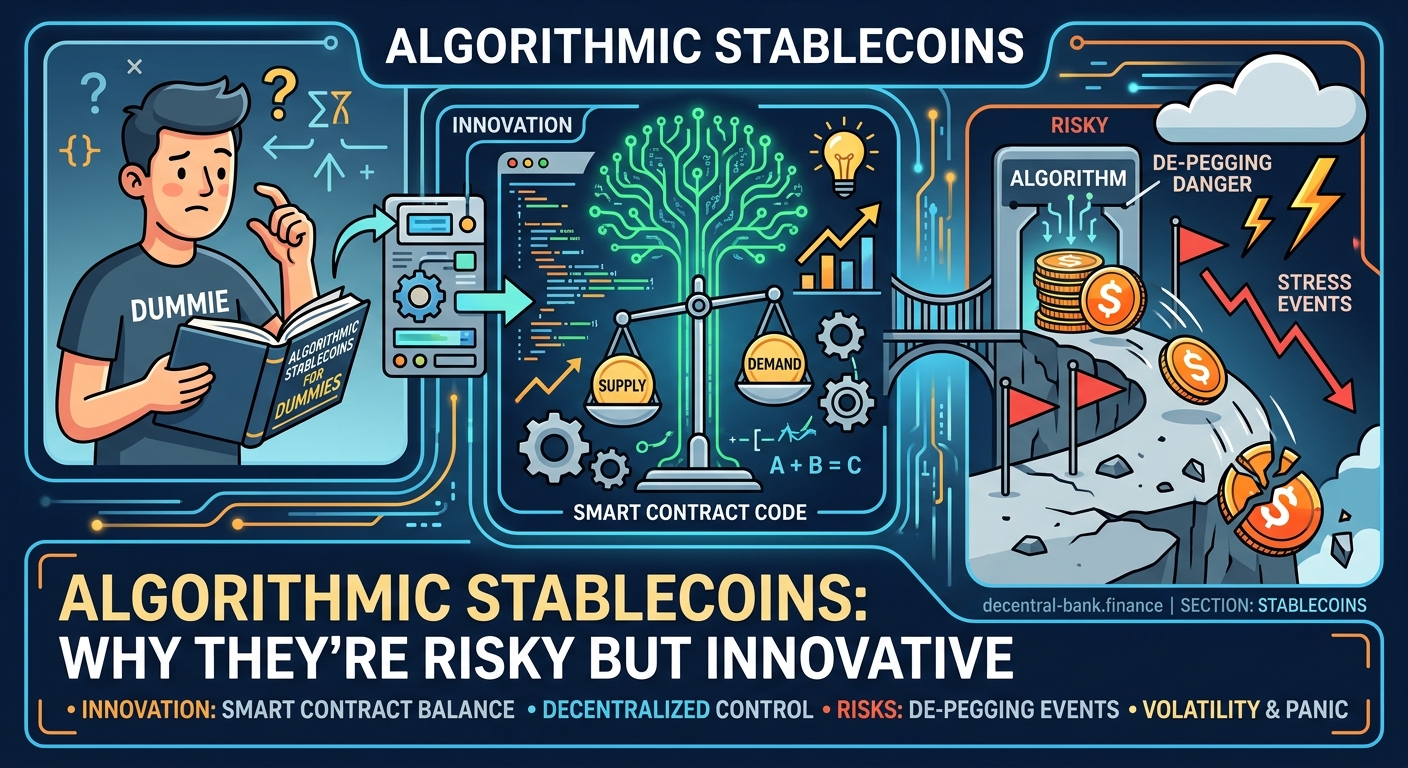
The mechanics vary between protocols, but most algorithmic stablecoins use one of three core mechanisms.
Rebase models automatically adjust your token balance. If the stablecoin trades at $1.10, the protocol mints new tokens directly into every holder’s wallet. Your 100 tokens might become 110 tokens. If it trades at $0.90, your balance shrinks to 90 tokens. The goal is keeping each token worth $1 even as total supply fluctuates.
Seigniorage models use a two-token system. The stablecoin aims for $1, while a secondary token absorbs volatility. When the stablecoin trades above $1, users can buy bonds or secondary tokens at a discount, which they can later redeem for the stablecoin at a profit. This creates selling pressure on the stablecoin. When it trades below $1, the protocol offers incentives to burn stablecoins in exchange for future rewards.
Fractional-algorithmic models combine collateral with algorithmic mechanisms. Part of each stablecoin is backed by crypto collateral like ETH or USDC. The rest relies on algorithmic supply adjustments and a secondary token. As confidence grows, the collateral ratio can decrease. During stress, it increases.
Here’s a comparison of these mechanisms:
| Model Type | Collateral Required | Complexity | Historical Stability |
|---|---|---|---|
| Rebase | None | Low | Poor during volatility |
| Seigniorage | None | High | Extremely fragile |
| Fractional | Partial | Medium | Better but still risky |
Each approach sounds logical in theory. The problem emerges when theory meets market panic.
Why algorithmic stablecoins struggle during market stress
The fatal flaw in most algorithmic stablecoins is their dependence on perpetual growth and confidence.
When the stablecoin trades below $1, the system needs people willing to buy it. They’re betting the price will recover, allowing them to profit from the discount. But if confidence evaporates, nobody wants to catch a falling knife. The algorithmic mechanisms that should restore the peg become useless without willing participants.
This creates a death spiral scenario.
Price drops below $1. The protocol tries to incentivize buying. But if people don’t believe the peg will hold, they won’t buy. More holders panic and sell. Price drops further. The secondary token that’s supposed to absorb volatility collapses because its value depends entirely on the stablecoin’s success. Now both tokens are crashing, and the algorithmic mechanisms accelerate the collapse instead of preventing it.
Terra’s UST provided the most spectacular example in May 2022. UST maintained its peg through an algorithmic relationship with LUNA. When UST dropped below $1, users could burn 1 UST to mint $1 worth of LUNA, creating arbitrage opportunities that should restore the peg.
It worked beautifully during growth. During panic, it failed catastrophically.
As confidence cracked, the arbitrage mechanism meant billions of LUNA flooded the market. LUNA’s price collapsed from $80 to fractions of a cent. UST never recovered its peg. Tens of billions in value evaporated within days. The entire ecosystem imploded.
The fundamental problem with algorithmic stablecoins is they’re stable when you don’t need them to be and unstable exactly when stability matters most. They’re fair-weather friends in a market that regularly experiences storms.
Real examples of algorithmic stablecoins and their outcomes
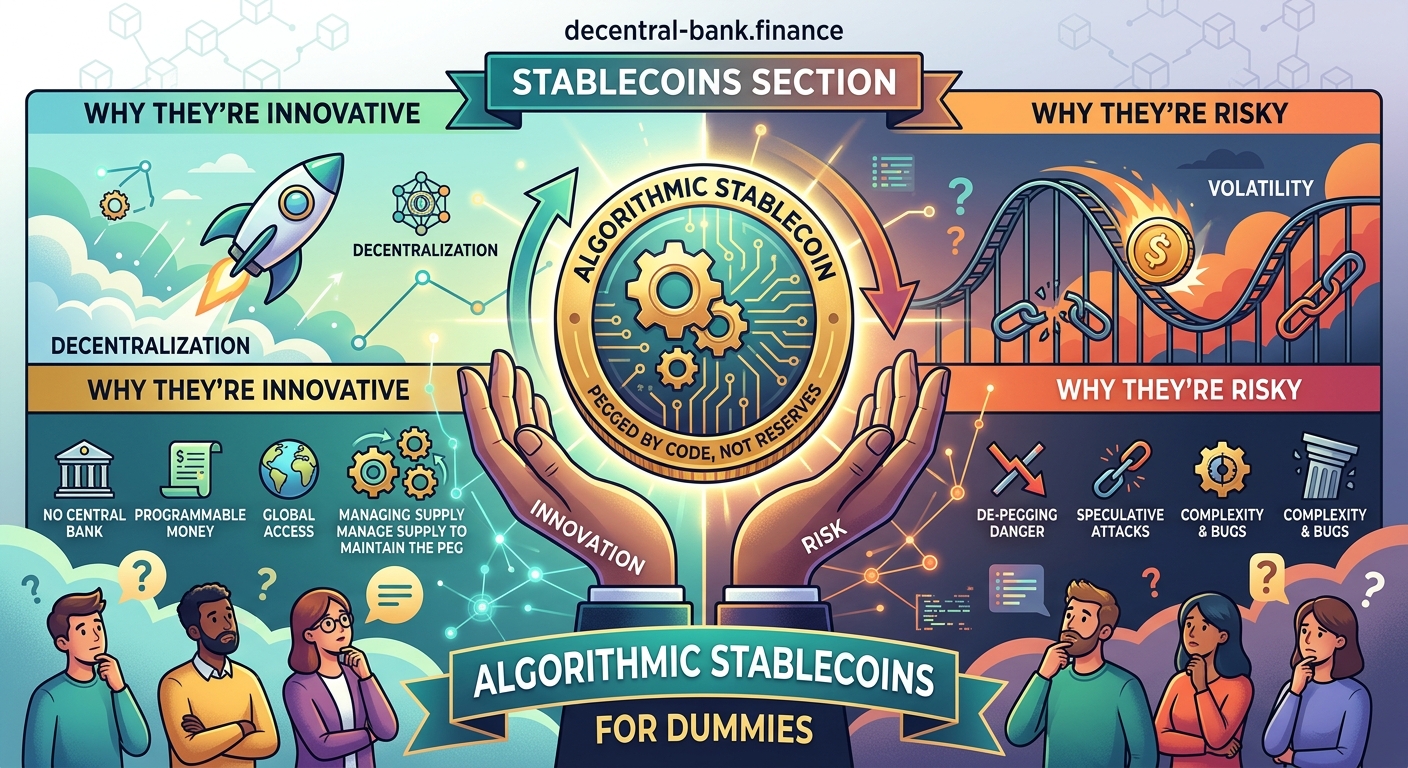
Let’s look at what actually happened with various algorithmic stablecoin experiments.
Ampleforth (AMPL) launched in 2019 as one of the first rebase tokens. Instead of maintaining a strict $1 peg, it targets the 2019 dollar’s purchasing power, adjusting supply daily based on price. It’s survived longer than most algorithmic experiments, but “survived” doesn’t mean “succeeded.” AMPL regularly trades 20-30% away from its target, experiences extreme volatility, and never achieved its goal of becoming a reliable medium of exchange.
Basis Cash attempted a seigniorage model with three tokens. BAC was the stablecoin, BAS was the share token, and BAB were bonds users could buy when BAC traded below $1. The system worked briefly during the 2020-2021 bull market. When crypto cooled, BAC lost its peg permanently. The entire protocol became abandoned, with BAC trading at $0.003 today. Thousands of users lost nearly everything.
Frax took the fractional approach, launching with 100% collateral that could theoretically decrease as confidence grew. Frax survived longer than pure algorithmic experiments by maintaining substantial collateral backing. After the Terra collapse, Frax actually increased its collateral ratio back toward 100%, essentially admitting the algorithmic portion was too risky. Today it functions more like a traditional collateralized stablecoin.
Empty Set Dollar (ESD) and Dynamic Set Dollar (DSD) both attempted variations on seigniorage models. Both lost their pegs. Both communities fragmented. Both tokens trade for pennies today.
The pattern repeats across dozens of failed experiments. Algorithmic stablecoins work during growth phases when confidence is high and people are willing to participate in arbitrage mechanisms. They fail during stress when those same participants flee.
The innovation that algorithmic stablecoins actually represent
Despite their failures, algorithmic stablecoins pushed important boundaries in how DeFi actually works without banks or middlemen.
They proved smart contracts could implement complex monetary policy. They demonstrated that protocols could coordinate user behavior through incentives. They showed that decentralized systems could attempt to maintain price stability without centralized control or traditional reserves.
These weren’t worthless experiments. They generated valuable lessons about mechanism design, game theory, and the limits of algorithmic coordination.
The core insight remains valuable: if you could create a stablecoin without collateral requirements, you’d eliminate many of DeFi’s biggest constraints. No need for over-collateralization like DAI requires. No regulatory concerns about reserve custody. No single points of failure from banking relationships.
The problem isn’t the goal. The problem is that every mechanism tried so far depends on perpetual confidence and growth. When confidence breaks, the mechanisms accelerate collapse instead of preventing it.
Some researchers believe future iterations might solve these problems. Perhaps with better mechanism design, stronger collateral buffers, or integration with other DeFi primitives. But as of 2024, no algorithmic stablecoin has demonstrated reliable stability through multiple market cycles.
Steps to evaluate an algorithmic stablecoin before using it
If you encounter an algorithmic stablecoin project, here’s how to assess its risk:
-
Identify the exact mechanism being used. Is it pure algorithmic, fractional, or something else? The more collateral backing, the lower the algorithmic risk. Pure algorithmic models have the worst track record.
-
Check the collateral ratio if fractional. Projects claiming to be “fractional-algorithmic” should clearly disclose what percentage is backed by real collateral. If that number is below 80%, you’re taking substantial algorithmic risk. If they won’t disclose it, that’s a red flag.
-
Examine the secondary token’s purpose and value. Most algorithmic systems use a secondary token to absorb volatility. Check if that token has value beyond the stablecoin mechanism. If its only utility is maintaining the peg, it’s vulnerable to death spirals. Projects where the secondary token has independent utility (governance, revenue sharing, other functions) are slightly more resilient.
-
Look at historical peg stability. Has the stablecoin maintained its peg through market downturns? Check price charts during crypto crashes. A stablecoin that lost its peg during previous stress will likely lose it again. Understanding what happens when stablecoins lose their peg helps you recognize warning signs.
-
Assess the protocol’s transparency and audits. Have reputable firms audited the smart contracts? Does the team clearly explain mechanics? Are reserves verifiable on-chain? Lack of transparency compounds algorithmic risk. Even with audits, remember that smart contract audits can miss critical bugs.
-
Consider the team and community. Anonymous teams running algorithmic experiments should raise concerns. These projects need strong technical expertise and the credibility to maintain confidence during stress. Deciding whether to trust protocols with anonymous teams involves weighing multiple factors.
-
Never use algorithmic stablecoins for long-term storage. Even the most sophisticated algorithmic designs carry depeg risk. If you interact with these protocols, treat them as experimental and high-risk. Only allocate money you can afford to lose completely.
Common mistakes people make with algorithmic stablecoins
Understanding these errors helps you avoid painful lessons others learned the hard way.
Treating algorithmic stablecoins like traditional stablecoins. The name “stablecoin” creates false confidence. People assume algorithmic stablecoins are as safe as USDC or USDT. They’re not even close. The risk profiles are completely different. Using an algorithmic stablecoin to store your emergency fund or park crypto profits is a recipe for disaster.
Chasing high yields without understanding the mechanism. Algorithmic stablecoin projects often offer 20%, 50%, or even 100%+ APY to attract users. Those yields exist because the protocol desperately needs liquidity to maintain its peg. High yields signal high risk. If you don’t understand exactly how the protocol maintains stability, you shouldn’t chase those returns.
Assuming “this time is different” with new projects. Every new algorithmic stablecoin claims to have solved the problems that killed previous attempts. Better mechanisms. Smarter incentives. More sophisticated game theory. Yet they keep failing for the same fundamental reasons. Skepticism is warranted until a project proves stability through multiple market cycles.
Ignoring warning signs of depeg. When an algorithmic stablecoin starts trading at $0.98, many holders assume it’s a buying opportunity. Sometimes the peg recovers. Sometimes $0.98 becomes $0.95, then $0.85, then $0.50. Recognizing the real risk of stablecoin depegging means knowing when to exit rather than average down.
Failing to diversify stablecoin holdings. Even if you believe in a particular algorithmic stablecoin, concentrating your entire stable holdings in it is dangerous. The Terra collapse wiped out people who had converted their entire portfolios to UST for the Anchor Protocol’s 20% yield. Diversification across multiple stablecoin types (fiat-backed, crypto-collateralized, algorithmic) limits catastrophic loss.
Not understanding the liquidation risks. If you use an algorithmic stablecoin as collateral in lending protocols or liquidity pools, understand what happens if it depegs. Your positions could get liquidated even though you thought you held “stable” assets. The stability you counted on can vanish exactly when you need it most.
Better alternatives for beginners seeking stability
For most people, especially those new to crypto, traditional stablecoins offer better risk-adjusted options.
Fiat-backed stablecoins like USDC and USDT maintain their pegs through actual dollar reserves. They have centralization risks and regulatory exposure, but they’ve maintained stability through multiple market crashes. USDC in particular has strong transparency and regular attestations of reserves.
Crypto-collateralized stablecoins like DAI use over-collateralization to maintain stability. You need to lock up $150 worth of ETH to mint $100 of DAI. This makes them capital-inefficient but much more resilient than algorithmic designs. The collateral provides a real backing that algorithmic models lack.
Yield-bearing stablecoins from established protocols let you earn returns without algorithmic risk. Platforms like Aave and Compound offer interest on USDC deposits. The yields are lower than algorithmic experiments promise, but they’re backed by real lending activity rather than unsustainable token emissions.
For those interested in understanding how different stablecoin types compare, traditional options provide a better starting point. Learn with proven stablecoins before experimenting with algorithmic designs.
If you do want exposure to algorithmic innovations, consider limiting it to 5-10% of your stable holdings. Treat it as venture capital on experimental technology, not as a safe store of value.
Algorithmic stablecoins in the broader DeFi ecosystem
These experiments didn’t happen in isolation. They’re part of DeFi’s broader attempt to recreate financial primitives without traditional infrastructure.
Algorithmic stablecoins connect to multiple DeFi concepts you’ll encounter. They often integrate with liquidity pools that power DeFi protocols, creating additional complexity and risk. They’re used in lending markets, creating potential for cascading failures. They interact with governance tokens that give users control over protocol changes.
Understanding algorithmic stablecoins means understanding how different DeFi pieces connect. When Terra collapsed, it didn’t just affect UST holders. It impacted lending protocols that accepted UST as collateral. It affected liquidity providers in UST pools. It damaged confidence in the entire DeFi ecosystem.
This interconnectedness is both DeFi’s strength and its weakness. Innovations in one area spread quickly to others. But failures also propagate through the system.
The Terra collapse led to important changes across DeFi. Protocols became more cautious about accepting algorithmic stablecoins as collateral. Users became more skeptical of unsustainable yields. Regulators increased scrutiny of algorithmic designs.
These lessons improved the ecosystem even though they came at enormous cost to individuals caught in the collapse.
What current research says about algorithmic stability
Academic researchers and protocol developers continue studying algorithmic stablecoin designs.
Recent work focuses on hybrid models that combine multiple stability mechanisms. Instead of pure algorithmic designs, these approaches layer algorithmic elements on top of partial collateralization, creating multiple lines of defense against depeg events.
Some researchers explore using algorithmic stablecoins not as general-purpose money but for specific use cases where temporary stability matters more than permanent reliability. For example, an algorithmic stablecoin might work for short-term trading pairs even if it’s unsuitable for long-term storage.
Others investigate whether algorithmic mechanisms could work at larger scales. Perhaps the failures we’ve seen reflect insufficient liquidity and adoption rather than fundamental flaws. A stablecoin with hundreds of billions in market cap might have different stability properties than one with hundreds of millions.
The honest answer is nobody knows yet. Every algorithmic stablecoin that’s achieved significant scale has eventually failed. But that doesn’t prove the concept is impossible, only that we haven’t found a design that works reliably.
For users, this means approaching algorithmic stablecoins as ongoing experiments rather than finished products. The technology might mature eventually. But it hasn’t matured yet.
Regulatory perspectives on algorithmic stablecoins
Regulators worldwide are paying close attention to stablecoins, with algorithmic designs receiving particular scrutiny.
The Terra collapse caught regulatory attention because it demonstrated how “stable” assets could rapidly destabilize, affecting millions of users globally. Many jurisdictions are considering or implementing stablecoin regulations that would effectively prohibit pure algorithmic designs.
The European Union’s MiCA framework, for example, requires stablecoins to maintain adequate reserves. This essentially mandates collateralization, making pure algorithmic designs non-compliant. Similar approaches are being discussed in the United States and other major markets.
Some argue these regulations stifle innovation. Others contend they protect users from inherently unstable designs. Regardless of your perspective, the regulatory landscape is shifting toward requiring real backing for assets claiming stability.
This doesn’t necessarily mean algorithmic stablecoins will disappear. They might persist in jurisdictions with lighter regulation or operate in gray areas. But mainstream adoption faces significant regulatory headwinds.
For users, this regulatory uncertainty adds another layer of risk. A protocol that works today might face legal challenges tomorrow, potentially affecting your ability to redeem holdings or creating unexpected tax complications.
Making sense of algorithmic stablecoins as a beginner
If you’re new to crypto, algorithmic stablecoins represent the experimental edge of DeFi. They’re fascinating from a technical perspective. They push boundaries in mechanism design and decentralized coordination. They attempt to solve real problems with creative solutions.
But they’re not suitable for beginners seeking stability.
Start with common DeFi terms every beginner should know and traditional stablecoins before considering algorithmic experiments. Build understanding of how stablecoins maintain their peg during normal conditions before exploring edge cases.
When you do encounter algorithmic stablecoins, approach them with healthy skepticism. Understand the mechanism. Recognize the risks. Only allocate funds you can afford to lose. Treat them as speculative technology experiments, not as safe havens.
The innovation is real. The risks are equally real. Balancing both perspectives helps you navigate this complex corner of DeFi without becoming another cautionary tale.
Should you ever use algorithmic stablecoins
The answer depends entirely on your risk tolerance, understanding, and goals.
For storing value, paying bills, or holding stable assets long-term, algorithmic stablecoins are inappropriate. The depeg risk is too high. Traditional alternatives exist with much better safety profiles.
For short-term trading, arbitrage opportunities, or experimental DeFi strategies, algorithmic stablecoins might make sense if you deeply understand the mechanisms and actively monitor your positions. Some traders profit from the volatility and arbitrage opportunities these protocols create.
For learning about DeFi mechanism design and monetary experiments, algorithmic stablecoins offer fascinating case studies. Reading about how they work, studying their failures, and understanding their innovations builds valuable knowledge. Just do your learning with small amounts or paper trading rather than serious capital.
The key is matching your use to the actual risk profile rather than the implied safety of the word “stablecoin.”
Most people overestimate algorithmic stablecoin safety and underestimate traditional stablecoin reliability. Correcting that perspective prevents costly mistakes.
Why algorithmic stablecoins keep attracting builders despite failures
Given the track record of failures, why do developers keep building algorithmic stablecoins?
The potential upside is enormous. A truly decentralized, scalable, capital-efficient stablecoin would be revolutionary. It would enable DeFi to scale beyond current limitations. It would eliminate dependence on centralized stablecoin issuers. It would prove that decentralized coordination can replicate complex financial primitives.
That vision attracts talented builders despite the risks. Each team believes they’ve identified the flaw in previous designs and created a mechanism that will succeed where others failed.
Sometimes innovation requires many failures before success. Aviation had decades of failed experiments before the Wright brothers succeeded. Early internet companies crashed spectacularly before the web transformed society.
Maybe algorithmic stablecoins will follow a similar path. Maybe they’re fundamentally flawed. Time will tell.
For users, the lesson is simple: let others do the experimenting with serious capital until someone proves the concept actually works. Being an early adopter of unproven technology can be expensive.
Recognizing when algorithmic experiments become too risky
Certain warning signs indicate an algorithmic stablecoin is heading toward failure.
Persistent trading below peg. If the stablecoin consistently trades at $0.95-0.98 instead of $1.00, the algorithmic mechanisms aren’t working. Small deviations are normal. Persistent ones signal problems.
Declining secondary token price. In two-token systems, the secondary token’s health indicates overall system confidence. If it’s dropping while the stablecoin holds its peg, the system is absorbing stress that might soon overwhelm it.
Decreasing liquidity. If trading volume drops and liquidity pools shrink, fewer participants believe in the mechanism. Reduced liquidity makes the stablecoin more vulnerable to manipulation and death spirals.
Team communication changes. When developers stop providing updates, avoid questions about mechanism performance, or suddenly pivot to new projects, confidence is eroding from the inside.
Unsustainable yield reductions. If a protocol offered 50% APY and suddenly drops to 10%, it’s likely struggling to maintain incentives. This often precedes broader problems.
Recognizing these signs early lets you exit before catastrophic failure. The challenge is distinguishing normal market stress from terminal problems. When in doubt, reducing exposure is safer than hoping for recovery.
Learning from algorithmic stablecoins without losing money
You can gain the educational value of algorithmic stablecoins without taking financial risk.
Read post-mortems of failed projects. The Terra collapse generated extensive analysis explaining exactly what went wrong. These write-ups teach mechanism design lessons without costing you anything.
Follow current projects from a distance. Watch how they respond to market stress. Observe whether their mechanisms work as claimed. Learn from others’ experiences rather than your own losses.
Use testnets and paper trading. Many protocols offer testnet versions where you can interact with mechanisms using worthless test tokens. This lets you understand the user experience and mechanics without real risk.
Engage with the research community. Academic papers on algorithmic stablecoins explore theoretical properties and failure modes. Reading this research builds understanding of why certain designs work or fail.
Start with traditional stablecoins and proven DeFi protocols. Master the basics before experimenting with cutting-edge designs. Setting up your first DeFi wallet properly and understanding basic security practices matters more than chasing innovation.
If you do allocate money to algorithmic experiments, treat it as tuition for an expensive education. You’re paying to learn, not investing for returns. That mindset prevents disappointment and encourages thoughtful risk management.
Where algorithmic stablecoins fit in your DeFi journey
Think of algorithmic stablecoins as advanced territory on the DeFi map. They’re not where beginners should start, but they’re worth understanding as you gain experience.
Your DeFi journey might look like this:
- Learn basic concepts and set up secure wallets
- Use established stablecoins like USDC for your first transactions
- Try simple DeFi activities like providing liquidity on Uniswap or lending on established platforms
- Understand more complex concepts like impermanent loss and liquidation mechanics
- Explore different stablecoin types and their trade-offs
- Only then consider algorithmic experiments with money you can afford to lose
This progression builds knowledge and experience before exposing you to higher-risk innovations. Each step teaches lessons that prepare you for the next.
Rushing into algorithmic stablecoins without this foundation is like trying to run before you can walk. The complexity and risks are too high for beginners to navigate safely.
The future of algorithmic stablecoins remains uncertain
Nobody knows whether algorithmic stablecoins will eventually succeed or remain a footnote in crypto history.
Optimists point to continuous innovation and learning from failures. Each generation of projects incorporates lessons from previous collapses. Perhaps the next iteration will finally crack the code.
Pessimists argue the fundamental problem is unsolvable. Maintaining stability without backing requires perpetual confidence and growth. But markets cycle. Confidence breaks. When it does, algorithmic mechanisms accelerate collapse rather than preventing it.
Realists acknowledge both possibilities while emphasizing that no algorithmic design has yet proven reliable. Until one does, treating them as high-risk experiments rather than safe stablecoins is prudent.
The debate continues among researchers, developers, and users. Meanwhile, billions in venture capital and developer time continue flowing into new algorithmic experiments.
For you as a user, the uncertainty means staying informed, remaining skeptical, and prioritizing safety over innovation. Let the experiments continue. Learn from them. But protect your capital by using proven alternatives until someone demonstrates algorithmic stability actually works.
Building your understanding without taking unnecessary risks
Algorithmic stablecoins represent some of DeFi’s most ambitious experiments. They attempt to solve real problems through innovative mechanisms. They push the boundaries of what’s possible with smart contracts and decentralized coordination.
They also have a track record of spectacular failures that destroyed billions in value.
Understanding how they work, why they fail, and what they’re trying to achieve makes you a more informed DeFi participant. That knowledge helps you evaluate new projects, recognize risks, and make better decisions about where to allocate your capital.
But understanding doesn’t require participation. You can learn about algorithmic stablecoins while keeping your money in safer alternatives. You can follow the innovation without funding the experiments.
As you continue exploring DeFi, you’ll encounter algorithmic stablecoins in various contexts. Projects will promise revolutionary new mechanisms. Yields will tempt you. FOMO will whisper that you’re missing opportunities.
Remember what history has shown. Approach with caution. Prioritize safety. And never risk more than you can afford to lose on experimental technology that hasn’t proven itself through multiple market cycles.
The future might bring algorithmic stablecoins that actually work reliably. Until then, traditional stablecoins offer the stability most people actually need.