
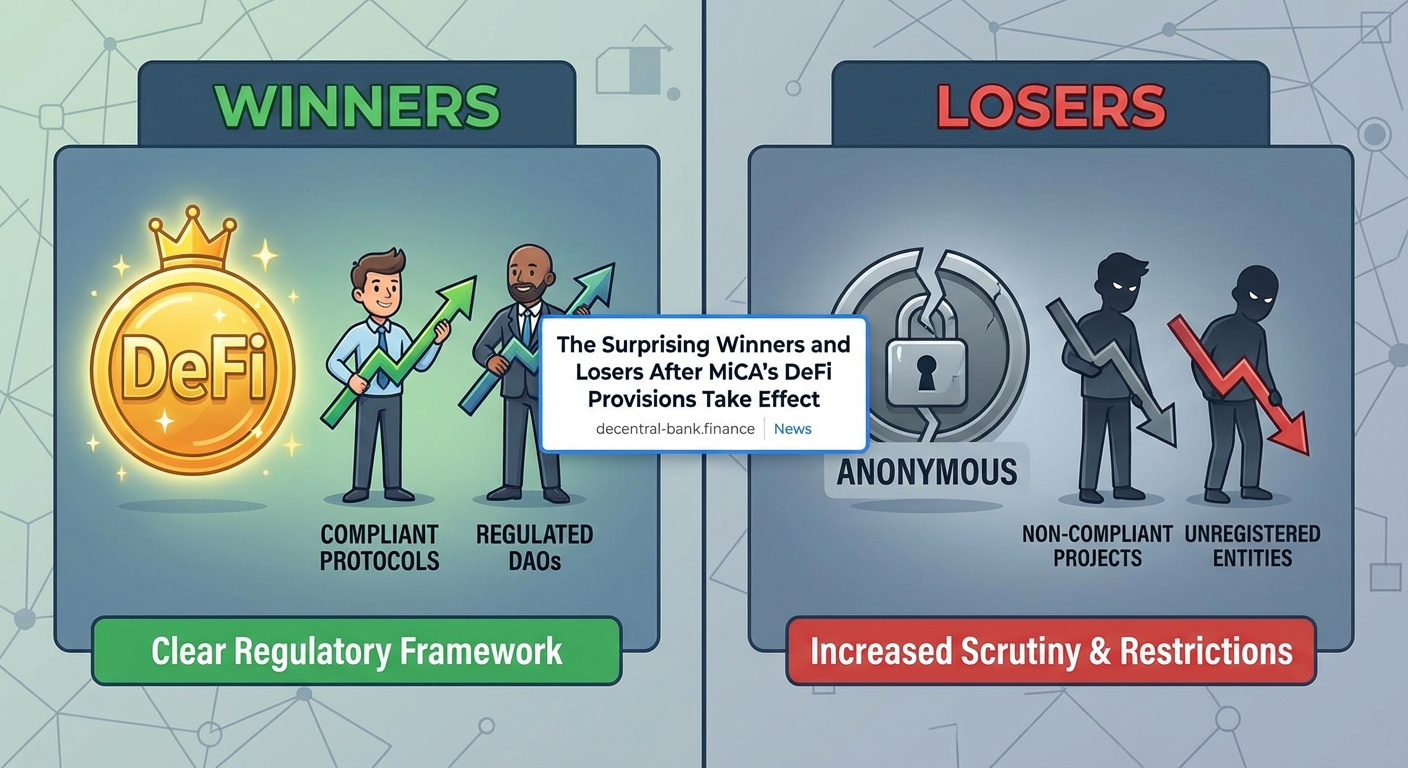
Europe’s Markets in Crypto-Assets regulation changed everything for digital asset markets in 2024 and 2025. Some projects soared. Others vanished overnight. The difference often came down to a single choice: adapt or exit.
MiCA regulations created clear winners like Circle’s EURC and compliant exchanges such as Coinbase, while forcing Tether and privacy-focused protocols to retreat from European markets. Stablecoin issuers with transparent reserves and centralized exchanges with robust KYC infrastructure gained massive market share, but [decentralized protocols](https://decentral-bank.finance/how-does-defi-actually-work-without-banks-or-middlemen/) face ongoing uncertainty about their regulatory status. Understanding these shifts helps investors and builders position themselves for Europe’s regulated crypto future.
The compliance divide reshaping European crypto markets
MiCA created two distinct camps in European crypto markets. On one side sit regulated entities with banking partnerships, legal teams, and compliance budgets. On the other stand projects built on decentralization principles that resist traditional oversight.
The gap between these groups widens every month.
Centralized stablecoins like USDC and EURC now dominate European trading pairs. Circle’s euro-denominated stablecoin grew from nearly zero to over €290 million in circulation within months of MiCA’s full implementation. That growth came directly from Tether’s forced exit from major European exchanges.
Meanwhile, algorithmic stablecoins and yield-bearing tokens face existential questions. Regulators haven’t banned them outright, but the legal uncertainty makes most platforms hesitant to list them for European users.
Stablecoins that won the regulatory race

Circle emerged as MiCA’s biggest stablecoin winner. The company prepared for years, building relationships with European regulators and establishing the reserve transparency MiCA demands.
USDC already had monthly attestations and a clear backing mechanism. Adding MiCA compliance required relatively minor adjustments. The payoff was massive. As Tether exited major European platforms, USDC trading pairs became the default for euro-area traders.
EURC’s launch timing proved perfect. European traders wanted a euro-denominated stablecoin that matched their regulatory environment. Circle delivered exactly that product at exactly the right moment.
Ripple’s RLUSD joined the compliant stablecoin tier in late 2025. The company learned from Circle’s playbook, launching with full regulatory alignment from day one. Institutional adoption followed within weeks.
Here’s how the compliant stablecoins stack up:
| Stablecoin | Issuer | Reserve Type | MiCA Status | Primary Use Case |
|---|---|---|---|---|
| USDC | Circle | Cash and short-term treasuries | Fully compliant | Trading pairs, DeFi collateral |
| EURC | Circle | Euro cash and equivalents | Fully compliant | European payments, euro trading |
| RLUSD | Ripple | USD cash reserves | Fully compliant | Cross-border payments, institutional |
These three captured nearly all the market share that Tether left behind in Europe.
The Tether retreat and what it means
Tether’s delisting from major European exchanges marked MiCA’s most visible impact. Binance, Kraken, and other platforms removed USDT trading pairs for European users throughout 2024 and early 2025.
Tether didn’t collapse. It simply moved focus to markets outside MiCA’s jurisdiction. Trading volumes in Asia, Latin America, and parts of Africa remained strong.
But European traders lost access to crypto’s most liquid stablecoin. That forced a rapid migration to USDC and EURC. Some traders switched willingly. Others had no choice when their preferred platforms delisted USDT.
The transition created temporary liquidity issues. Certain trading pairs saw wider spreads for several months. Arbitrage opportunities emerged and disappeared as markets adjusted to the new stablecoin landscape.
Privacy-focused stablecoins faced even harsher treatment. Projects that couldn’t or wouldn’t implement full KYC found themselves completely shut out of European markets.
Centralized exchanges that thrived under new rules
Coinbase entered MiCA compliance with advantages most competitors lacked. The company already operated under strict U.S. regulations. Adding European requirements felt like incremental work rather than a fundamental shift.
The exchange secured multiple European licenses ahead of MiCA deadlines. That preparation paid off when smaller competitors struggled to meet compliance costs and timelines.
Kraken followed a similar path. Years of regulatory experience in the U.S. and other jurisdictions prepared the platform for MiCA’s demands. The exchange maintained its European market share and even grew in some segments.
Binance faced a rockier transition. Regulatory scrutiny in multiple jurisdictions complicated the platform’s MiCA compliance efforts. But Binance’s resources and market position allowed it to weather the storm and maintain European operations.
Smaller exchanges without deep compliance expertise or significant capital reserves simply exited European markets. The cost of MiCA compliance exceeded their potential European revenue.
“MiCA didn’t kill European crypto. It killed undercapitalized crypto businesses that couldn’t afford compliance. The survivors are stronger, but there are fewer of them.” — European crypto legal expert
DeFi protocols caught in regulatory limbo
Decentralized finance protocols occupy MiCA’s gray zone. The regulation primarily targets centralized entities, but DeFi’s boundaries blur traditional definitions.
Uniswap, Aave, and other major protocols continue operating in Europe. But frontend interfaces increasingly implement geographic restrictions. European users can still access smart contracts directly, but user-friendly interfaces often block them.
This creates a two-tier system. Technically sophisticated users maintain full DeFi access. Less experienced traders find themselves pushed toward regulated centralized platforms.
Some protocols launched compliant frontends specifically for European users. These versions implement KYC checks and transaction limits. They sacrifice decentralization for regulatory clarity.
Other projects chose different paths. They blocked European IP addresses entirely, avoiding MiCA’s requirements by excluding European users from their primary interfaces.
The long-term impact remains uncertain. MiCA’s DeFi provisions continue evolving as regulators observe how protocols respond to initial guidance.
Token classifications that created winners and losers
MiCA’s distinction between utility tokens and security tokens reshaped project strategies. Understanding these classifications became essential for European crypto projects.
Tokens clearly classified as utilities faced lighter regulatory burdens. Projects with governance-only tokens or protocol fee tokens often qualified for simplified compliance paths.
Tokens offering profit-sharing, staking rewards, or other investment-like features triggered security token requirements. Those requirements brought heavy compliance costs and ongoing reporting obligations.
Some projects restructured their tokenomics to avoid security classification. They removed yield features, changed governance structures, or split functionality across multiple tokens.
Others embraced security token status. They viewed regulatory compliance as a competitive advantage that would attract institutional investors wary of legal uncertainty.
Privacy coins and the compliance impossibility
Monero, Zcash, and other privacy-focused cryptocurrencies faced MiCA’s harshest impact. The regulation’s anti-money laundering provisions effectively banned these assets from regulated European exchanges.
Privacy coins can’t provide the transaction transparency MiCA requires. Their core technology directly conflicts with regulatory demands for traceable transactions and identifiable users.
Major exchanges delisted privacy coins for European users. Some platforms removed them entirely to avoid regulatory complications.
Privacy coin advocates argue these delistings harm financial freedom. Regulators counter that anonymous transactions enable illicit activity that MiCA aims to prevent.
The practical result is clear. European traders lost easy access to privacy-focused cryptocurrencies. Trading moved to decentralized platforms, peer-to-peer networks, and non-European exchanges.
How to position yourself in the post-MiCA landscape
Investors and builders need strategies that account for Europe’s new regulatory reality. Here’s a practical framework:
-
Prioritize assets with clear regulatory status. Compliant stablecoins and tokens with established classifications carry less regulatory risk than projects in legal gray areas.
-
Verify exchange compliance before depositing funds. Check whether your platform holds necessary European licenses and follows MiCA requirements for secure custody.
-
Understand geographic restrictions on DeFi protocols. Some interfaces block European users while others implement compliant versions with different features.
-
Monitor ongoing regulatory developments. MiCA continues evolving as regulators issue guidance on previously unclear areas like DeFi and NFTs.
-
Diversify across jurisdictions if possible. Don’t concentrate all holdings on European platforms if you might need access to assets MiCA restricts.
Staking and yield products under regulatory pressure
Crypto staking services face complex MiCA implications. Centralized staking platforms must classify their services and follow corresponding regulations.
Some staking products qualify as securities under MiCA. Others fall into different regulatory categories depending on their specific structure. The classification determines compliance requirements and operational constraints.
Yield-bearing stablecoins triggered particular regulatory scrutiny. Products that promised stable value plus yield often couldn’t satisfy both promises under stress. MiCA’s stability requirements forced many yield stablecoins to restructure or exit European markets.
Ethena’s USDe experienced volatility that raised regulatory concerns. The protocol’s delta-neutral strategy worked in stable markets but showed weakness during volatility spikes. European regulators questioned whether such products should market themselves as “stable” coins.
Several smaller yield protocols collapsed entirely in 2025. Elixir’s deUSD represented the most dramatic failure, losing its peg and wiping out user funds. These incidents reinforced regulators’ skepticism toward complex yield mechanisms.
The compliance checklist for crypto projects targeting Europe
Projects planning European operations need systematic compliance approaches:
- Determine your token classification under MiCA definitions
- Establish legal entities in MiCA-compliant jurisdictions
- Implement KYC and AML procedures meeting regulatory standards
- Create transparent reserve reporting for stablecoin projects
- Develop incident response plans for technical failures or market stress
- Build relationships with European regulators before launching
- Budget for ongoing compliance costs and legal reviews
The upfront investment is substantial. But projects that skip these steps find themselves locked out of European markets or facing enforcement actions.
What MiCA means for DeFi lending and borrowing
Decentralized lending protocols operate in MiCA’s most uncertain territory. These platforms facilitate financial services without traditional intermediaries, creating regulatory classification challenges.
Aave and Compound continue serving European users, but both protocols implemented geographic restrictions on certain features. High-risk lending pairs disappeared for European traders. Leverage limits appeared where none existed before.
Some lending platforms added compliant frontends with identity verification. Users prove their identity and jurisdiction, then access lending services within regulatory guardrails.
Other protocols maintained permissionless access but blocked European IP addresses from primary interfaces. This approach preserves decentralization while attempting to avoid MiCA’s direct application.
The regulatory uncertainty creates risks for European DeFi users. Platforms might suddenly restrict access. Smart contracts could freeze funds if developers face regulatory pressure. Insurance options remain limited.
Liquidity provision and the new European DeFi landscape
Providing liquidity on decentralized exchanges became more complex for European users under MiCA. Platforms implementing geographic restrictions sometimes exclude Europeans from liquidity mining programs.
Rewards structures changed to avoid security token classifications. Simple liquidity mining with token rewards might trigger regulatory requirements that pure trading fee sharing avoids.
Liquidity fragmented across compliant and non-compliant interfaces. European traders found deeper liquidity on regulated platforms for major pairs. Exotic pairs and new tokens remained primarily accessible through unrestricted DeFi protocols.
This fragmentation increased costs for European DeFi users. Wider spreads, higher slippage, and reduced arbitrage efficiency became the price of regulatory compliance.
Stablecoin backing mechanisms that passed regulatory scrutiny
MiCA established clear standards for stablecoin reserve management. Compliant issuers needed transparent, liquid reserves matching their outstanding token supply.
Fiat-backed stablecoins with simple reserve structures adapted most easily. Circle’s cash and treasury approach met MiCA requirements with minimal changes.
Algorithmic stablecoins faced existential challenges. Most couldn’t demonstrate the stability and reserve backing MiCA demands. Several exited European markets rather than attempting compliance.
Crypto-collateralized stablecoins occupied middle ground. DAI’s overcollateralized model provided some stability assurance, but complex collateral baskets raised regulatory questions about risk management and transparency.
Yield-generating reserves triggered additional scrutiny. Stablecoins investing reserves in DeFi protocols or other yield strategies had to prove those investments didn’t compromise stability or redemption ability.
Red flags that predict non-compliance problems
Investors can spot projects likely to struggle with MiCA compliance:
- Opaque reserve management or refusal to provide regular attestations
- Anonymous teams without established legal entities
- Token structures offering guaranteed returns or profit-sharing
- Privacy features that prevent transaction tracing
- Yield mechanisms dependent on continuous new user growth
- Governance structures that can’t clearly identify responsible parties
- Marketing that promises both perfect stability and high yields
Projects displaying multiple red flags face high odds of European market exclusion. Protecting yourself from problematic projects requires recognizing these warning signs early.
The institutional advantage in regulated markets
Traditional financial institutions gained competitive advantages under MiCA. Banks and asset managers already possessed compliance infrastructure, regulatory relationships, and legal expertise.
Several major banks launched crypto custody services specifically targeting MiCA-compliant institutional clients. They offered regulatory certainty that pure crypto companies struggled to match.
Asset managers created crypto investment products meeting MiCA’s investor protection standards. These products attracted conservative investors who avoided crypto due to regulatory uncertainty.
The institutional influx brought capital and legitimacy. But it also shifted crypto’s culture toward traditional finance norms. Permissionless innovation became harder as compliance costs favored established players.
Geographic arbitrage and the regulatory fragmentation problem
MiCA created sharp regulatory boundaries within global crypto markets. Projects compliant in Europe might face restrictions in other jurisdictions. Assets banned in Europe often trade freely elsewhere.
This fragmentation enabled geographic arbitrage. Traders in non-MiCA jurisdictions accessed products European traders couldn’t. Price differences emerged between European and global markets for certain assets.
VPN usage increased among European crypto users seeking access to restricted platforms. This behavior creates legal gray areas and enforcement challenges for regulators.
Some projects established multiple entities to serve different regulatory zones. A European subsidiary handled MiCA compliance while offshore entities served users in other jurisdictions.
Building for the next phase of European crypto regulation
Major DeFi protocols adapted their strategies as MiCA’s implementation progressed. Smart projects recognized that regulation would expand rather than contract.
Forward-thinking teams built compliance features into core protocols. They created modular designs allowing compliant frontends while preserving permissionless smart contract access.
Others focused on regulatory engagement. They participated in policy discussions, provided technical education to regulators, and helped shape implementation guidance.
The most successful projects balanced regulatory compliance with crypto’s core values. They found ways to meet legal requirements without completely abandoning decentralization and permissionless access.
Why regulatory clarity beats regulatory absence
MiCA’s implementation revealed an unexpected truth. Clear regulations, even strict ones, often benefit markets more than regulatory uncertainty.
Projects knowing exactly what compliance requires can build accordingly. Investors understanding legal protections feel more confident deploying capital. Institutions enter markets with defined rules even if those rules impose costs.
The alternative is regulatory limbo where projects guess at requirements and face unpredictable enforcement. That uncertainty kills innovation more effectively than clear restrictions.
European crypto markets in 2025 showed more institutional participation, greater liquidity in compliant assets, and fewer outright scams than in previous years. The compliance costs were real, but so were the benefits.
Your strategic position in Europe’s regulated crypto future
MiCA separated crypto’s future into distinct paths. Compliant projects with institutional backing, regulatory expertise, and significant capital will dominate European markets. They’ll offer safer but more restricted products to verified users.
Permissionless protocols will continue operating but with reduced European access. Sophisticated users will maintain connections through various means. Mainstream adoption will concentrate in regulated channels.
Your position depends on your priorities. Maximum regulatory protection points toward compliant centralized platforms and approved tokens. Maximum freedom and privacy requires accepting higher risks and working around geographic restrictions.
The middle path involves using compliant platforms for significant holdings while maintaining limited exposure to permissionless protocols for specific use cases. This balanced approach captures regulatory protection where it matters most while preserving access to crypto’s innovative edge.
Europe’s regulatory framework will influence global crypto development for years. Understanding the winners and losers under MiCA helps you position yourself strategically as other jurisdictions follow similar paths. The compliance divide isn’t temporary. It’s the new structure of crypto markets worldwide.