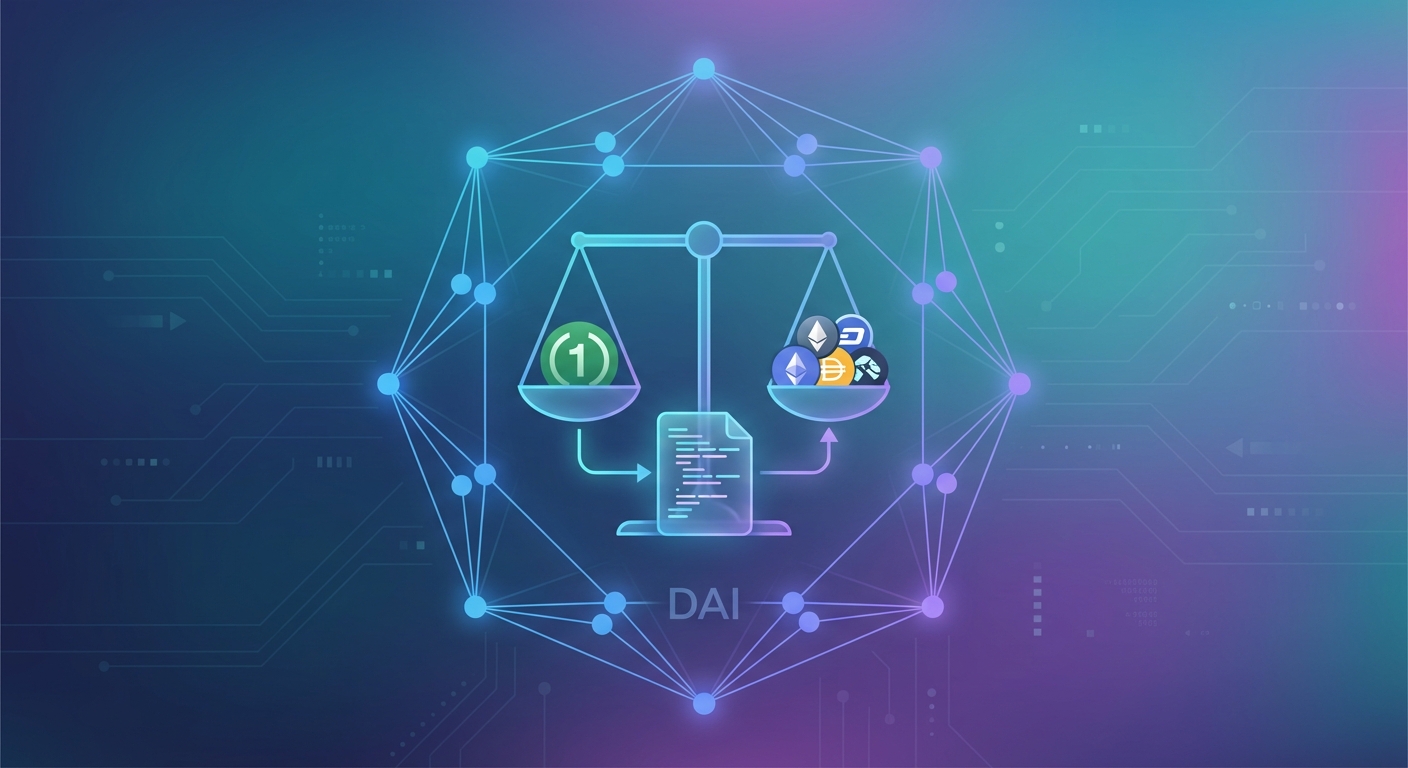
DAI is a stablecoin that stays pegged to $1 without any company holding dollars in a vault. No bank account backs it. No single entity controls it. Instead, DAI relies on smart contracts, overcollateralization, and a decentralized governance system to maintain stability. If you’ve wondered how a digital dollar can exist without a central authority holding the actual dollars, you’re about to find out.
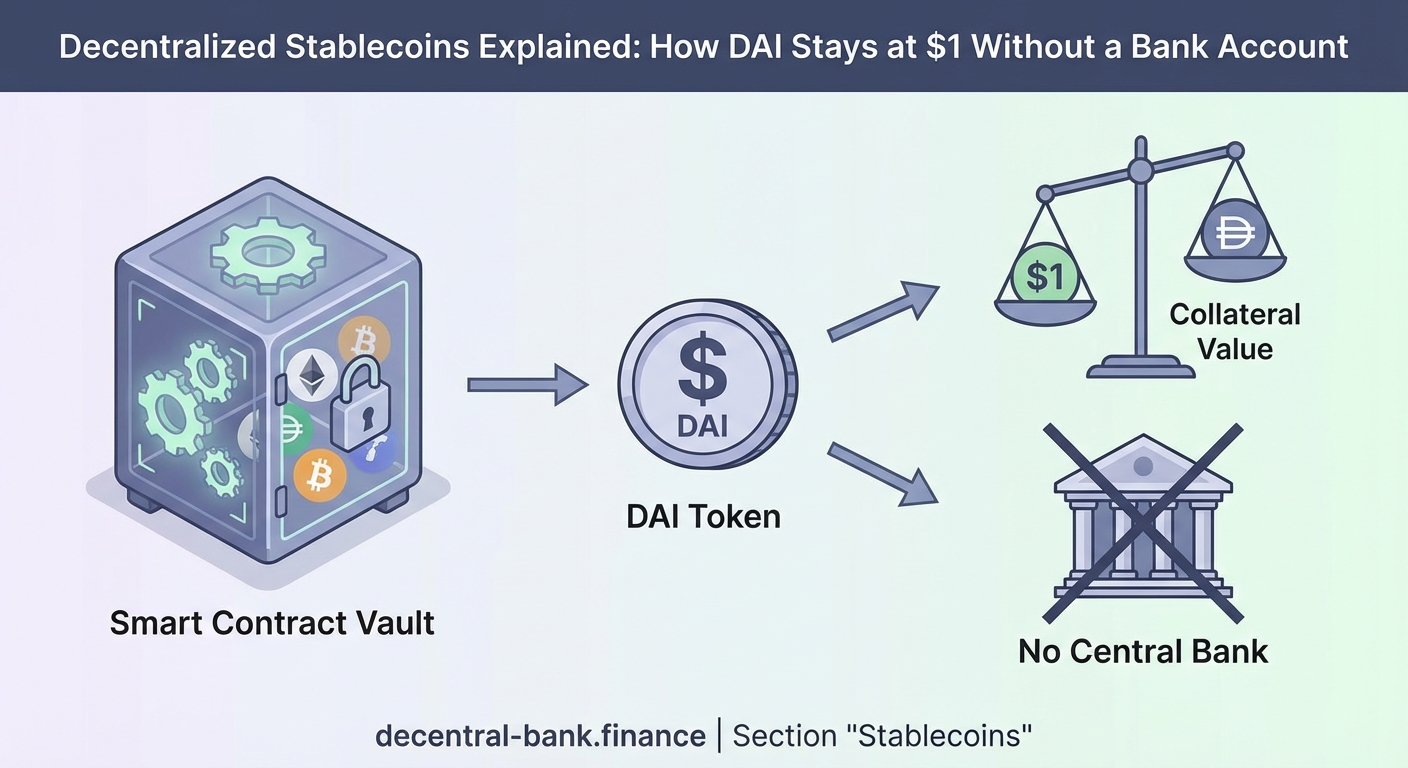
DAI maintains its $1 peg through overcollateralized crypto deposits locked in smart contracts. Users deposit assets worth more than the DAI they mint, creating a buffer against price swings. Automated liquidations and economic incentives keep the system stable without banks, companies, or centralized control. DAI represents a fundamentally different approach to stablecoins built on transparency and code.
What Makes DAI Different from Regular Stablecoins
Most stablecoins work like digital IOUs. USDC and Tether claim to hold one dollar in a bank for every token issued. You trust the company. You trust their audits. You trust they won’t freeze your funds.
DAI flips this model completely.
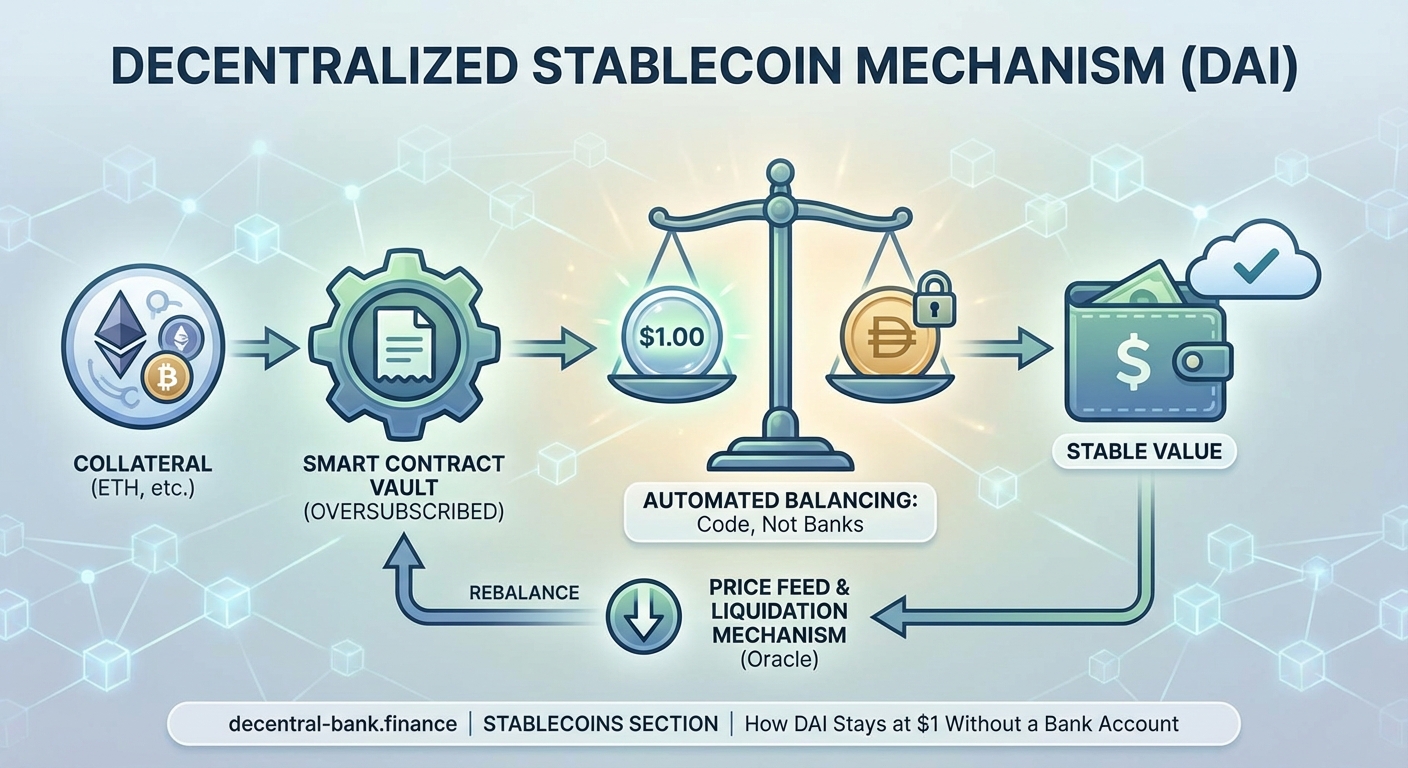
DAI is minted when you lock cryptocurrency into a smart contract called a Vault (previously called a CDP or Collateralized Debt Position). The smart contract holds your crypto. You receive DAI in return. No company decides if you qualify. No bank processes your request.
The entire system runs on Ethereum through the MakerDAO protocol. Everything is visible on the blockchain. Every Vault. Every liquidation. Every governance vote.
This transparency matters because you can verify the collateral backing DAI at any moment. You don’t need to trust quarterly reports or hope an auditor did their job properly.
How DAI Gets Created Through Vaults
Creating DAI follows a specific process that anyone can execute. Here’s exactly how it works:
-
You open a Vault on the MakerDAO platform. Think of this as a secure deposit box that only smart contracts can access.
-
You deposit cryptocurrency as collateral. ETH is the most common choice, but MakerDAO accepts other approved assets like wrapped Bitcoin, staked ETH, and certain stablecoins.
-
You generate DAI against your collateral. The system requires you to deposit significantly more value than you withdraw. If you want 1,000 DAI, you might need to lock up $1,500 worth of ETH at a minimum collateralization ratio of 150%.
This overcollateralization creates a safety cushion. When ETH drops 20%, your Vault still has enough value to back the DAI you created. The extra collateral absorbs price volatility.
The process resembles how to borrow crypto without selling your assets, except you’re minting a new stablecoin rather than borrowing existing tokens.
Why Overcollateralization Keeps the Peg Stable
The math behind DAI’s stability is straightforward but powerful.
Let’s say you deposit $2,000 worth of ETH and mint 1,000 DAI. Your collateralization ratio is 200%. If ETH drops 25%, your collateral is now worth $1,500. Your ratio falls to 150%, which is still above the minimum for most Vault types.
But if ETH keeps dropping, you hit dangerous territory. When your collateralization ratio falls below the liquidation threshold (typically around 145% to 150% depending on the collateral type), the system automatically sells your collateral to buy back and burn the DAI you created.
This automatic liquidation mechanism protects the entire system. It ensures that DAI always has sufficient backing, even during market crashes.
The beauty of DAI is that trust shifts from institutions to mathematics. You don’t need to believe a company’s promises. You verify the collateral ratios yourself and trust that code executes as written.
Liquidations happen through a decentralized auction process. Keepers (specialized bots and participants) bid to purchase the liquidated collateral at a discount. They pay DAI to acquire the collateral, and that DAI gets burned, removing it from circulation.
The Stability Fee and DAI Savings Rate
MakerDAO uses two primary interest rate mechanisms to balance DAI supply and demand.
The Stability Fee is what you pay to mint DAI. It’s an annual percentage rate charged on your outstanding DAI debt. If you generate 1,000 DAI with a 2% stability fee, you’ll owe roughly 20 DAI in interest over a year.
When DAI trades below $1, MakerDAO governance can increase the stability fee. Higher borrowing costs make creating new DAI less attractive. Supply decreases. The price moves back toward $1.
The DAI Savings Rate (DSR) works in the opposite direction. Anyone holding DAI can lock it in a special contract and earn interest. When DAI trades above $1, MakerDAO can increase the DSR. This makes holding DAI more attractive. Demand increases. The price moves back toward $1.
These two levers create a dynamic balancing system. Neither requires human intervention once governance sets the rates. The market responds automatically to the incentives.
How MKR Token Holders Govern the System
DAI isn’t controlled by a CEO or board of directors. MKR token holders make all major decisions through on-chain voting.
They decide which cryptocurrencies can be used as collateral. They set the collateralization ratios for each asset type. They adjust stability fees and the DSR. They determine liquidation penalties.
This governance model distributes power across thousands of token holders rather than concentrating it in a single entity. It’s a core feature of how does DeFi actually work without banks or middlemen.
MKR holders also bear the ultimate risk. If the system becomes undercollateralized (collateral value falls below outstanding DAI), new MKR gets minted and sold to cover the shortfall. This dilutes existing MKR holders.
This mechanism aligns incentives powerfully. MKR holders are motivated to make conservative decisions about collateral types and ratios because they suffer direct financial consequences from system failures.
What Happens During Extreme Market Crashes
DAI faced its biggest test during the March 2020 crypto crash. ETH dropped over 50% in a single day. The system experienced significant stress.
Some Vaults became undercollateralized faster than liquidation auctions could process them. Network congestion on Ethereum made the situation worse. Gas fees spiked. Some auctions completed with zero bids, allowing keepers to acquire collateral for free while leaving the system with bad debt.
MakerDAO responded by introducing several improvements:
- Adding USDC as collateral to provide stability during crypto volatility
- Implementing auction improvements to prevent zero-bid scenarios
- Raising the DAI Savings Rate to attract more holders
- Eventually clearing the bad debt through new MKR auctions
The system survived, but the event revealed important limitations. Pure crypto-collateralized stablecoins face extreme challenges during synchronized market crashes.
Today, DAI’s collateral includes a mix of crypto assets and real-world assets. This diversification reduces reliance on crypto prices alone, though it also introduces some centralization that early DAI avoided.
DAI Compared to Other Stablecoin Approaches
Different stablecoins solve the pegging problem through different mechanisms. Understanding these differences helps you assess risks.
| Stablecoin Type | How It Maintains $1 | Main Risk | Example |
|---|---|---|---|
| Fiat-backed | Company holds dollars in bank | Centralization, freezing, trust | USDC, Tether |
| Crypto-collateralized | Overcollateralization + liquidations | Crypto volatility, complexity | DAI |
| Algorithmic | Supply adjustments through incentives | Death spirals, lost confidence | UST (failed) |
| Hybrid | Mix of collateral types | Varies by implementation | FRAX |
DAI sits in the crypto-collateralized category, though recent governance decisions have added some fiat-backed elements through USDC collateral and real-world assets.
The tradeoff is clear. Pure decentralization requires accepting crypto volatility risk and complexity. Adding stable collateral like USDC reduces volatility risk but reintroduces some centralization.
Neither approach is universally better. Your preference depends on which risks you’re more comfortable accepting.
For context on how stablecoins generally maintain their peg across different market conditions, how do stablecoins maintain their $1 peg during market crashes provides broader perspective.
Common Mistakes When Using DAI Vaults
People new to DAI often make predictable errors that lead to unnecessary liquidations or losses.
Mistake 1: Minimal collateralization
Opening a Vault at exactly the minimum ratio (say 150%) leaves zero room for price movement. A small ETH dip triggers liquidation. Always maintain a buffer of at least 200% to 250%.
Mistake 2: Ignoring liquidation prices
Know the exact ETH price that triggers your liquidation. Set alerts. Monitor your Vault regularly during volatile markets. The MakerDAO interface shows this clearly, but many users ignore it.
Mistake 3: Not understanding the liquidation penalty
When your Vault gets liquidated, you lose your collateral AND pay a penalty (typically 13%). This double hit makes liquidations extremely expensive. Prevention is far cheaper than recovery.
Mistake 4: Forgetting about stability fees
Your DAI debt grows over time due to accruing interest. A Vault you opened months ago requires more DAI to close than you originally minted. Budget for this.
Mistake 5: Using DAI Vaults for speculation
Vaults work well for accessing liquidity while maintaining crypto exposure. They work poorly as leveraged long positions. The liquidation risk and fees make them expensive for pure speculation.
Security Considerations for DAI Users
DAI’s decentralized nature eliminates some risks but introduces others.
Smart contract risk remains the biggest concern. Bugs in MakerDAO’s code could theoretically be exploited. The protocol has been audited extensively and battle-tested for years, but no code is perfectly safe.
Oracle risk matters because MakerDAO relies on price feeds to determine collateral values. If oracles report incorrect prices, liquidations could trigger inappropriately or fail to trigger when needed.
Governance risk means MKR holders could theoretically make destructive decisions. The distributed nature of MKR ownership makes this unlikely, but it’s not impossible.
When holding DAI, wallet security becomes your responsibility. Unlike a bank account, there’s no customer service to call if you lose your private keys. Consider your storage options carefully, weighing the tradeoffs between how to choose between hot wallets and cold wallets for your crypto.
The decentralized nature also means you can’t be arbitrarily frozen out of your funds. No company can block your transactions. No government can easily seize your DAI. This cuts both ways, providing freedom but eliminating safety nets.
Practical Uses for DAI in DeFi
DAI’s decentralized nature makes it particularly valuable in DeFi applications where centralized stablecoins create dependencies or risks.
Lending and borrowing: Platforms like Aave and Compound accept DAI for lending. You can earn interest on DAI deposits or borrow against other crypto using DAI.
Liquidity provision: DAI pairs are common on decentralized exchanges. Providing liquidity in DAI/ETH or DAI/USDC pools can generate trading fees, though you should understand the risks before how to provide liquidity on Uniswap without losing money.
Payments and transfers: Some people prefer DAI for crypto-to-crypto transactions because it avoids volatility without relying on centralized issuers.
Yield farming: Various DeFi protocols offer incentives for DAI deposits. Returns vary significantly based on platform risk and market conditions.
Hedging: If you believe crypto prices will drop but don’t want to exit entirely, converting to DAI preserves value without cashing out to fiat.
The key advantage is composability. DAI works seamlessly across DeFi protocols without requiring permission from a central issuer. This makes it more censorship-resistant than alternatives.
How DAI Fits Into the Broader DeFi Ecosystem
DAI represents one of DeFi’s foundational primitives. Many protocols build on top of it or integrate it deeply.
The stablecoin serves as a base layer for more complex financial products. Synthetic assets, derivatives, and structured products often use DAI as a settlement currency or collateral base.
This integration creates network effects. As more protocols accept DAI, it becomes more useful. As it becomes more useful, more protocols integrate it.
The governance token MKR has become a significant DeFi asset in its own right. Understanding how to identify utility tokens vs security tokens before investing helps clarify MKR’s role and regulatory position.
DAI also demonstrates how decentralized governance can manage complex financial systems. The lessons learned from MakerDAO inform other protocol designs across DeFi.
Risks You Should Understand Before Using DAI
No financial system is risk-free. DAI eliminates certain risks but introduces others.
Collateral volatility remains the core challenge. Crypto assets fluctuate dramatically. Even with overcollateralization, extreme moves can create system stress.
Complexity creates user error risk. Managing a Vault requires understanding collateralization ratios, liquidation prices, and stability fees. Mistakes are expensive.
Regulatory uncertainty affects all DeFi protocols. Governments worldwide are still determining how to regulate decentralized systems. Future regulations could impact DAI’s utility or legality in certain jurisdictions. How major DeFi protocols are responding to new regulatory frameworks in 2024 covers this evolving landscape.
Depeg risk exists despite the mechanisms designed to prevent it. DAI has occasionally traded above or below $1, though usually by small amounts and briefly. During extreme stress, larger deviations are possible.
Centralization creep has occurred as MakerDAO added USDC and real-world assets as collateral. This improves stability but reduces the pure decentralization that originally defined DAI.
Understanding these risks doesn’t mean avoiding DAI. It means using it appropriately based on your risk tolerance and needs.
Watching for Red Flags in Stablecoin Projects
DAI’s transparent, overcollateralized approach contrasts sharply with problematic stablecoin designs.
Be wary of stablecoins that don’t clearly explain their backing. If you can’t verify collateral on-chain or through regular audits, you’re taking unnecessary risk.
Algorithmic stablecoins without collateral have repeatedly failed. UST’s collapse in 2022 demonstrated the dangers of relying purely on incentive mechanisms without hard backing.
Projects promising unrealistic yields on stablecoin deposits often hide unsustainable economics. If you can’t identify where the yield comes from, it’s probably not sustainable.
The same principles that help you how to spot a rug pull before you lose your crypto apply to evaluating stablecoins. Transparency, verified collateral, and proven mechanisms matter more than marketing promises.
DAI isn’t perfect, but its open, verifiable design provides a template for how decentralized stablecoins should operate.
Getting Started with DAI Safely
If you want to use DAI, start small and learn the mechanics before committing significant funds.
For holding DAI:
– Acquire DAI through a decentralized exchange like Uniswap
– Store it in a wallet you control (not an exchange)
– Consider earning the DAI Savings Rate through the official MakerDAO interface
– Monitor the peg occasionally to ensure it’s trading near $1
For creating DAI through a Vault:
– Start with a test amount to understand the process
– Maintain high collateralization ratios (200%+) initially
– Set price alerts for your liquidation threshold
– Close your Vault during high volatility if you’re uncomfortable with the risk
– Factor in gas fees, which can be significant on Ethereum
For using DAI in DeFi:
– Research platforms thoroughly before depositing
– Understand the specific risks of each protocol
– Start with established, audited platforms
– Never invest more than you can afford to lose
The learning curve is real, but understanding DAI opens doors to the broader DeFi ecosystem.
Why DAI Matters for Crypto’s Future
DAI proves that stablecoins don’t require central authorities or bank accounts. This matters far beyond the technical achievement.
Financial systems have always depended on trusted institutions. Banks, governments, and corporations form the backbone of traditional finance. DAI demonstrates an alternative where code and cryptographic incentives replace institutional trust.
This model has limitations. It’s more complex. It requires users to take more responsibility. It faces challenges during extreme volatility.
But it also offers unique advantages. Censorship resistance. Transparency. Composability. Accessibility to anyone with an internet connection.
The tension between pure decentralization and practical stability will likely define stablecoin evolution for years to come. DAI sits at the center of this debate, constantly balancing ideals against market realities.
Making Sense of Decentralized Stability
DAI works because it replaces trust in institutions with trust in mathematics and economic incentives. Overcollateralization creates a safety buffer. Liquidations protect the system automatically. Interest rates balance supply and demand. Governance distributes decision-making power.
This approach isn’t simpler than traditional stablecoins. It’s not always more stable. But it is more transparent and resistant to single points of failure.
Whether DAI fits your needs depends on what you value. If you prioritize decentralization and transparency, DAI offers compelling advantages. If you prefer simplicity and don’t mind trusting centralized issuers, other stablecoins might suit you better.
Understanding how DAI maintains its peg without a bank account helps you make informed decisions about which stablecoins to use and trust. That knowledge becomes increasingly valuable as digital currencies play larger roles in global finance.