Your wallet balance changes overnight. You didn’t buy or sell anything. The number of tokens you hold just increased or decreased automatically. That’s the strange reality of rebase tokens, a type of cryptocurrency that adjusts supply instead of price to maintain stability.
Rebase tokens use elastic supply mechanisms that automatically increase or decrease the number of tokens in every holder’s wallet to maintain a target price. Unlike traditional cryptocurrencies where price fluctuates with demand, rebase tokens adjust supply proportionally across all wallets. While this creates unique opportunities for price stability and speculation, it introduces complexity, tax implications, and volatility risks that make these tokens challenging for most investors.
Understanding elastic supply tokens
Rebase tokens operate on a fundamentally different principle than standard cryptocurrencies. Instead of letting market forces determine price while keeping supply fixed, these tokens do the opposite. They target a specific price and adjust the total supply to reach it.
The mechanism works through periodic rebases, usually every 24 hours. A smart contract checks the current market price against the target price. If the token trades above target, the protocol expands supply by minting new tokens proportionally to all holders. If it trades below target, the protocol contracts supply by reducing everyone’s balance proportionally.
This creates an unusual experience. You might wake up with 1,200 tokens instead of 1,000. Or you might find only 800 tokens where 1,000 used to be. The percentage of total supply you own stays constant, but the absolute number changes.
The goal is to maintain price stability while allowing your share of the network to represent your investment value. In theory, if you own 1% of all tokens, you should always own 1% regardless of how many individual tokens that represents.
How rebase mechanics actually work
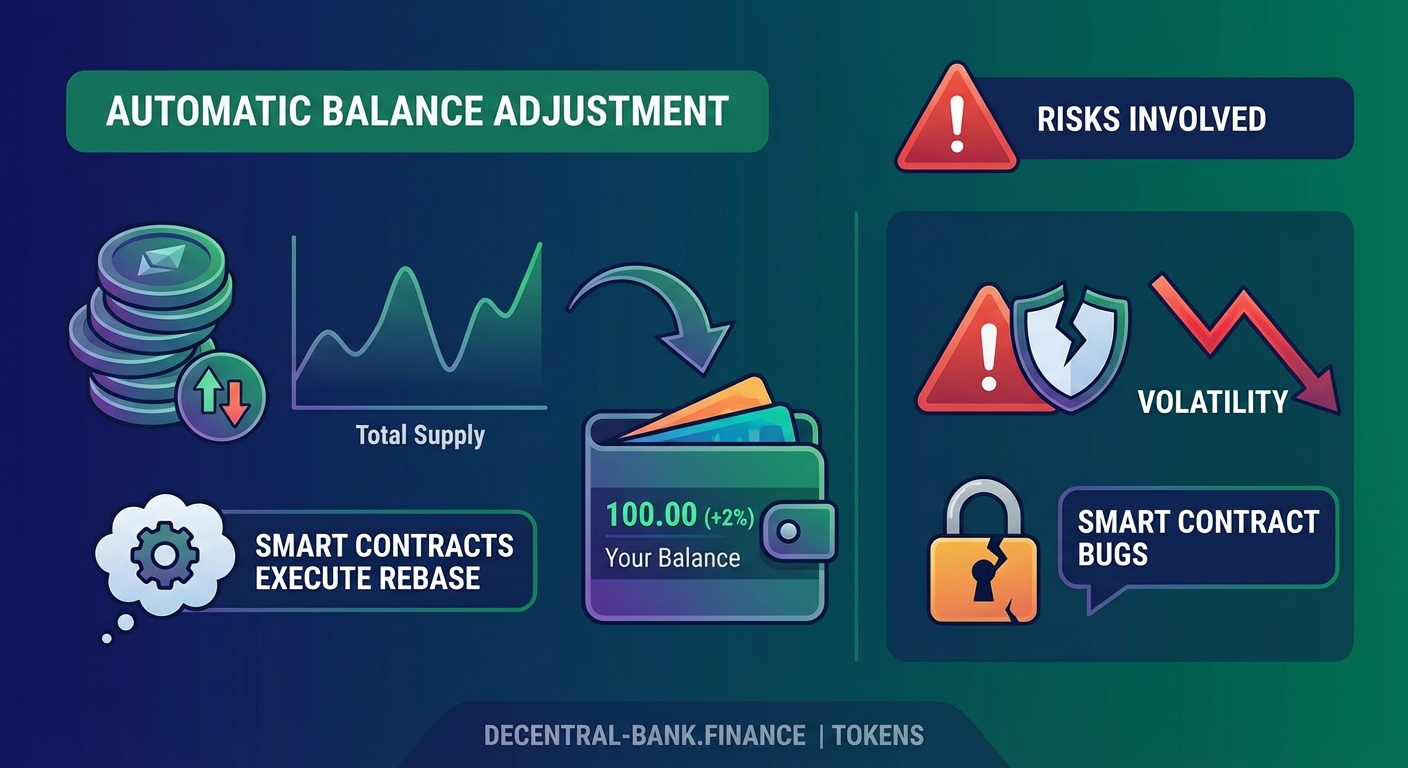
The rebase process follows a predictable pattern that happens automatically through smart contracts. Understanding this cycle helps you anticipate what might happen to your holdings.
The target price mechanism
Most rebase tokens peg themselves to a specific value, often $1 USD. The protocol monitors price through oracles that aggregate data from multiple exchanges. These oracles provide the smart contract with current market prices.
When the token price deviates from target by a certain threshold (often 5% or more), the rebase activates. Small deviations might not trigger a rebase to avoid constant tiny adjustments that create confusion.
The protocol calculates how much supply needs to change to bring price back toward target. This calculation assumes that adjusting supply will influence price, though market dynamics don’t always cooperate.
Supply expansion and contraction
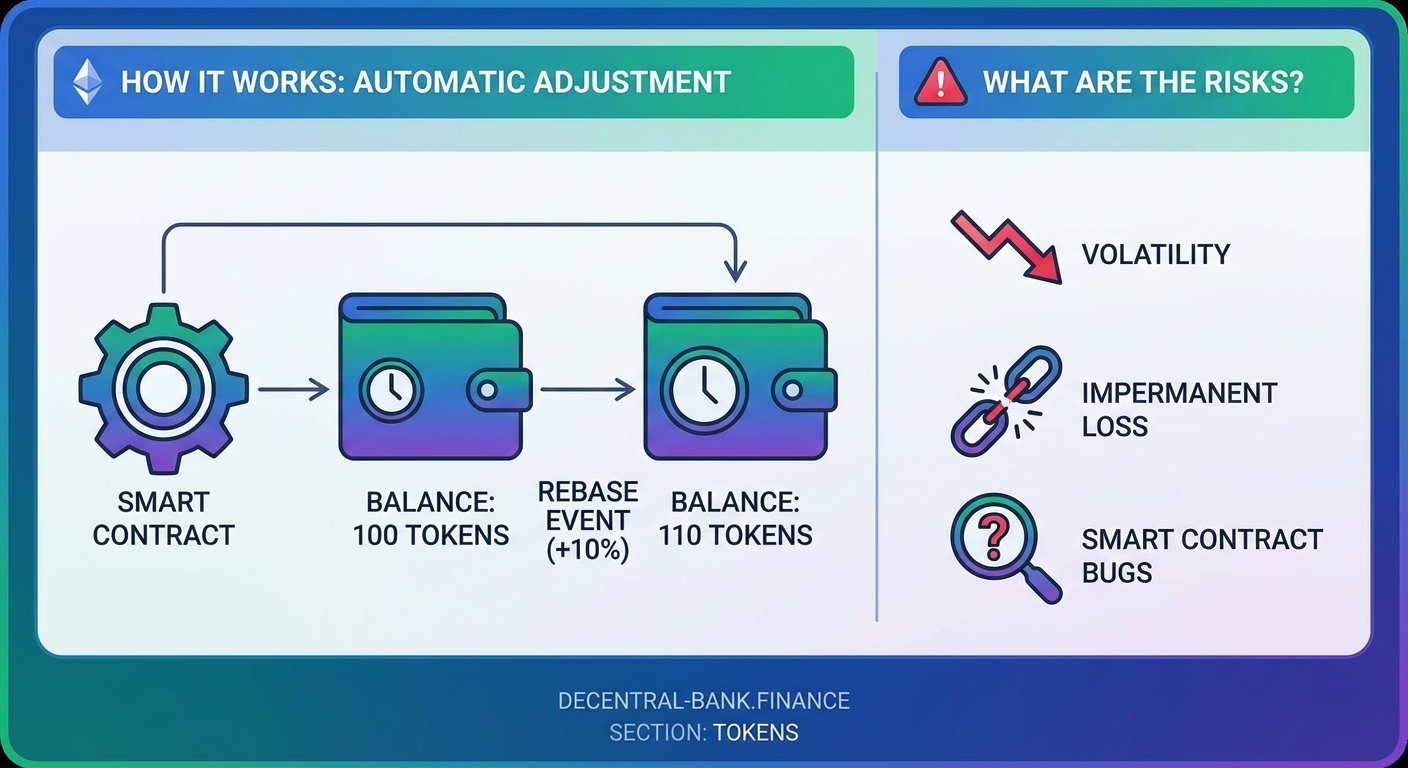
Positive rebases happen when the token trades above target price. The protocol mints new tokens and distributes them proportionally to all holders. If you own 1,000 tokens and the rebase increases supply by 10%, you’ll receive 100 new tokens.
Negative rebases occur when price falls below target. The protocol reduces everyone’s balance proportionally. That same 10% negative rebase would reduce your 1,000 tokens to 900.
These adjustments happen automatically. You don’t need to claim tokens or execute any transaction. The smart contract simply updates balances across all addresses simultaneously.
The proportional nature of adjustments
The key principle is proportionality. Every holder experiences the same percentage change. If supply expands by 15%, everyone’s balance grows by 15%. If it contracts by 8%, everyone loses 8%.
This means you can’t escape a negative rebase by moving tokens or choosing between hot wallets and cold wallets for your crypto. The rebase affects tokens wherever they sit, whether on exchanges, in wallets, or in smart contracts.
Your proportional ownership of the network remains constant. If you owned 0.5% before the rebase, you own 0.5% after. Only the absolute token count changes.
Popular examples of rebase tokens
Several projects have implemented rebase mechanisms with different approaches and goals.
Ampleforth (AMPL) pioneered the rebase token model. It targets $1 USD and rebases daily based on a 10-day moving average price. AMPL aims to be a non-correlated asset that behaves differently from other cryptocurrencies.
Olympus DAO (OHM) used rebases as part of a reserve-backed currency model. OHM rebased multiple times per day during its peak, offering extremely high APY through rapid supply expansion. The project faced criticism when the mechanism proved unsustainable.
Base Protocol (BASE) tracks the total cryptocurrency market cap rather than a fixed dollar amount. This creates a rebase token that expands when the entire crypto market grows and contracts when it shrinks.
Each implementation demonstrates different use cases for elastic supply. Some target stability, others aim for growth mechanics, and some experiment with alternative pegging mechanisms.
Why rebase tokens exist
The rebase mechanism attempts to solve specific problems in cryptocurrency design.
Traditional stablecoins like USDC maintain their $1 peg through collateral reserves. They hold dollars or other assets backing each token. This requires centralization and regulatory compliance that some users want to avoid.
Algorithmic approaches try to maintain stability without collateral. Standard algorithmic stablecoins use mechanisms like how stablecoins maintain their $1 peg during market crashes, adjusting incentives to influence supply and demand. Rebase tokens take a more direct approach by simply changing supply.
The elastic supply model also creates unique trading opportunities. Traders can speculate on whether the protocol will successfully maintain its target price. They can profit from understanding rebase timing and market psychology around supply changes.
Some advocates argue rebase tokens provide non-correlated assets. Because they behave differently from typical cryptocurrencies, they might offer diversification benefits in a portfolio.
Step-by-step guide to holding rebase tokens
If you decide to experiment with rebase tokens, follow these steps to avoid common mistakes.
-
Research the specific protocol thoroughly. Each rebase token implements the mechanism differently. Read the documentation to understand rebase frequency, target price, thresholds, and calculation methods. Know exactly when rebases occur in your time zone.
-
Calculate potential outcomes before buying. Model scenarios where price stays above or below target for extended periods. Understand how continuous negative rebases would affect your position. Consider how many tokens you’d need to hold to make the investment worthwhile given transaction costs.
-
Choose your wallet carefully. Not all wallets display rebase tokens correctly. Some show old balances until you refresh. Others don’t support the token at all. Use wallets explicitly compatible with the rebase token you’re holding. Test with a small amount first to verify the balance updates properly.
-
Track your cost basis separately. Your wallet won’t accurately reflect cost basis after rebases. Create a spreadsheet tracking your initial purchase price, date, and quantity. Record each rebase event with the percentage change and new token count. This documentation becomes critical for tax reporting.
-
Understand exchange behavior. Centralized exchanges handle rebase tokens inconsistently. Some credit or debit rebases to your account. Others don’t support rebases at all and may freeze deposits or withdrawals. Check exchange policies before depositing rebase tokens. Consider keeping them in a self-custody wallet instead.
-
Set price alerts around rebase times. Rebase events often trigger volatility as traders react to supply changes. Price might spike or crash immediately after a rebase. Set alerts for 30 minutes before and after scheduled rebases to monitor unusual activity.
-
Monitor the protocol’s health indicators. Watch metrics like how often rebases occur, whether they’re consistently positive or negative, and how quickly price returns to target after rebases. Sustained negative rebases indicate the mechanism isn’t working as designed.
Key differences between rebase tokens and standard crypto
| Feature | Rebase Tokens | Standard Tokens |
|---|---|---|
| Supply | Elastic, changes regularly | Fixed or predictable inflation |
| Balance changes | Automatic increases or decreases | Only through transactions |
| Price stability | Target maintained through supply | Determined by market forces |
| Ownership percentage | Constant proportion of total supply | Fixed token count |
| Wallet display | May show changing balances | Shows stable count |
| Tax implications | Each rebase may be taxable event | Only sales trigger taxes |
| Exchange support | Limited, inconsistent | Widely supported |
| Smart contract interaction | Complex, must handle rebases | Straightforward |
Risks that make rebase tokens dangerous
Rebase tokens introduce risks that don’t exist with standard cryptocurrencies. Understanding these dangers helps you decide if the complexity is worth it.
Tax complexity and reporting nightmares
Every rebase that increases your token count might constitute taxable income in many jurisdictions. If you hold a rebase token that rebases daily for a year, you could have 365 taxable events to report.
Each positive rebase gives you new tokens. Tax authorities might consider this income at the fair market value when received. You’d owe taxes even if you never sold anything.
Negative rebases create additional confusion. Can you claim a loss when tokens disappear from your wallet? How do you calculate cost basis when your token count constantly changes? Most tax software doesn’t handle rebase tokens properly.
The record-keeping burden alone makes rebase tokens impractical for many investors. You need detailed logs of every rebase with timestamps, token counts, and prices.
Death spirals and negative rebase loops
When a rebase token falls below its target price, the protocol contracts supply to push price back up. But this doesn’t always work as intended.
If the market lacks confidence in the token, reducing supply won’t increase demand. Price might stay low or fall further. This triggers another negative rebase, reducing supply again.
Each negative rebase can shake holder confidence, causing more selling. This creates a death spiral where negative rebases lead to selling, which leads to more negative rebases, continuing until the token becomes worthless.
Several rebase tokens have experienced this fate. Once the spiral starts, it’s difficult to reverse because the mechanism itself contributes to the problem.
Smart contract vulnerabilities
Rebase tokens require complex smart contracts that interact with price oracles, calculate supply adjustments, and update balances across potentially millions of addresses. This complexity creates attack surfaces.
Oracle manipulation represents a significant risk. If an attacker can temporarily manipulate the price feed the rebase contract uses, they might trigger incorrect rebases. This could unfairly distribute tokens or reduce balances based on false data.
The rebase calculation itself might contain bugs. An error in the math could cause incorrect supply adjustments, potentially destroying value or creating tokens from nothing.
How to protect yourself from DeFi rug pulls and exit scams becomes even more important with rebase tokens because the complexity makes auditing difficult.
Liquidity pool complications
Providing liquidity for rebase tokens creates unique problems. When you add tokens to a liquidity pool on a decentralized exchange, those tokens still experience rebases.
A positive rebase increases the token count in the pool. This changes the pool’s ratio and can cause impermanent loss. A negative rebase reduces tokens in the pool, creating different ratio imbalances.
Some protocols for providing liquidity on Uniswap don’t handle rebases correctly. The pool might not update balances properly, leading to accounting errors that cost liquidity providers money.
Trading rebase tokens on automated market makers becomes unpredictable around rebase times. Arbitrage bots often exploit the moment when rebases occur, extracting value from regular traders.
Exchange and integration challenges
Most centralized exchanges don’t support rebase tokens properly. They can’t handle balances that change automatically. This limits where you can trade these tokens and reduces liquidity.
When exchanges do list rebase tokens, they often use wrapper versions that don’t rebase. This creates two versions of the same token: the native rebasing version and the non-rebasing exchange version. Price can diverge between these versions.
Integration with DeFi protocols that work without banks or middlemen becomes complicated. Lending protocols, for example, struggle with collateral that changes quantity. If you borrow crypto without selling your assets using rebase tokens as collateral, negative rebases could unexpectedly liquidate your position.
Common mistakes investors make with rebase tokens
Avoiding these errors can save you from costly lessons.
-
Ignoring rebase timing when trading. Buying right before a negative rebase means you immediately lose tokens. Timing purchases after rebases can improve your entry point.
-
Holding on centralized exchanges. Many exchanges don’t credit rebases to your account. You miss positive rebases and don’t benefit from the mechanism. Always check exchange policies before depositing.
-
Confusing token count with value. More tokens doesn’t always mean more value. A 50% positive rebase doesn’t make you 50% richer if everyone else got the same rebase. Focus on your percentage ownership and the token’s market cap.
-
Neglecting to track cost basis. Without detailed records, you can’t accurately report taxes or know if you’re profitable. Start tracking from your first purchase.
-
Assuming the peg will hold. Many rebase tokens have failed to maintain their target price despite the mechanism. The rebase doesn’t guarantee price stability, it just attempts to create it.
-
Using rebase tokens in complex DeFi strategies. Staking, lending, or providing liquidity with rebase tokens multiplies complexity and risk. Understand exactly how each protocol handles rebases before depositing.
-
Forgetting about gas costs. Some rebase protocols require users to manually trigger rebases or claim new tokens. Gas fees can exceed the value of small holdings, making them uneconomical.
When rebase tokens might make sense
Despite the risks, some scenarios justify considering rebase tokens.
Experienced traders might use them for short-term speculation around rebase events. Understanding market psychology and timing can create profit opportunities that don’t exist with standard tokens.
Researchers and developers studying monetary policy experiments might hold small amounts to observe how elastic supply mechanisms perform in real markets. The data provides insights into alternative currency designs.
Portfolio diversification strategies could include small allocations to rebase tokens as non-correlated assets. Their unique behavior might provide benefits during specific market conditions, though this remains largely theoretical.
Users seeking alternatives to centralized stablecoins might experiment with rebase tokens as one option among many algorithmic approaches. This makes most sense for those who understand the tradeoffs and can accept the complexity.
“Rebase tokens represent an experiment in monetary policy on the blockchain. Like any experiment, they produce valuable data whether they succeed or fail. But experiments carry risk, and most investors should observe from the sidelines rather than putting significant capital at stake.” — DeFi researcher on elastic supply mechanisms
Practical considerations before investing
Before buying any rebase token, answer these questions honestly.
Can you track every rebase event for tax purposes? Do you have systems in place to record dates, times, token counts, and prices for potentially hundreds of events per year?
Do you understand exactly when rebases occur and how the specific protocol calculates supply adjustments? Can you explain the mechanism to someone else without looking at documentation?
Have you modeled worst-case scenarios? What happens to your investment if the token experiences 30 consecutive days of negative rebases? Can you afford to lose the entire investment?
Do you know how your wallet, exchange, or DeFi protocol handles rebase tokens? Have you tested with a small amount to verify everything works as expected?
Are you investing an amount small enough that the complexity and risk are justified? For most people, rebase tokens should represent a tiny experimental portion of a portfolio, not a core holding.
The future of elastic supply mechanisms
Rebase tokens remain experimental and controversial. Early implementations revealed significant challenges that tempered initial enthusiasm.
The tax implications alone make rebase tokens impractical for mainstream adoption in jurisdictions that treat each rebase as taxable income. Until regulatory clarity improves, this limits their audience to sophisticated users willing to handle complex reporting.
Technical improvements might address some current limitations. Better oracle designs, more efficient rebase calculations, and improved integration with DeFi protocols could make elastic supply mechanisms more viable.
Some projects are exploring hybrid approaches that combine elements of rebase mechanisms with other stability techniques. These might offer benefits without the full complexity of pure rebase tokens.
The broader lesson from rebase tokens applies to all DeFi innovation. Novel mechanisms create novel risks. What seems clever in theory often reveals unexpected problems in practice. Approaching new token designs with caution and skepticism protects you from expensive mistakes.
Making sense of supply that won’t sit still
Rebase tokens challenge fundamental assumptions about how cryptocurrency works. They replace price volatility with balance volatility, creating a strange experience where your holdings change while you sleep.
For most crypto investors, this complexity outweighs potential benefits. The tax burden, technical risks, and integration challenges make rebase tokens impractical as core holdings. Standard tokens or properly collateralized stablecoins serve most needs better.
But understanding rebase mechanisms matters even if you never hold these tokens. They represent important experiments in monetary design. They reveal how difficult price stability is to achieve algorithmically. They demonstrate that clever mechanisms can fail when they encounter real market conditions and human behavior.
If you do experiment with rebase tokens, start small. Use amounts you can afford to lose completely. Track everything meticulously. Expect surprises. And remember that your goal isn’t just to make money, but to learn how these unusual systems actually behave beyond the whitepaper promises.