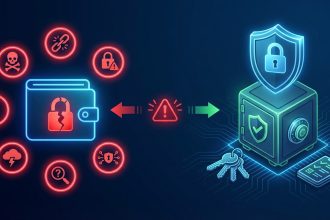
Your crypto wallet holds the keys to your digital assets. Lose those keys, and your funds disappear forever. Use the same address repeatedly, and anyone can track every transaction you’ve ever made. That’s where hierarchical deterministic wallets changed everything for cryptocurrency users.
HD wallets generate unlimited cryptocurrency addresses from a single seed phrase using mathematical algorithms. This design lets you back up all current and future addresses with one recovery phrase, improve privacy by using fresh addresses for each transaction, and organize multiple accounts under one wallet. They’ve become the standard for modern crypto wallets because they solve the backup nightmare and privacy issues that plagued earlier wallet designs.
Understanding the wallet technology that came before
Early cryptocurrency wallets generated random private keys independently. Each key had no connection to the others.
This created a serious problem. Every time you created a new address, you needed to back up that specific private key. Miss one backup, and those funds became unrecoverable.
Imagine managing 50 different addresses. You’d need 50 separate backups stored safely. One corrupted file or lost piece of paper meant permanent loss of those coins.
Non-deterministic wallets also made organization impossible. You couldn’t group addresses by purpose or create logical structures. Everything existed as a flat list of unrelated keys.
The privacy situation was equally problematic. Many users reused the same address because managing multiple addresses was too complicated. Address reuse destroys privacy by linking all your transactions together on the public blockchain.
What makes HD wallets different from older designs
Hierarchical deterministic wallets solve these problems through clever mathematics. They generate all your private keys from one master seed.
That seed is typically displayed as a 12 or 24 word recovery phrase. Words like “abandon,” “ability,” and “able” come from a standardized list of 2,048 options.
The “deterministic” part means the wallet always generates the same keys from the same seed. Feed in your recovery phrase, and you’ll recreate every address you’ve ever used, in the exact same order.
The “hierarchical” part refers to the tree structure. Your wallet can create parent keys that generate child keys, which can generate their own children, and so on.
This structure lets you organize addresses logically. You might have one branch for how to start staking crypto, another for daily spending, and a third for long-term savings.
The introduction of BIP-32 in 2012 fundamentally changed how we think about wallet backups. Instead of managing hundreds of private keys, users only need to protect one seed phrase. This single innovation made cryptocurrency accessible to millions who would have been overwhelmed by the old key management burden.
How your wallet generates addresses from one seed
The process follows a specific mathematical path. Here’s how it works:
- Your wallet starts with the seed phrase you wrote down during setup
- It runs this seed through a one-way cryptographic function to create the master private key
- The master key generates child keys using a derivation function that combines the parent key with an index number
- Each child key can generate its own children, creating the tree structure
- Public addresses are calculated from the private keys using elliptic curve mathematics
- The wallet can generate billions of unique addresses, all recoverable from the original seed
The beauty of this system is that the derivation process is standardized. Any wallet following the same standards can recreate your addresses from your seed phrase.
Standards like BIP-32, BIP-39, and BIP-44 ensure compatibility across different wallet software. You can create a wallet in one app, then restore it in a completely different app using the same recovery phrase.
The practical advantages you get every day
HD wallets deliver benefits that matter for anyone using cryptocurrency regularly.
Single backup covers everything. Write down your 12 or 24 words once, and you’ve backed up every address you’ll ever create with that wallet. No need to repeat the backup process when generating new addresses.
Fresh addresses improve privacy. Your wallet can generate a new receiving address for every transaction. This makes it much harder for observers to link your transactions together or calculate your total balance.
Organized account management. You can maintain separate accounts for different purposes, all under one seed. Your how to borrow crypto without selling your assets activity can stay separate from your trading addresses.
Watch-only wallet capability. HD wallets can generate public keys without exposing private keys. This lets you create watch-only wallets that can generate receiving addresses and monitor balances without the ability to spend funds.
Easier inheritance planning. Your heirs only need to find one seed phrase to recover all your cryptocurrency holdings, not dozens of individual private keys scattered across different backups.
Derivation paths and how wallets know where to look
Derivation paths tell wallets which branch of the tree to follow when generating addresses. They look like this: m/44’/60’/0’/0/0
Each number represents a level in the hierarchy:
- m indicates the master key
- 44′ refers to the BIP-44 standard
- 60′ represents Ethereum (each cryptocurrency has its own number)
- 0′ is the account number
- 0 indicates external addresses (the second 0 would be for internal change addresses)
- The final 0 is the address index
The apostrophe marks indicate “hardened” derivation, a security feature that prevents child keys from exposing information about parent keys.
Different cryptocurrencies use different derivation paths. Bitcoin typically uses m/44’/0’/0’/0/0, while Ethereum uses m/44’/60’/0’/0/0.
When you restore a wallet, the software checks multiple derivation paths to find your addresses. This is why recovery sometimes takes a few minutes as the wallet scans for activity across different paths.
Common mistakes people make with seed phrases
Even though HD wallets simplify backup, users still make critical errors that put their funds at risk.
| Mistake | Why It’s Dangerous | Better Approach |
|---|---|---|
| Taking a photo of the seed phrase | Photos sync to cloud services and can be hacked | Write on paper or metal, store offline |
| Storing seed phrase in password managers | If the manager is compromised, all funds are lost | Use physical storage in multiple secure locations |
| Splitting the seed phrase | Incomplete phrases are useless for recovery | Store complete phrases in 2-3 separate secure places |
| Writing seed phrase in wrong order | Wrong order generates different addresses | Number each word clearly (1-12 or 1-24) |
| Testing recovery with small amounts first | Small tests don’t reveal all potential issues | Test full recovery in a separate wallet before funding |
| Assuming wallet apps will remember your seed | Apps can be deleted, devices can break | Physical backup is the only reliable method |
The most dangerous mistake is assuming your seed phrase is safe because you “hid it well” at home. House fires, floods, and burglaries happen. You need at least two physically separate backup locations.
Security considerations for protecting your master seed
Your seed phrase is the master key to everything. Anyone who obtains it controls all your funds permanently.
Hardware wallets provide the strongest protection for HD wallets. Devices like Ledger and Trezor generate and store your seed phrase offline. Private keys never leave the device, even when signing transactions.
For those choosing between storage methods, understanding how to choose between hot wallets and cold wallets for your crypto helps you match security level to your needs.
Software wallets on your phone or computer are convenient but more vulnerable. Malware can potentially steal seed phrases from devices connected to the internet.
Never enter your seed phrase on any website, even if it looks legitimate. Phishing sites specifically target seed phrase theft. How to protect yourself from DeFi rug pulls and exit scams covers broader security practices that apply to wallet safety too.
Consider using a passphrase (sometimes called a 25th word) as an additional security layer. This optional feature adds another word to your seed phrase that you memorize rather than write down. Without the passphrase, the seed generates a different set of addresses.
Metal backup plates resist fire and water damage better than paper. Several companies make steel plates designed specifically for stamping or engraving seed phrases.
How HD wallets work with DeFi protocols
When you connect your wallet to how does DeFi actually work without banks or middlemen, you’re typically using an HD wallet behind the scenes.
DeFi protocols don’t see your entire wallet structure. They only interact with the specific address you connect. Your wallet signs transactions to prove you control that address.
This creates a useful separation. You can use one address for how to provide liquidity on Uniswap without losing money and a different address for other protocols. If one protocol gets exploited, only that address is at risk.
Some users create entirely separate accounts (different branches in the HD tree) for high-risk DeFi experiments versus long-term holdings. The same seed phrase manages both, but the accounts remain isolated.
Watch-only wallets become particularly useful for DeFi monitoring. You can track your positions and balances on a device that can’t spend funds, reducing the risk of connecting your signing wallet to potentially malicious websites.
Choosing an HD wallet that matches your needs
Nearly all modern wallets use HD technology, but they differ in features and security models.
Mobile wallets like MetaMask, Trust Wallet, and Coinbase Wallet prioritize convenience. They’re perfect for small amounts and frequent transactions. Just remember that your phone is connected to the internet and running many apps that could contain malware.
Desktop wallets like Exodus and Electrum offer more features and larger screens for managing complex transactions. They’re still hot wallets (connected to the internet), so treat them as you would a physical wallet with moderate amounts of cash.
Hardware wallets provide cold storage security. Your private keys stay on a dedicated device that never connects to the internet directly. You can interact with DeFi and sign transactions while keeping your keys isolated from potential malware.
Web wallets run entirely in browsers. They’re the least secure option because they’re always online and vulnerable to website exploits. Only use them for tiny amounts you can afford to lose.
Multisig wallets add another layer by requiring multiple signatures to spend funds. Some support HD technology for each signer, making backup and recovery more manageable even with the added complexity.
Real scenarios where HD wallets prevent disaster
Consider someone who used a non-deterministic wallet in 2015 and created 30 addresses over two years. Their laptop died without warning. They had backed up the first 10 addresses but hadn’t updated the backup file in months. The other 20 addresses, containing thousands of dollars, were permanently lost.
With an HD wallet, they would have written down 12 words once. When the laptop died, they’d install wallet software on a new device, enter those 12 words, and recover everything in minutes.
Another user wanted to accept payments for freelance work without revealing how much cryptocurrency they already owned. With an HD wallet, they generated a fresh address for each client. No client could see payments from other clients or the user’s total balance.
A third person maintained separate accounts for different purposes. One account held long-term savings that never touched DeFi. Another account interacted with new protocols for yield farming. When a protocol they used got exploited, only the experimental account was affected. Their savings remained untouched, yet both accounts backed up to the same seed phrase.
Technical details that matter for advanced users
Extended keys let you share address generation capability without exposing spending ability. An extended public key (xpub) can generate all public addresses in a branch without accessing private keys.
This enables powerful features. A business can give an xpub to their accounting software, which generates unique addresses for each customer. The accounting system can track payments without holding any private keys. The business owner keeps the seed phrase offline and only brings it online when spending funds.
Hardened derivation prevents this public key sharing at certain levels of the tree. The trade-off is security versus convenience. Hardened keys can’t generate public addresses without the private key, but they also can’t leak information about parent keys if compromised.
BIP-32 defined the basic HD wallet structure. BIP-39 standardized the word lists for seed phrases. BIP-44 established the account structure and derivation paths. BIP-49 and BIP-84 added support for different Bitcoin address types.
Some wallets implement BIP-85, which lets you generate child seeds from a master seed. This allows you to create separate wallets for different purposes, all recoverable from one master seed phrase.
Why HD wallets became the universal standard
Before HD wallets, cryptocurrency felt like managing a filing cabinet with thousands of unlabeled folders. You needed to track every single key manually.
HD wallets transformed that experience into something manageable. One seed phrase replaces potentially infinite individual backups.
The standardization across the industry means you’re not locked into one wallet provider. Your seed phrase works with dozens of different wallet applications. If your preferred wallet stops being maintained, you can simply restore your seed in a different wallet.
This portability and ease of backup removed one of the biggest barriers to cryptocurrency adoption. People don’t need to understand cryptographic key management. They just need to protect 12 words.
The hierarchical structure also enabled innovations like hardware wallets to become practical. Imagine trying to back up hundreds of random keys from a hardware device. HD wallets made cold storage accessible to regular users, not just technical experts.
Making HD wallets work for your situation
Start by choosing a wallet that matches your security needs and technical comfort level. If you’re holding significant value, invest in a hardware wallet. For smaller amounts and frequent transactions, a reputable mobile wallet works fine.
When you first set up any HD wallet, write down the seed phrase immediately. Use pen and paper, not a digital note. Write clearly and double-check each word against what the wallet displays.
Store that paper in a fireproof safe or safety deposit box. Create a second copy and store it in a completely different location. If your house burns down, you still have access to your funds.
Test your backup before sending large amounts to the wallet. Restore the seed phrase in a different wallet app to verify you wrote it down correctly. Send a small test amount, then restore again to confirm you can access it.
Generate a new address for each significant transaction. This improves your privacy and makes it harder for others to track your holdings or transaction history.
Never share your seed phrase with anyone, including customer support representatives. Legitimate services never need your seed phrase. Any request for it is a scam attempt.
Consider using different accounts within your HD wallet for different purposes. Keep your long-term holdings separate from addresses you use for how to spot a rug pull before you lose your crypto experiments with new protocols.
Why this technology matters for your crypto security
HD wallets solved fundamental problems that made early cryptocurrency difficult and dangerous to use. They transformed backup from an ongoing maintenance nightmare into a one-time setup task.
The mathematical elegance of deriving unlimited keys from one seed enabled the privacy features that make cryptocurrency practical. You can now use a fresh address for every transaction without drowning in backup files.
Understanding what HD wallets are and how they protect your assets helps you make better decisions about wallet security. That knowledge directly translates to keeping your cryptocurrency safe from loss, theft, and privacy breaches.
Your seed phrase represents complete control over your digital assets. Protect it with the same care you’d protect a key to a safe containing your life savings, because that’s exactly what it is.