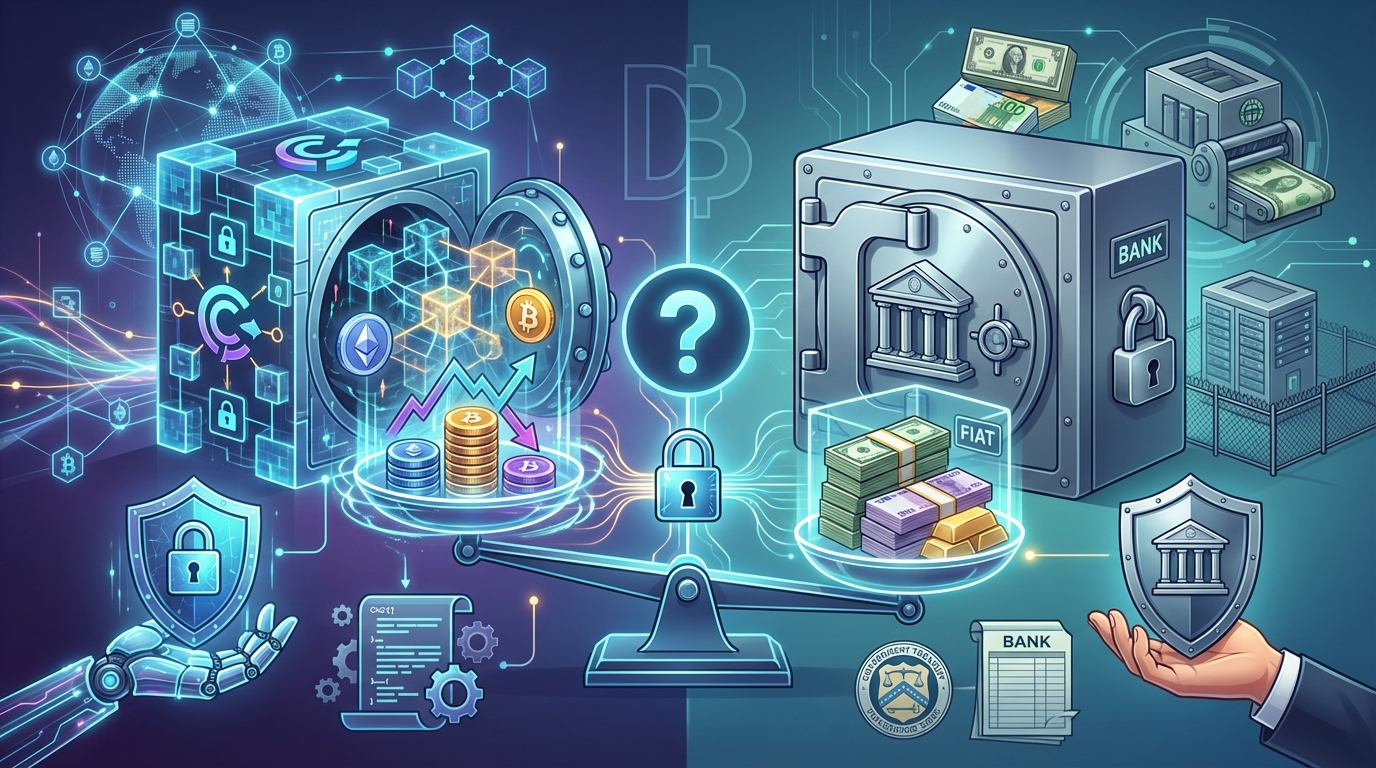
Stablecoins promise the best of both worlds: the speed of crypto and the stability of traditional money. But not all stablecoins are built the same. The way they maintain their peg determines everything from their security to their decentralization, and understanding the difference between fiat backed and crypto collateralized stablecoins can save you from costly mistakes.
Fiat backed stablecoins like USDC rely on dollar reserves held by centralized entities, offering simplicity and regulatory compliance. Crypto collateralized stablecoins like DAI use over-collateralized cryptocurrency as backing, providing decentralization at the cost of capital efficiency. Your choice depends on whether you prioritize trustless operation or institutional accountability. Both have distinct security profiles that matter for different use cases.
What makes fiat backed stablecoins work
Fiat backed stablecoins maintain their $1 peg through the simplest possible mechanism: holding real dollars in bank accounts. For every token in circulation, the issuer claims to hold one dollar in reserve.
The process works like this. You send dollars to the issuing company. They mint new stablecoin tokens and send them to your wallet. When you want to redeem, you send tokens back and receive dollars.
USDC, issued by Circle, follows this model. So does USDT from Tether, though with more controversy around its reserves. These tokens dominate the stablecoin market because they’re straightforward to understand and use.
The reserves backing these coins typically include cash, short-term Treasury bills, and other liquid assets. Circle publishes monthly attestations from accounting firms verifying their reserves match the circulating supply.
This model requires trust in the issuing company. You’re trusting they actually hold the reserves they claim. You’re also trusting they won’t freeze your tokens, which they can do because the smart contracts are centrally controlled.
Banks hold the actual dollars. This creates counterparty risk. If the bank fails or the issuer loses access to banking services, the stablecoin could lose its peg.
Regulatory compliance is built into the model. These companies operate under money transmission laws. They comply with KYC and AML requirements. They cooperate with law enforcement.
For many users, this centralization is a feature, not a bug. It provides accountability and legal recourse if something goes wrong.
How crypto collateralized stablecoins maintain their peg
Crypto collateralized stablecoins take a completely different approach. Instead of holding dollars in banks, they lock cryptocurrency into smart contracts as collateral.
DAI, created by MakerDAO, is the flagship example. Users deposit ETH or other approved cryptocurrencies into a smart contract called a vault. The protocol then lets them mint DAI against that collateral.
Here’s the catch: you can’t mint $100 of DAI with $100 of ETH. You need to deposit significantly more, typically 150% or higher. This over-collateralization protects against crypto’s price volatility.
If your collateral value drops too low, the protocol automatically liquidates some of it to maintain the system’s health. This happens through decentralized liquidators who compete to buy the collateral at a discount.
The entire process runs on smart contracts. No company controls the system. No bank holds reserves. The code enforces the rules automatically.
This design makes crypto collateralized stablecoins trustless. You don’t need to believe Circle or Tether will honor their promises. You only need to trust that the smart contract code works as intended.
The trade-off is capital efficiency. Locking up $150 to mint $100 means your capital isn’t working as hard as it could. This inefficiency is the price of decentralization.
These stablecoins integrate naturally with how DeFi actually works without banks or middlemen, enabling trustless lending, borrowing, and trading.
Comparing security models between the two types
Security means different things for each stablecoin type. Understanding these differences helps you choose the right tool for your needs.
Fiat backed stablecoins face these security concerns:
- Counterparty risk: The issuing company could mismanage reserves or commit fraud
- Banking risk: The financial institutions holding reserves could fail
- Regulatory risk: Government actions could freeze operations or seize assets
- Centralization risk: The issuer can freeze individual wallets or blacklist addresses
Crypto collateralized stablecoins face different challenges:
- Smart contract risk: Bugs in the code could be exploited by hackers
- Collateral volatility: Extreme price drops could trigger cascading liquidations
- Governance risk: Token holders make decisions that could harm the protocol
- Complexity risk: More moving parts mean more potential failure points
Neither model is universally more secure. They have different risk profiles suited to different situations.
If you’re a business needing regulatory compliance and predictable operations, fiat backed stablecoins offer clearer legal standing. If you’re building a DeFi application that needs censorship resistance, crypto collateralized options make more sense.
The best stablecoin for security isn’t the one with the most impressive technology. It’s the one whose risks align with your risk tolerance and use case. Match the tool to the job, not the hype to the headlines.
Breaking down the transparency differences
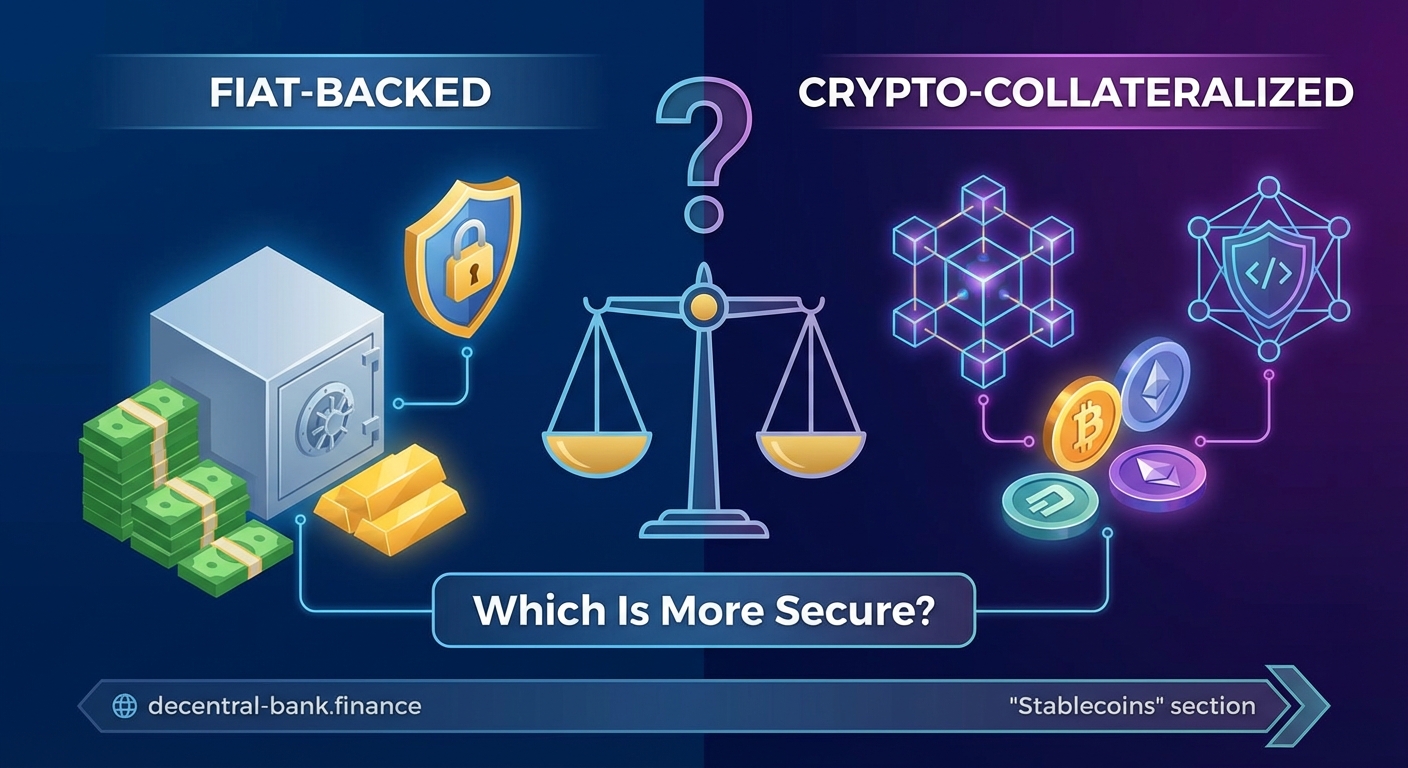
Transparency varies dramatically between fiat backed and crypto collateralized stablecoins.
Fiat backed stablecoins publish attestations. These reports from accounting firms verify that reserves match circulating supply. Circle releases these monthly. Tether publishes them quarterly.
But attestations aren’t audits. They provide a snapshot at a specific moment, not a comprehensive review of financial practices. The reserves could look different the day before or after the attestation date.
You also can’t verify reserves yourself. You must trust the attestation firm did their job properly. You’re trusting the issuer provided accurate information.
Crypto collateralized stablecoins offer radical transparency. Every transaction, every vault, every liquidation happens on-chain. Anyone can verify the collateral backing the system at any moment.
You can see exactly how much ETH sits in MakerDAO vaults right now. You can track liquidations in real time. You can audit the entire system yourself if you have the technical skills.
This transparency extends to governance. Proposals for protocol changes happen publicly. Token holders vote on-chain. The entire decision-making process is visible.
The downside is complexity. Understanding what you’re seeing requires technical knowledge. Reading smart contract data isn’t as simple as reading a bank statement.
Here’s a comparison of key transparency factors:
| Factor | Fiat Backed | Crypto Collateralized |
|---|---|---|
| Reserve verification | Third-party attestations | On-chain, real-time |
| Audit frequency | Monthly or quarterly | Continuous |
| User verification | Not possible | Anyone can check |
| Governance visibility | Private company decisions | Public, on-chain voting |
| Historical data | Limited disclosure | Complete blockchain history |
Understanding the decentralization trade-off
Decentralization isn’t just a philosophical preference. It has practical implications for how you can use stablecoins.
Fiat backed stablecoins are centralized by necessity. A company must interface with the traditional banking system. Someone needs to hold the reserves and manage redemptions.
This centralization means:
- The issuer can freeze your tokens if compelled by law enforcement
- Service can be denied to specific countries or individuals
- The company could shut down, leaving token holders scrambling
- You need to trust the issuer’s operational security and integrity
Crypto collateralized stablecoins aim for decentralization, though the reality is nuanced. The smart contracts run autonomously once deployed. No single entity can freeze tokens or prevent transactions.
But governance introduces centralization through the back door. Token holders vote on critical parameters like collateral types, stability fees, and liquidation ratios. Large token holders have outsized influence.
MakerDAO’s governance token, MKR, concentrates in relatively few hands. This means a small group effectively controls the protocol, even if the smart contracts themselves are permissionless.
True decentralization also requires decentralized price oracles. If a centralized entity provides price data, they could manipulate the system. Most crypto collateralized stablecoins use oracle networks to mitigate this risk.
For users who need to provide liquidity on decentralized exchanges, crypto collateralized stablecoins offer composability without permission. For those who need regulatory clarity and institutional backing, fiat backed options are the practical choice.
Evaluating which type fits your needs
Choosing between fiat backed and crypto collateralized stablecoins depends on your specific situation. Here’s how to think through the decision:
-
Identify your primary use case: Are you trading, providing liquidity, holding value, or building an application? Trading and holding favor fiat backed simplicity. DeFi protocols and composable applications lean toward crypto collateralized options.
-
Assess your risk tolerance: Can you accept smart contract risk in exchange for decentralization? Or do you prefer counterparty risk with a legally accountable entity? Neither is risk-free, but the risks differ fundamentally.
-
Consider your geographic and regulatory situation: If you’re in a jurisdiction with clear stablecoin regulations, fiat backed options may be safer legally. If you face capital controls or banking restrictions, crypto collateralized stablecoins provide alternatives.
-
Evaluate capital efficiency needs: If you’re borrowing crypto without selling your assets, the over-collateralization of crypto-backed stablecoins affects how much you can borrow. Fiat backed stablecoins don’t have this constraint when you’re using them, though acquiring them initially requires capital.
-
Think about custody and security: Fiat backed stablecoins work with any wallet, but the issuer controls the tokens ultimately. Crypto collateralized stablecoins require you to manage your own security. Understanding how to choose between hot wallets and cold wallets becomes essential.
Many experienced users hold both types for different purposes. USDC for on-ramps and off-ramps to traditional finance. DAI for DeFi protocols and trustless applications.
Your choice also depends on the specific stablecoin within each category. Not all fiat backed stablecoins have equal transparency or regulatory compliance. Not all crypto collateralized stablecoins have equal decentralization or smart contract security.
Research individual projects before committing significant capital. Check attestation reports for fiat backed options. Review audit reports and collateralization ratios for crypto backed alternatives.
Recognizing common mistakes and misconceptions
Several misconceptions about stablecoin security lead users into preventable problems.
Mistake 1: Assuming fiat backing guarantees perfect stability
Fiat backed stablecoins have temporarily lost their peg during banking crises or when issuers faced regulatory pressure. USDC briefly dropped to $0.88 in March 2023 when Silicon Valley Bank, which held some of Circle’s reserves, failed.
The peg recovered, but the incident proved that fiat backing doesn’t eliminate all risk. Understanding how stablecoins maintain their peg during market crashes helps you prepare for these scenarios.
Mistake 2: Believing crypto collateralized stablecoins can’t fail
Smart contract vulnerabilities have led to exploits in DeFi protocols. While major projects like MakerDAO have strong security records, smaller or newer crypto collateralized stablecoins carry significant risk.
Always verify that projects have been audited by reputable firms. Check if they have bug bounty programs. Look at their track record.
Mistake 3: Ignoring the difference between attestations and audits
An attestation confirms reserves exist at a specific moment. An audit examines financial practices over time. Fiat backed stablecoins typically provide attestations, not full audits. This leaves gaps in transparency.
Mistake 4: Treating all stablecoins within a category as equivalent
USDC and USDT are both fiat backed, but Circle provides more transparency and regulatory compliance than Tether historically has. DAI and lesser-known crypto collateralized stablecoins have vastly different risk profiles.
Mistake 5: Forgetting about regulatory risk
Both stablecoin types face regulatory uncertainty. Governments worldwide are developing frameworks that could dramatically change how stablecoins operate. Major DeFi protocols are responding to new regulatory frameworks, but the landscape remains fluid.
Protecting yourself from stablecoin risks
Regardless of which type you choose, these practices reduce your risk:
-
Diversify across multiple stablecoins: Don’t put all your stable value in one token. If one loses its peg or faces problems, you have alternatives.
-
Monitor collateralization ratios: For crypto collateralized stablecoins, watch the health of the overall system. If collateral values are dropping rapidly, consider reducing exposure.
-
Stay informed about issuer news: Follow official channels for fiat backed stablecoins. Banking problems, regulatory actions, and management changes can signal trouble.
-
Use appropriate storage: Keep stablecoins you’re actively using in hot wallets for convenience. Move long-term holdings to cold storage. Match your security approach to your usage pattern.
-
Understand redemption processes: Know how to convert your stablecoins back to fiat or other assets before you need to do it urgently. Test the process with small amounts.
-
Watch for warning signs: Persistent peg deviations, declining transparency, governance disputes, or sudden changes in operations should prompt you to reassess your holdings.
-
Be skeptical of new entrants: Established stablecoins have proven their models work. New projects promising better approaches often carry hidden risks. Learning to spot a rug pull helps you avoid obvious scams.
The stablecoin landscape continues to develop. New models emerge regularly, each claiming to solve the problems of existing approaches. Algorithmic stablecoins, for instance, tried to maintain pegs without collateral, but most failed spectacularly.
Stick with proven models until you deeply understand the trade-offs. Experimentation is fine with small amounts, but your core stable holdings should use battle-tested approaches.
Making stablecoins work for your strategy
Both fiat backed and crypto collateralized stablecoins serve important roles in the crypto ecosystem. They’re not competitors as much as complementary tools.
Fiat backed stablecoins excel at bridging traditional finance and crypto. They provide regulatory clarity, simple mechanics, and broad acceptance. They’re ideal for converting between crypto and fiat, paying for goods and services, and holding value with minimal complexity.
Crypto collateralized stablecoins enable trustless DeFi applications. They maintain censorship resistance, offer radical transparency, and integrate seamlessly with smart contract protocols. They’re essential for truly decentralized finance.
Your security priorities should match your usage. If you’re providing liquidity or staking crypto, understand the specific risks of the protocols you’re using. If you’re simply holding stable value, prioritize stablecoins with strong track records and transparent operations.
The debate over which type is more secure misses the point. Security depends on context. A stablecoin that’s secure for one use case might be risky for another.
As the crypto ecosystem matures, both models will likely persist. Fiat backed stablecoins will become more transparent and potentially more decentralized. Crypto collateralized stablecoins will improve capital efficiency and reduce complexity.
Understanding the fundamental differences between these approaches helps you navigate the stablecoin landscape confidently. You can choose the right tool for each situation, manage risks appropriately, and avoid common pitfalls that catch less informed users.
The security of your stablecoin holdings ultimately depends on your choices. Choose wisely, stay informed, and never invest more than you can afford to lose in any single asset or protocol.