Blockchain networks need a way to agree on which transactions are valid and who gets to add new blocks. That’s where consensus mechanisms come in. Two systems dominate the crypto world: proof of work and proof of stake. Understanding the difference helps you make smarter investment decisions and choose networks that match your goals.
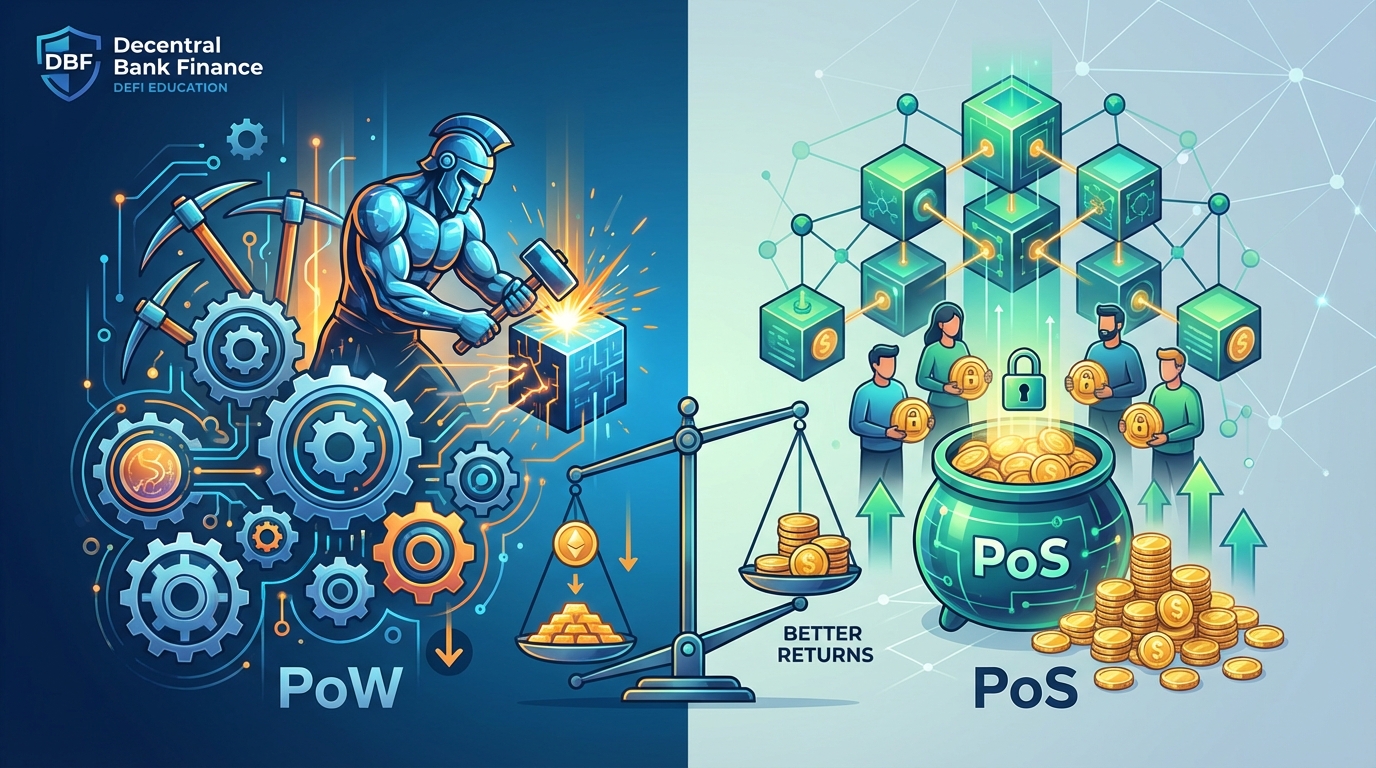
Proof of work requires miners to solve complex puzzles using computational power, consuming significant energy. Proof of stake selects validators based on their token holdings, offering energy efficiency and passive income through staking rewards. Each mechanism presents different security models, environmental impacts, and earning opportunities. Your choice depends on whether you prioritize battle-tested security or sustainable returns with lower barriers to entry.
Understanding proof of work mechanics
Proof of work was the original consensus mechanism introduced by Bitcoin in 2009. Miners compete to solve cryptographic puzzles that require massive computational effort. The first miner to solve the puzzle gets to add the next block and receives newly minted coins plus transaction fees.
Think of it like a race where thousands of participants try to guess a winning lottery number. The more computing power you have, the more guesses you can make per second. This process is called mining because it resembles extracting valuable resources through hard work.
Bitcoin miners use specialized hardware called ASICs (Application-Specific Integrated Circuits). These machines cost thousands of dollars and consume enormous amounts of electricity. A single Bitcoin transaction can use as much energy as an average household consumes in a month.
The difficulty adjusts automatically. If more miners join the network, puzzles become harder. This keeps block times consistent, around 10 minutes for Bitcoin. The system creates an economic incentive: miners invest in equipment and electricity, betting they’ll earn more in rewards than they spend on operations.
Security comes from the sheer cost of attacking the network. To rewrite transaction history, an attacker would need to control 51% of the total mining power. For established networks like Bitcoin, that would cost billions of dollars in hardware and electricity.
How proof of stake changes the game
Proof of stake eliminates the puzzle-solving competition entirely. Instead, validators lock up (stake) their tokens as collateral. The network randomly selects validators to propose new blocks based on factors like stake size and how long tokens have been locked.
Ethereum switched from proof of work to proof of stake in September 2022. This transition, called “The Merge,” reduced Ethereum’s energy consumption by over 99%. Validators now need 32 ETH (around $50,000 at recent prices) to run a validator node.
The selection process varies by network. Some use pure randomness weighted by stake size. Others incorporate additional factors like coin age or reputation scores. Validators earn rewards for honest behavior and lose staked tokens for malicious actions, a penalty called “slashing.”
Staking pools let smaller investors participate without meeting minimum requirements. You can stake as little as 0.01 ETH through exchanges or decentralized finance platforms. Pool operators handle technical requirements and share rewards with participants, minus a small fee.
The barrier to entry is lower than mining. You don’t need expensive hardware or technical expertise. Most staking requires just tokens and a reliable internet connection. Some networks even let you stake directly from secure wallets without running validator software.
Comparing staking returns and mining profits
Proof of stake networks typically offer annual returns between 4% and 20%, depending on the blockchain and total amount staked. Ethereum currently offers around 3.5% to 4.5% APR. Newer networks with fewer validators might offer higher rates to attract participants.
Mining profitability fluctuates wildly. It depends on:
- Cryptocurrency price
- Mining difficulty
- Electricity costs in your region
- Hardware efficiency
- Pool fees
A Bitcoin miner might earn $5 per day with a high-end ASIC, but electricity could cost $3 daily. That $2 profit disappears if Bitcoin’s price drops 20%. Hardware becomes obsolete as newer, more efficient models arrive.
Staking offers more predictable returns. Your percentage stays relatively stable unless the network changes its reward structure. You’re not competing against industrial mining operations with cheaper electricity. Your 100 tokens earn the same percentage as someone else’s 100 tokens.
Here’s a practical comparison:
| Factor | Proof of Work | Proof of Stake |
|---|---|---|
| Initial investment | $3,000 to $15,000 hardware | Token purchase only |
| Ongoing costs | High electricity bills | Minimal (internet, optional hardware) |
| Technical knowledge | Moderate to high | Low to moderate |
| Return predictability | Volatile | Relatively stable |
| Liquidity | Sell equipment (depreciated) | Unstake tokens (waiting period) |
| Environmental impact | Very high | Very low |
Mining also requires physical space, cooling systems, and noise tolerance. A single ASIC sounds like a hairdryer running 24/7. Staking happens silently on a computer or through a service provider.
Security models and attack vectors
Both systems protect against double-spending, but through different economic incentives. Proof of work makes attacks expensive through energy costs. Proof of stake makes attacks expensive through capital requirements and slashing penalties.
A 51% attack on Bitcoin would require controlling more mining power than all honest miners combined. At current difficulty levels, that means acquiring hundreds of thousands of ASICs and enough electricity to power a small city. Even if you succeeded, the attack would likely crash Bitcoin’s price, making your expensive effort worthless.
Proof of stake faces a different threat called “nothing at stake.” In theory, validators could vote on multiple competing chains since it costs nothing computationally. Networks solve this through slashing: validators who sign conflicting blocks lose their staked tokens.
“The beauty of proof of stake is that an attacker must own a significant portion of the network’s tokens. If they attack successfully, they destroy the value of their own holdings. It’s like burning down a house you just bought.” – Ethereum researcher
Newer proof of stake networks face bootstrapping challenges. With fewer validators and lower total stake, attacks become cheaper. Established networks like Ethereum have billions of dollars staked, making attacks prohibitively expensive.
Some critics argue proof of work has a longer track record. Bitcoin has run for 15 years without a successful 51% attack. Proof of stake networks have existed for less time, though major implementations like Ethereum have proven robust.
Getting started with staking step by step
If you want to earn passive income through proof of stake, follow this process:
-
Choose a network that matches your risk tolerance and return expectations. Research the project’s fundamentals, team, and community support before committing funds.
-
Acquire the required tokens through a reputable exchange. Transfer them to a wallet you control, not one managed by the exchange, for maximum security.
-
Select your staking method: run your own validator node, join a staking pool, or use an exchange’s staking service. Each option offers different tradeoffs between control, convenience, and fees.
-
Lock your tokens according to the network’s requirements. Read the unstaking terms carefully, as most networks impose waiting periods between 7 and 21 days before you can access your funds.
-
Monitor your rewards and validator performance regularly. Some networks require periodic actions to claim rewards or avoid penalties for extended downtime.
Most beginners start with exchange-based staking because it’s simple. You keep tokens on the platform, click “stake,” and earn rewards automatically. The downside is you don’t control the private keys, introducing custodial risk.
Running your own validator offers maximum rewards and supports network decentralization. It requires technical knowledge, reliable hardware, and constant uptime. One popular option is learning to stake through beginner-friendly platforms that simplify the technical aspects.
Staking pools provide a middle ground. You maintain custody of tokens while delegating validation duties to experienced operators. Rewards are slightly lower due to pool fees (typically 2% to 10%), but you avoid technical headaches.
Environmental impact and sustainability concerns
The energy debate separates these mechanisms dramatically. Bitcoin’s proof of work network consumes more electricity annually than entire countries like Argentina or Norway. Critics call it wasteful. Supporters argue it secures hundreds of billions in value.
Proof of stake networks use roughly the same energy as running a website. A validator node might consume 15 watts, similar to a laptop. Scaling to millions of users doesn’t significantly increase energy consumption because validation doesn’t require computational races.
This efficiency matters for institutional adoption. Companies and governments face increasing pressure to reduce carbon footprints. Proof of stake networks align with environmental, social, and governance (ESG) criteria that many investors now require.
Some proof of work advocates argue the energy debate misses context. Mining often uses stranded or renewable energy that would otherwise go to waste. Hydroelectric plants in remote areas, flared natural gas, and excess solar capacity all power mining operations.
The counterargument points out that any energy use has opportunity costs. Electricity powering mining could heat homes, run hospitals, or support other productive activities. As climate concerns grow, proof of stake’s efficiency advantage becomes more compelling.
Decentralization tradeoffs and governance
Proof of work theoretically allows anyone with electricity to participate. In practice, mining has centralized into large operations with cheap power and economies of scale. Three or four mining pools often control over 50% of Bitcoin’s hash rate.
Proof of stake risks “the rich get richer” dynamics. Validators with more tokens earn more rewards, potentially increasing their share over time. Networks address this through mechanisms like delegation, where token holders can stake through validators they trust.
Geographic distribution differs too. Proof of work mining concentrates in regions with cheap electricity: China (historically), Kazakhstan, and parts of the United States. Proof of stake validators can operate anywhere with stable internet, promoting global distribution.
Governance participation often ties to staking. Many proof of stake networks let stakers vote on protocol upgrades, fee structures, and treasury spending. This creates alignment between those securing the network and those making decisions about its future.
Critics worry about exchanges accumulating voting power through customer deposits. If 30% of a network’s tokens sit on exchanges offering staking, those platforms gain enormous influence over governance decisions, even though they don’t own the tokens.
Choosing the right mechanism for your goals
Your investment strategy should guide which networks you support. Proof of work offers:
- Longer track record and battle-tested security
- No lockup periods (sell mined coins immediately)
- Independence from initial token distribution
- Physical assets (mining equipment) with resale value
Proof of stake provides:
- Lower barriers to entry for earning rewards
- Predictable returns without operational complexity
- Environmental sustainability
- Easier participation in network governance
Many investors hold both types. Bitcoin remains the largest and most recognized cryptocurrency, using proof of work. Ethereum, the second-largest, now uses proof of stake and supports thousands of applications through smart contracts.
Consider your technical skills honestly. Mining requires understanding hardware, cooling, electrical systems, and pool configurations. Staking can be as simple as clicking a button in a wallet interface.
Tax implications differ too. Mining creates taxable income when you receive coins. Staking rewards also trigger taxes, but the timing and classification vary by jurisdiction. Consult a tax professional familiar with cryptocurrency before making significant commitments.
Risk tolerance matters. Newer proof of stake networks offer higher returns but carry greater uncertainty. Established proof of work networks provide stability but lower returns and higher operational costs.
Common mistakes that cost investors money
Don’t stake tokens you might need soon. Most networks impose unbonding periods of one to three weeks. If the price crashes and you want to sell, you’ll watch helplessly while your tokens remain locked.
Ignoring slashing conditions leads to painful losses. Each network has specific rules about validator behavior. Running your validator on multiple machines simultaneously (to prevent downtime) can trigger slashing if both sign the same block. Read the documentation carefully.
Choosing validators based solely on commission rates backfires. A validator charging 3% instead of 5% might seem attractive, but if they have poor uptime or get slashed, you’ll earn less overall. Research validator reputation and performance history.
Leaving rewards unclaimed on some networks means missing compound growth. Ethereum automatically adds rewards to your stake, but other networks require manual claiming. Set reminders to collect and restake rewards regularly.
Overlooking security fundamentals puts everything at risk. Use hardware wallets for significant holdings. Enable two-factor authentication everywhere. Never share seed phrases or private keys, even with supposed “support staff” who contact you. Understanding wallet security prevents devastating losses.
Failing to diversify concentrates risk. Don’t stake 100% of your holdings on a single network. If a critical bug emerges or the price crashes, you’ll have no liquidity to respond. Keep some assets unstaked and spread stakes across multiple networks.
Making your consensus choice work for you
Both proof of work and proof of stake serve important roles in the blockchain ecosystem. Your choice doesn’t have to be exclusive. Many successful investors mine established proof of work coins while staking promising proof of stake networks.
Start small and learn the mechanics before committing significant capital. Stake a small amount on a testnet or with minimal funds. Understand the claiming process, unstaking timeline, and reward calculations through hands-on experience.
Track your actual returns, not just the advertised APR. Factor in fees, price changes, and tax obligations. What looks like 15% APR might deliver 8% after all costs. Honest accounting helps you make better allocation decisions.
Stay informed about network upgrades and governance proposals. Changes to reward structures, inflation rates, or staking requirements directly affect your returns. Join community forums and follow official channels for networks where you stake significant amounts.
The consensus mechanism debate will continue as both systems evolve. Proof of work advocates work on layer-two solutions to improve efficiency. Proof of stake developers refine security models and decentralization mechanisms. Your best strategy is understanding both systems and choosing networks that align with your financial goals and values.
Whether you’re drawn to the proven security of proof of work or the sustainable efficiency of proof of stake, both mechanisms offer opportunities to participate in the future of decentralized finance. Make your choice based on careful research, honest self-assessment, and a clear understanding of the risks and rewards each system presents.