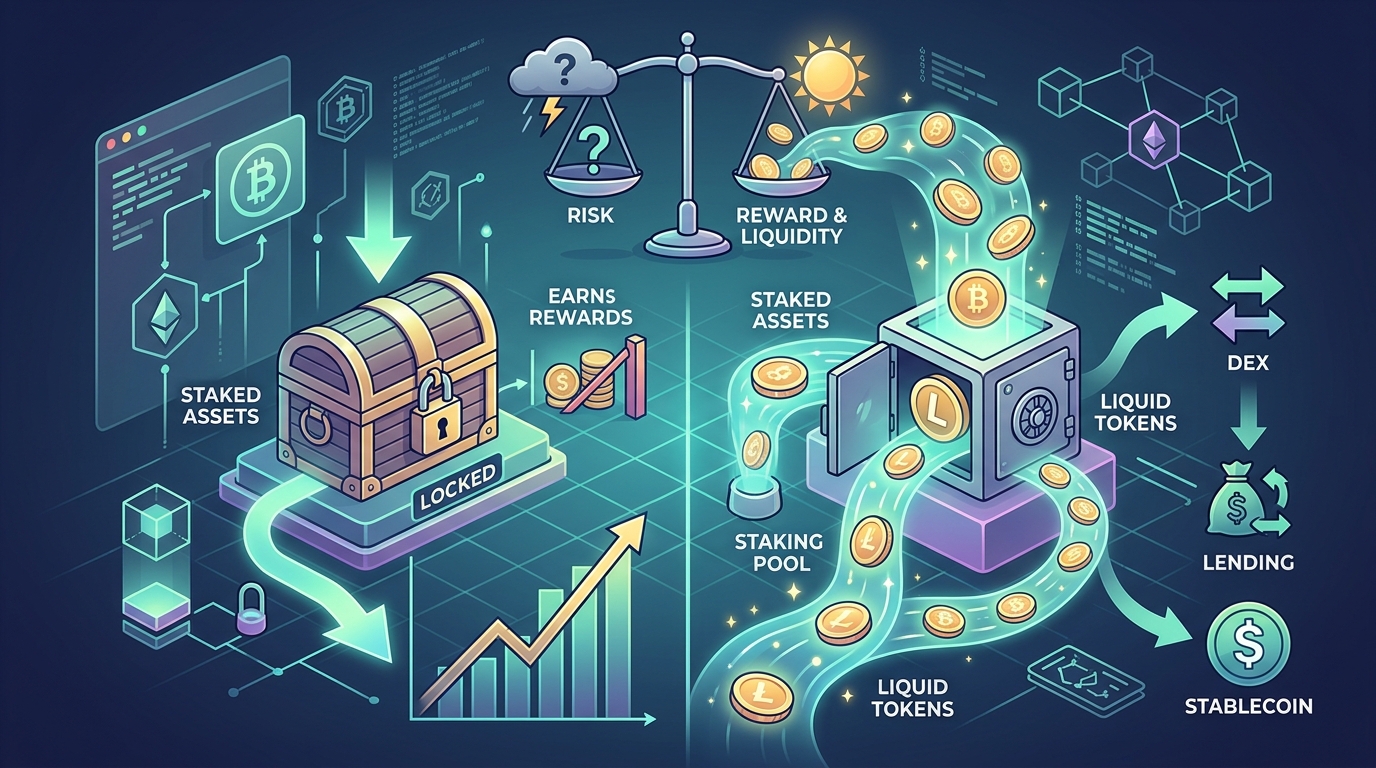
Staking your crypto sounds simple until you realize there are two completely different ways to do it. One locks your tokens away like a time deposit. The other lets you keep using them while they earn rewards. Both promise passive income, but they work in fundamentally different ways and carry distinct risks.
Traditional staking locks your tokens directly with validators for predictable rewards but zero liquidity. Liquid staking issues derivative tokens you can trade while earning rewards, offering flexibility at the cost of smart contract risk, depegging potential, and protocol dependencies. Your choice depends on whether you prioritize security and simplicity or capital efficiency and DeFi opportunities.
How traditional staking actually works
Traditional staking means locking your tokens with a validator to help secure a proof-of-stake blockchain. You delegate your assets directly to a node operator who processes transactions and creates new blocks.
Your tokens sit in a smart contract or validator node. They cannot move. You cannot sell them. You cannot use them as collateral. They stay frozen for the entire staking period.
Most networks enforce unbonding periods. Ethereum requires you to join an exit queue that can take days or weeks. Cosmos chains typically lock you in for 21 days after you request withdrawal. Solana offers faster unbonding but still imposes waiting periods.
During this time, your tokens earn staking rewards. These come from block rewards and transaction fees. The rate stays relatively stable because it depends on network inflation schedules and total staked supply.
The process looks like this:
- Choose a validator with good uptime and reasonable commission rates
- Send your tokens to the staking contract or delegate through your wallet
- Wait for the tokens to become active (usually one epoch or a few hours)
- Earn rewards automatically, often compounded if you restake them
- Request withdrawal when you want to exit, then wait through the unbonding period
You maintain custody in most cases. The validator cannot steal your tokens. But you sacrifice all liquidity for the duration of your stake.
What makes liquid staking different
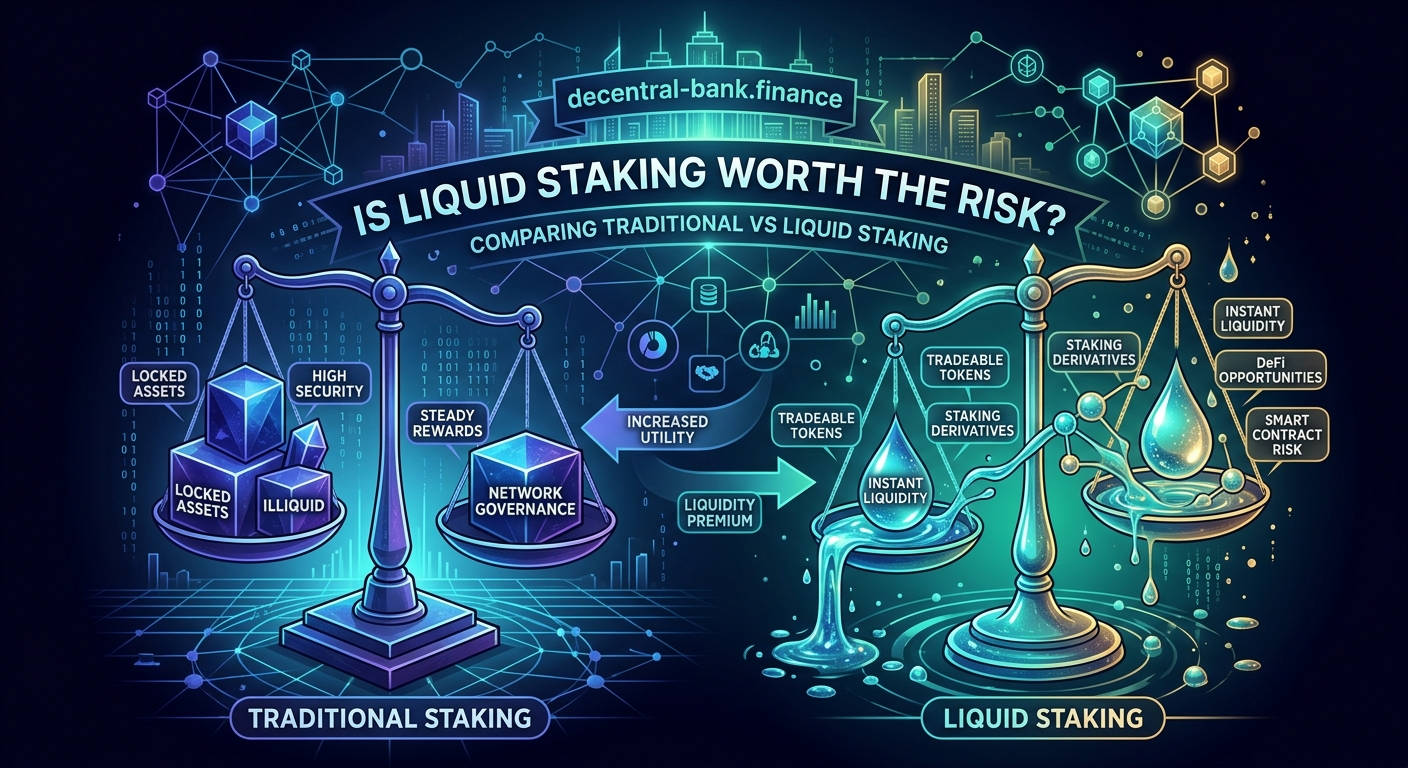
Liquid staking protocols give you a derivative token when you stake. You deposit ETH and receive stETH. You stake SOL and get mSOL. These tokens represent your staked assets plus accrued rewards.
The derivative token stays liquid. You can trade it on decentralized exchanges. You can use it as collateral in lending protocols. You can provide liquidity in AMM pools. Your capital works in multiple places simultaneously.
The staking happens behind the scenes. The protocol pools deposits from many users and distributes them across professional validator operators. You do not choose validators yourself. The protocol handles that complexity.
Rewards accumulate in the token itself. Some derivatives like stETH use a rebase mechanism that increases your token balance daily. Others like wstETH or rETH grow in value relative to the base asset. Either way, your holdings appreciate without manual claiming.
The trade-off is additional layers of risk. You trust the liquid staking protocol’s smart contracts. You depend on its validator selection. You face potential depegging if the derivative token loses its 1:1 relationship with the underlying asset.
Risk comparison between both methods
Traditional staking carries validator risk. If your chosen validator goes offline, you lose rewards during downtime. If they get slashed for malicious behavior or technical failures, you lose a portion of your stake. Choosing reputable validators with strong track records minimizes but does not eliminate this risk.
Liquid staking spreads validator risk across multiple operators but introduces protocol risk. The smart contracts managing deposits, withdrawals, and reward distribution could contain bugs. Exploits have drained millions from DeFi protocols. Audits help but cannot guarantee safety.
Depegging represents a unique liquid staking risk. Market stress, withdrawal bottlenecks, or loss of confidence can cause derivative tokens to trade below their theoretical value. During the Ethereum merge preparation, stETH briefly traded at 0.93 ETH. Holders who panicked sold at a loss despite the tokens remaining fully backed.
Centralization concerns affect both methods differently. Traditional staking lets you choose smaller validators to support decentralization. Liquid staking protocols often concentrate stake with a handful of large operators. Lido controls over 30% of staked ETH. This concentration could threaten network security if a single protocol dominates.
Regulatory uncertainty looms over liquid staking more heavily. Derivative tokens might be classified as securities in some jurisdictions. Protocols face potential enforcement actions. Traditional staking appears more straightforward from a regulatory perspective since you directly hold the base asset.
| Risk Type | Traditional Staking | Liquid Staking |
|---|---|---|
| Validator slashing | Direct exposure to chosen validator | Spread across protocol’s validator set |
| Smart contract bugs | Minimal (only staking contract) | High (protocol contracts plus integrations) |
| Liquidity | Zero during lock period | Full liquidity via derivative token |
| Depegging | Not applicable | Possible during market stress |
| Protocol failure | Limited to validator | Could lose access to underlying assets |
| Regulatory risk | Lower | Higher due to derivative nature |
Rewards and returns breakdown
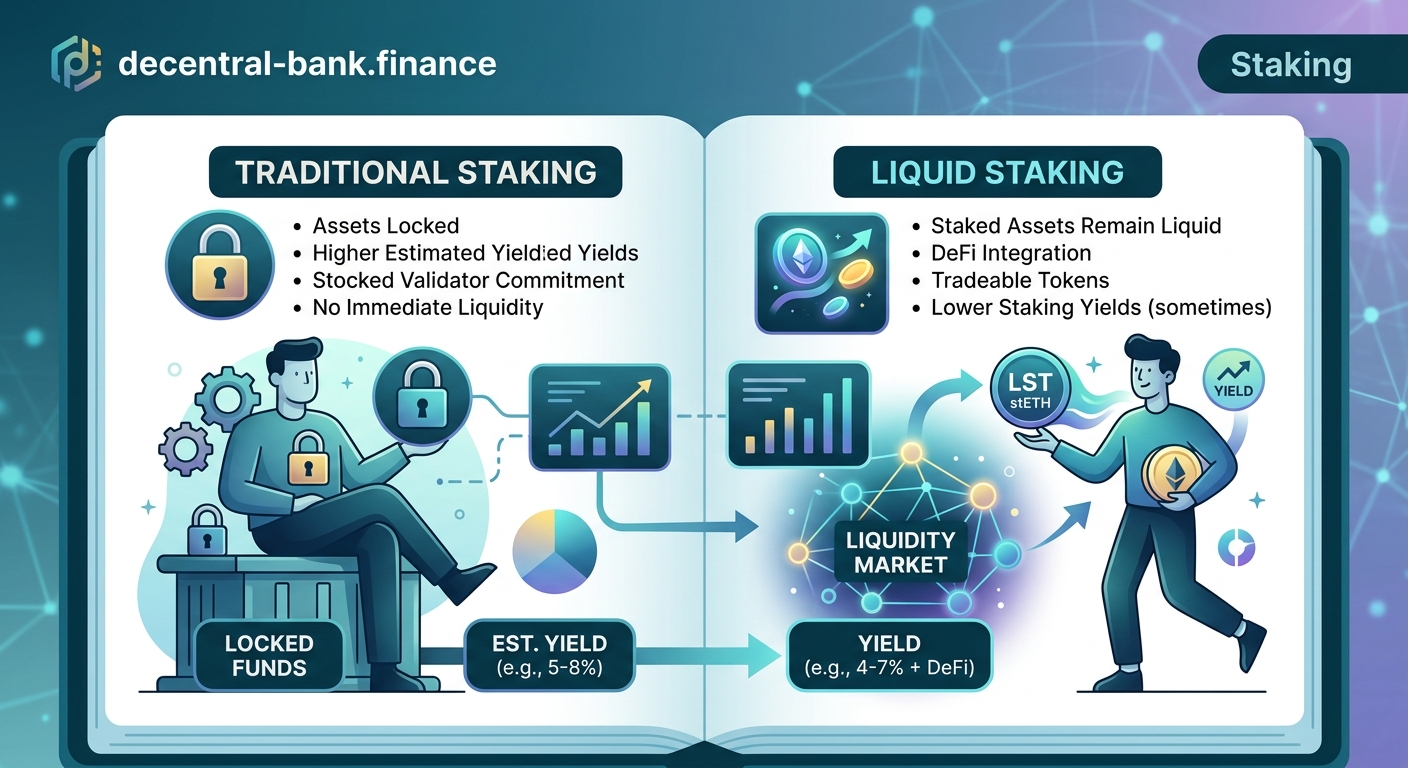
Traditional staking offers predictable base rewards. Ethereum currently yields around 3-4% APR from consensus rewards. Cosmos chains range from 10-20% depending on inflation rates. These numbers fluctuate with total staked supply and network parameters but change gradually.
You can increase returns by choosing validators with lower commission rates. Most charge 5-10% of your rewards. Some offer 0% commission to attract delegators. But extremely low fees might signal inadequate infrastructure investment.
Liquid staking protocols take their own fee on top of validator commissions. Lido charges 10% of staking rewards. Rocket Pool takes 15% but distributes some to node operators. These fees reduce your net yield compared to traditional staking.
The compensation comes from capital efficiency. You can deposit your derivative tokens into lending markets like Aave to earn additional yield. You can provide liquidity in Curve pools for trading fees and incentive tokens. You can use them in leverage strategies or other DeFi protocols.
Sophisticated users stack these opportunities. They stake ETH for stETH, deposit stETH as collateral to borrow stablecoins, use those stablecoins in yield farming strategies, and potentially loop the process. This amplifies returns but also multiplies risks.
The highest yields in liquid staking come from using derivative tokens across multiple protocols. But each additional layer adds smart contract risk and liquidation exposure. Most users should start simple and only add complexity as they understand the mechanisms and risks involved.
Practical considerations for choosing your approach
Your time horizon matters enormously. If you plan to hold for years and rarely need access to your tokens, traditional staking makes sense. You avoid protocol fees and smart contract risks while earning solid baseline returns.
Active traders and DeFi participants benefit more from liquid staking. The ability to exit positions without unbonding delays proves valuable during market volatility. The derivative tokens enable strategies impossible with locked assets.
Portfolio size influences the decision too. Smaller holders often prefer liquid staking because minimum stake requirements do not apply. You can stake any amount. Traditional staking on some networks requires minimum deposits or makes running your own validator node impractical below certain thresholds.
Technical comfort level plays a role. Traditional staking through reputable wallets requires minimal technical knowledge. You choose a validator and click stake. Liquid staking introduces more moving parts. You need to understand derivative tokens, depegging risks, and how to safely use them in DeFi.
Tax implications differ between jurisdictions. Some tax authorities treat staking rewards as income when received. Others tax only when sold. Liquid staking’s automatic reward accrual might trigger taxable events more frequently than traditional staking where you manually claim rewards. Consult a tax professional familiar with crypto before committing large amounts.
Security practices for both staking types
Traditional staking security focuses on validator selection and wallet protection. Research validator uptime history, commission rates, and community reputation. Check if they have been slashed before. Look for validators who communicate actively and maintain robust infrastructure.
Use hardware wallets when possible. Staking does not require keeping tokens on exchanges. Most proof-of-stake networks support staking directly from Ledger or Trezor devices through compatible wallet interfaces.
For liquid staking, verify you interact with legitimate protocol contracts. Phishing sites create fake interfaces to steal deposits. Always bookmark official protocol URLs. Double-check contract addresses before approving transactions.
Start with small test amounts. Stake a minimal quantity first to confirm the process works correctly. Verify you receive derivative tokens. Test a withdrawal if the protocol allows. Only commit larger sums after successfully completing a full cycle.
Diversify across protocols if you use liquid staking extensively. Do not put all your staked assets into a single protocol. Spread holdings between Lido, Rocket Pool, and other established providers. This limits damage if one protocol suffers an exploit or regulatory action.
Monitor your positions regularly. Set up alerts for significant depegging events. Stay informed about protocol governance proposals that might affect your holdings. Join community channels where security issues get discussed promptly.
Common mistakes that cost stakers money
Chasing the highest advertised yields often backfires. Extremely high rates usually come from unsustainable token emissions or risky leverage strategies. New protocols offering 50%+ APY rarely maintain those rates long term. Many collapse, taking user funds with them.
Ignoring unbonding periods causes problems. Users stake tokens planning to sell during a pump, then discover they cannot access funds for weeks. The price crashes while their tokens sit locked. Always factor unbonding time into your trading plans.
Failing to claim rewards in traditional staking systems wastes potential compound growth. Some networks require manual claiming. Unclaimed rewards sit idle instead of generating additional returns. Set reminders to claim and restake regularly.
Using liquid staking derivatives without understanding depegging risk leads to panic selling. When stETH traded at 0.95 ETH, many users sold at a loss despite full backing. Patient holders who understood the mechanism either held or bought more at a discount.
Overlooking validator performance in traditional staking reduces returns. A validator with 95% uptime earns noticeably less than one with 99.9% uptime. Poor validator choices compound over months and years. Spend time researching before delegating.
Concentrating all stake with one validator creates unnecessary risk. If that validator gets slashed or goes offline, your entire stake suffers. Spread delegations across multiple validators to diversify risk while supporting network decentralization.
Making the right choice for your situation
Most crypto holders benefit from a hybrid approach. Keep a portion in traditional staking for maximum security and simplicity. Use liquid staking for funds you might need or want to deploy in DeFi opportunities.
Conservative investors prioritizing safety should lean toward traditional staking. Accept the liquidity trade-off for reduced protocol risk. Choose established validators with long track records. Stake amounts you genuinely do not need for months or years.
DeFi-active users gain more from liquid staking despite higher risks. The capital efficiency unlocks strategies that multiply returns. Just size positions appropriately. Do not leverage liquid staking derivatives so heavily that a depegging event liquidates you.
New users should start with traditional staking to learn the basics. Understand how proof-of-stake works, how validators operate, and how rewards accumulate. Graduate to liquid staking once you grasp the fundamentals and feel comfortable with additional complexity.
Large holders might run their own validator nodes instead of delegating. This maximizes rewards by eliminating commission fees and gives you complete control. But it requires technical expertise, reliable infrastructure, and significant capital.
The best choice changes as your knowledge, portfolio size, and goals change. Reassess your staking strategy every few months. Market conditions shift. New protocols launch. Regulatory environments change. Stay flexible and informed.
Your staking strategy starts here
Neither traditional nor liquid staking is universally superior. Each serves different needs and risk tolerances. Traditional staking offers simplicity and security for long-term holders. Liquid staking provides flexibility and capital efficiency for active participants.
Start by honestly assessing your goals. Do you want to set and forget for years? Traditional staking works. Do you want to actively manage and optimize returns? Liquid staking opens more doors. Do you want both? Split your holdings.
The crypto staking landscape keeps maturing. More protocols launch. Existing ones improve security and features. Regulatory clarity slowly emerges. Your choice today does not lock you in forever. You can always unstake and switch approaches as circumstances change.
Take time to research specific protocols and validators before committing funds. Read documentation. Check audit reports. Join community discussions. The few hours you invest in due diligence protect against costly mistakes and help you stake with confidence.