Watching your collateral get liquidated feels like a punch to the gut. One minute you’re earning yield on your crypto, the next minute the protocol has seized your assets to cover a loan you didn’t realize was underwater. It happens faster than most people expect, especially during volatile market conditions.
Avoiding liquidation in DeFi requires maintaining healthy collateral ratios (150% minimum), monitoring positions daily, using price alerts, diversifying collateral across stablecoins and blue-chip assets, and adding funds before reaching liquidation thresholds. Most liquidations happen during sudden market drops when users aren’t actively watching their positions. Prevention beats recovery every time.
Understanding why liquidations happen in the first place
DeFi lending protocols require you to lock up collateral worth more than what you borrow. This over-collateralization protects lenders from losses if your collateral drops in value.
When your collateral value falls below a certain threshold, the protocol automatically sells it to repay your loan. This process happens without warning and without your permission.
Most protocols use a liquidation threshold between 75% and 85%. If you borrowed $1,000 worth of stablecoins against $1,500 worth of ETH, and ETH drops 20%, you’re getting liquidated.
The protocol doesn’t care about your long-term conviction. It cares about protecting lenders.
Calculate your liquidation price before borrowing anything
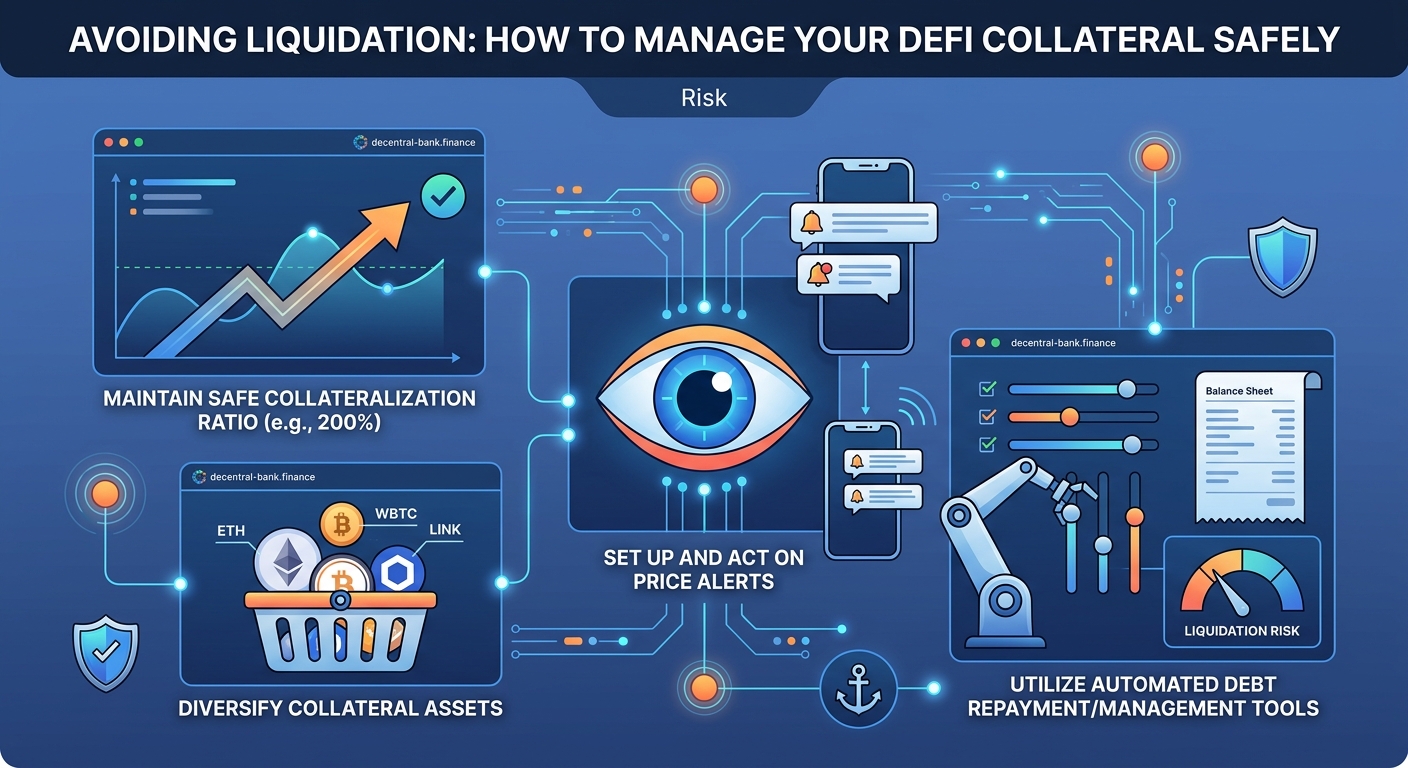
You need to know exactly where your position becomes unsafe. This isn’t optional.
Here’s how to calculate it:
- Find your protocol’s liquidation threshold (usually 75-85%)
- Multiply your borrowed amount by this threshold
- Divide by the amount of collateral you deposited
- That’s your liquidation price per unit of collateral
Example: You deposit 10 ETH at $2,000 each ($20,000 total) and borrow $10,000 USDC. With an 80% liquidation threshold, your liquidation price is $1,000 per ETH.
Understanding collateral ratios helps you see why this math matters so much. Most people skip this step and regret it later.
Maintain a safety buffer way above minimum requirements
The minimum collateral ratio is not your target. It’s your red line.
If a protocol requires 150% collateralization, aim for 200% or higher. This buffer gives you breathing room during market volatility.
Think of it like driving. The speed limit isn’t a suggestion to go exactly that fast in all conditions. You slow down in rain or fog.
Your collateral buffer works the same way. Market conditions change. Volatility spikes without warning. News breaks at 3 AM.
A 200% collateral ratio means your assets can drop 33% before you’re in danger. A 150% ratio only gives you 16% wiggle room. That extra buffer is the difference between sleeping well and panic-selling at the worst possible time.
Set up price alerts for your collateral assets
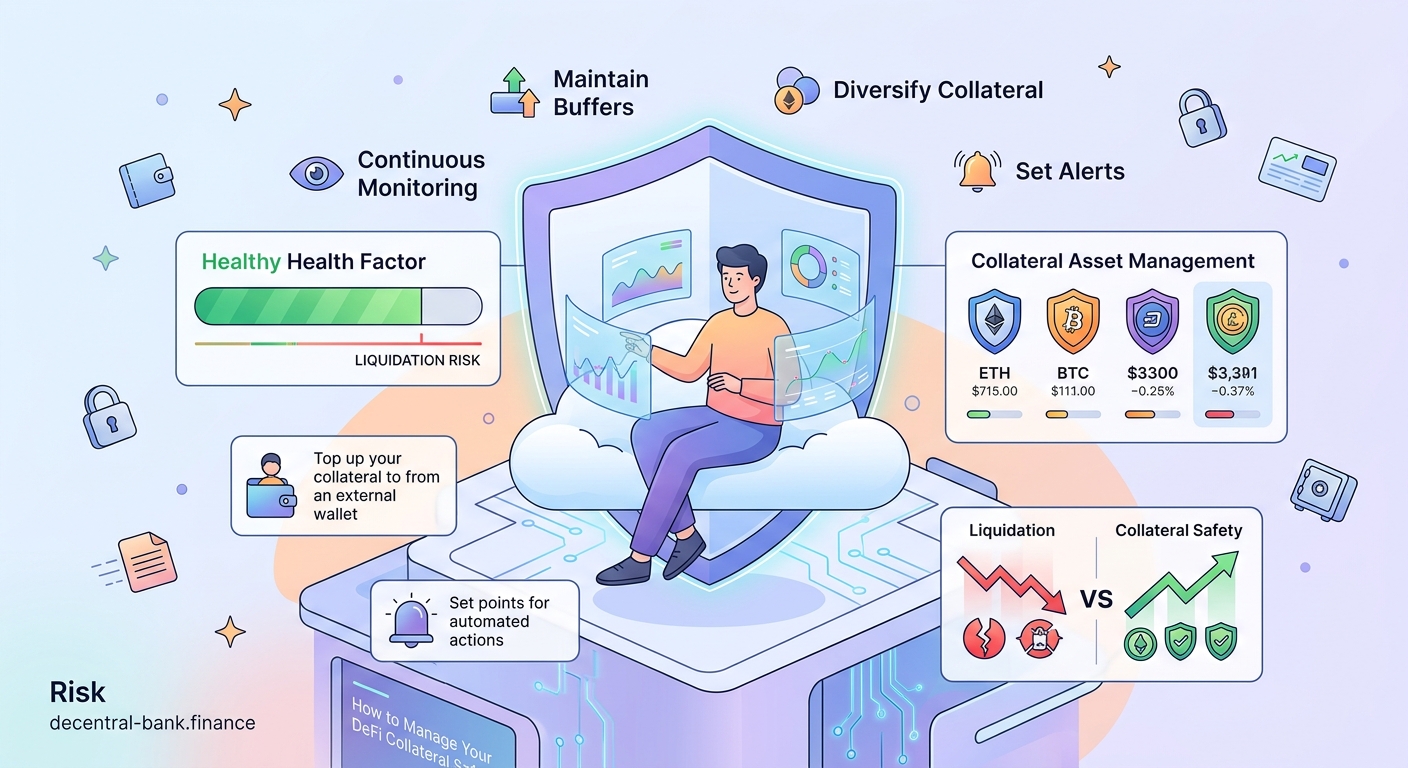
You can’t watch the markets 24/7. Price alerts do it for you.
Set multiple alert levels:
- First alert: When your collateral drops 10% from deposit price
- Second alert: When you’re 15% above liquidation threshold
- Final alert: When you’re 5% above liquidation threshold
Use apps like CoinGecko, Delta, or your exchange’s native alerts. Set them to push notifications, not just email.
Test them. Send yourself a fake alert to make sure your phone actually buzzes.
During the May 2021 crash, most liquidations happened between 2 AM and 6 AM UTC. People were asleep. Their alerts didn’t wake them up because they never tested the settings.
Monitor your health factor daily
Most lending protocols show a “health factor” or “borrow limit” percentage. This number tells you how close you are to liquidation.
A health factor of 1.5 means you’re at 150% collateralization. Anything below 1.0 triggers liquidation.
Check this number every day. Make it part of your morning routine, like checking the weather.
If your health factor drops below 1.3, take action immediately. Don’t wait for it to recover on its own.
What happens during a DeFi liquidation shows you exactly why that 1.3 threshold matters. Liquidators move fast.
Add collateral before you need to
The best time to add collateral is before the market drops, not during the panic.
Keep some stablecoins or extra crypto in your wallet specifically for topping up positions. This emergency fund should be 10-20% of your total borrowed amount.
When your first price alert goes off, add collateral immediately. Don’t wait to see if the price bounces back.
Adding collateral during a crash is harder than it sounds. Gas fees spike. Transactions fail. Your hands shake. The interface loads slowly.
Do it when you’re calm and the network isn’t congested.
Choose stable collateral assets over volatile ones
Not all collateral is created equal. ETH and BTC are safer than small-cap altcoins.
Stablecoins as collateral give you zero liquidation risk, but lower borrowing capacity. A 50/50 split between stablecoins and blue-chip crypto often works well.
Avoid using:
- New tokens with less than 6 months of price history
- Assets with low liquidity
- Tokens that recently pumped 100%+ in a week
- Anything you wouldn’t hold through a 50% drawdown
Wrapped tokens vs native tokens explains why the form of your collateral matters too. Some wrapped assets have additional risks.
Diversify across multiple positions instead of one large loan
Putting all your collateral into one position creates a single point of failure.
Split your collateral across 2-3 separate positions. If one gets liquidated, you still have the others.
This also lets you experiment with different collateral ratios. Maybe one position runs at 200% and another at 300%.
The downside is higher gas fees to manage multiple positions. But the safety benefit usually outweighs the cost.
Understand liquidation penalties before they hit you
Getting liquidated doesn’t just mean losing your collateral. You also pay a penalty.
Most protocols charge 5-15% of your collateral as a liquidation fee. This goes to the liquidator as an incentive to execute the transaction quickly.
On a $10,000 position, that’s $500-$1,500 gone instantly.
Some protocols also charge a protocol fee on top of the liquidator bonus. Read the documentation carefully.
Why your crypto loan got liquidated breaks down the full cost of liquidation with real examples.
Use protocols with partial liquidations when possible
Some protocols liquidate your entire position. Others only liquidate enough to bring you back to safety.
Partial liquidation is much better. If you need $2,000 to get healthy, the protocol only takes $2,000 worth of collateral, not everything.
Aave, Compound, and MakerDAO all use partial liquidations. Smaller or newer protocols might not.
Check the protocol documentation before depositing. This feature can save you thousands during a flash crash.
Consider using stablecoins as your borrowed asset
Borrowing volatile assets multiplies your risk. If you borrow ETH and it pumps 30%, your debt just increased 30% in dollar terms.
Borrowing stablecoins keeps your debt constant. Your only risk is your collateral dropping.
This strategy works well if you:
- Need liquidity without selling
- Want to farm yield with borrowed stablecoins
- Plan to hold your collateral long-term
Can you really earn interest on stablecoins through DeFi lending shows you what to do with those borrowed stablecoins.
Watch for cascading liquidations during market crashes
When one whale gets liquidated, it can trigger a domino effect.
Their collateral gets dumped on the market, pushing prices lower, which triggers more liquidations, which dumps more collateral.
This happened during the March 2020 COVID crash and the May 2021 selloff.
During extreme volatility:
- Reduce your borrowed amount
- Increase your collateral buffer to 250%+
- Consider closing positions entirely
- Don’t try to catch falling knives
Common mistakes that lead to liquidation
| Mistake | Why it’s dangerous | Better approach |
|---|---|---|
| Borrowing maximum amount | Zero safety buffer | Borrow 50-70% of maximum |
| Never checking positions | Miss warning signs | Daily health checks |
| Using only volatile collateral | High liquidation risk | Mix stable and volatile assets |
| Ignoring gas fees | Can’t add collateral fast | Keep extra ETH for gas |
| Trusting price will recover | Hope isn’t a strategy | Add collateral immediately |
| No emergency fund | Can’t respond to alerts | Keep 10-20% in stablecoins |
Set up automated protection with DeFi Saver or similar tools
Some services automatically manage your collateral ratio for you.
DeFi Saver, for example, can automatically add collateral or repay debt when you approach liquidation thresholds.
These services charge a fee, but it’s usually cheaper than liquidation penalties.
The downside is giving smart contract permissions to manage your position. Make sure you understand the risks and what happens when you approve a smart contract.
Know when to cut your losses and close the position
Sometimes the best move is admitting you’re wrong and closing out.
If your collateral has already dropped 30% and you’re approaching liquidation, you might be better off:
- Repaying the loan
- Withdrawing remaining collateral
- Accepting the loss
- Living to trade another day
Holding on out of pride or hope often makes things worse. The market doesn’t care about your entry price.
Over-collateralization in DeFi lending helps you understand whether the capital efficiency is worth the risk in the first place.
Practice with small positions first
Don’t learn these lessons with your entire portfolio.
Start with $100-500 positions. Experience how the protocol works. Watch how your health factor changes with price movements.
Make mistakes when they cost $50, not $5,000.
After you’ve managed a small position successfully for a month, gradually increase your size.
Your liquidation prevention checklist
Use this before opening any new position:
- Calculate exact liquidation price
- Set up three levels of price alerts
- Confirm protocol uses partial liquidations
- Verify you have emergency funds available
- Check current gas prices and network congestion
- Document your position details somewhere safe
- Set calendar reminder for daily health checks
- Understand the full liquidation penalty
- Know exactly how to add collateral quickly
Protecting your positions is a daily practice
Avoiding liquidation isn’t about setting up your position perfectly once and forgetting about it. It’s about daily vigilance and quick responses to changing conditions.
The protocols are automated and merciless. They will liquidate you at 3 AM on a Sunday without hesitation.
But with proper monitoring, healthy buffers, and a clear action plan, you can use DeFi lending safely and profitably. Start conservative, stay alert, and never borrow more than you can afford to lose.