
Picking the wrong validator can cost you more than just missed rewards. It can lead to slashed funds, prolonged downtime, and even total loss of your staked tokens. Yet most people select validators based solely on the highest APY advertised on a dashboard.
That approach ignores the factors that actually determine whether your stake stays safe and productive over time.
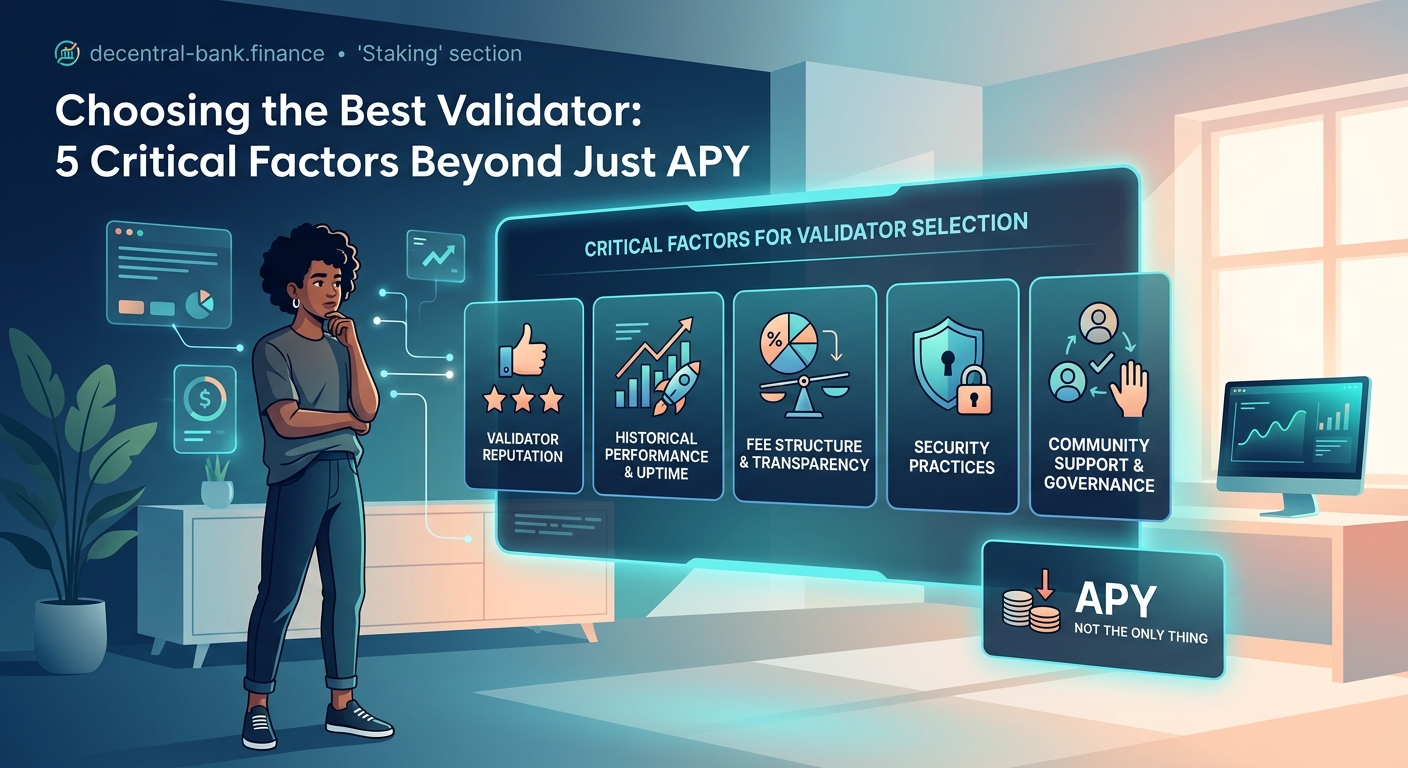
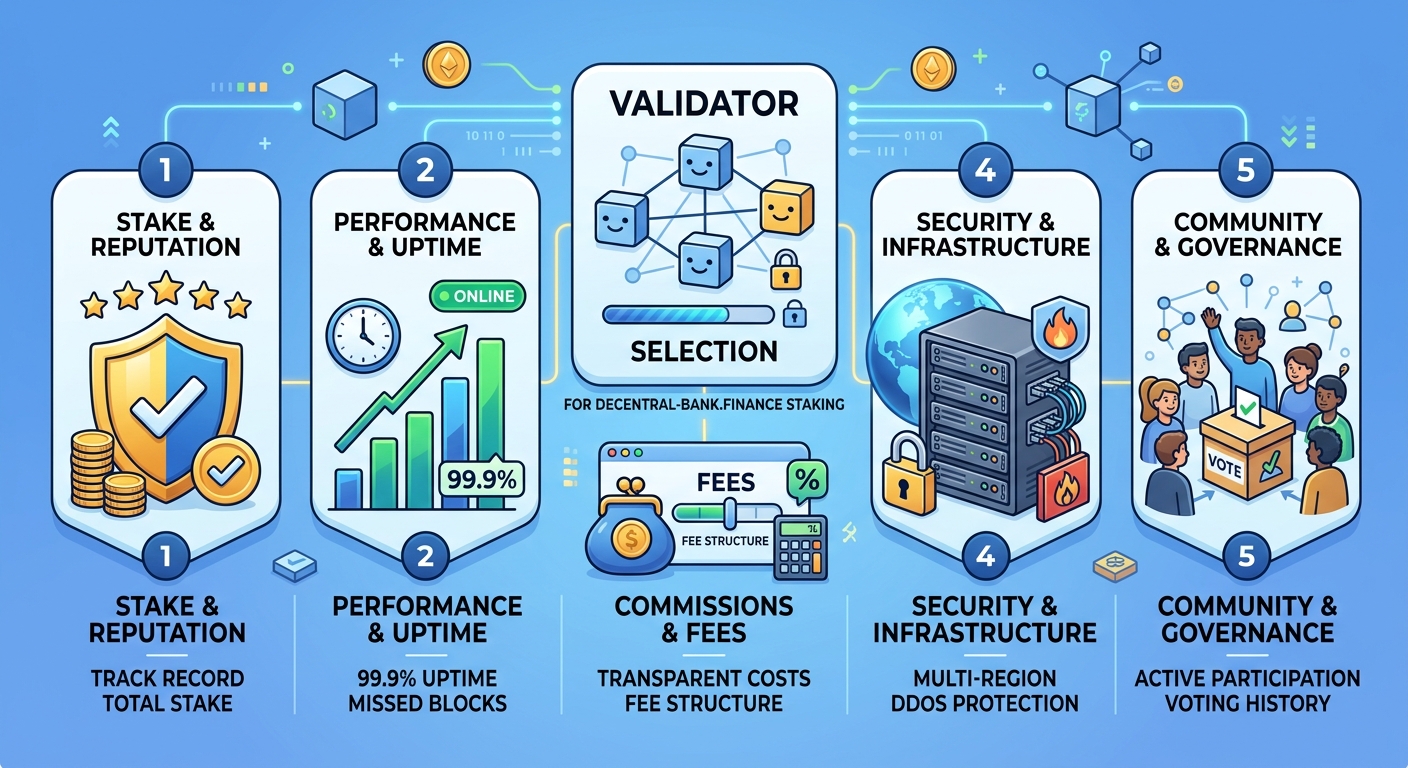
Choosing a validator requires evaluating uptime history, commission structure, security practices, community reputation, and network decentralization. High APY alone doesn’t guarantee safety or consistent returns. The best validators balance competitive rates with transparent operations, proven reliability, and active participation in governance. Understanding these factors helps you protect your staked assets from slashing penalties and unexpected losses.
Why validator selection matters more than you think
When you stake tokens on a proof of stake network, you delegate control to a validator who processes transactions and secures the blockchain on your behalf.
If that validator goes offline, you miss rewards.
If they misbehave or get hacked, you face slashing penalties that reduce your principal.
If they charge hidden fees or operate multiple nodes under different names, your returns shrink without warning.
The validator you choose directly impacts your earnings, your security, and your ability to exit positions when market conditions change. Understanding slashing penalties helps you grasp what’s at stake beyond just APY numbers.
Uptime and performance history
Validators earn rewards by staying online and participating in consensus.
Every missed block means lost rewards for you.
Check the validator’s uptime percentage over the past 90 days. Anything below 99% should raise concerns. Networks like Cosmos, Polkadot, and Ethereum publish this data publicly through block explorers.
Look for patterns of downtime. A single maintenance window is normal. Repeated outages suggest infrastructure problems or poor management.
Some validators run redundant servers across multiple data centers. Others operate from a single location with no backup. Ask about their setup before delegating.
Performance also includes participation rate in governance votes and network upgrades. Validators who skip votes or delay updates may miss rewards or face penalties during protocol transitions.
Commission rates and fee structures
Validators charge a commission on your staking rewards.
This fee typically ranges from 0% to 20%, depending on the network and the validator’s strategy.
A 0% commission sounds attractive, but it often signals a new validator trying to attract delegators. They may raise fees later or lack the resources to maintain reliable infrastructure.
A 5% to 10% commission is standard for established validators with proven track records.
Some validators also charge additional fees for services like liquid staking derivatives or auto-compounding. Read the fine print before delegating.
Compare effective yield after fees, not just the advertised APY. A validator offering 12% APY with 10% commission gives you 10.8% net yield. Another offering 10% APY with 5% commission gives you 9.5% net yield.
The math matters more than the marketing.
Security practices and infrastructure
Your staked tokens remain in your wallet, but the validator controls the signing keys that validate transactions.
If those keys get compromised, attackers can trigger slashing conditions that burn your stake.
Ask validators about their key management practices:
- Do they use hardware security modules (HSMs)?
- Are signing keys stored in cold storage or hot wallets?
- Do they run nodes in secure data centers with physical access controls?
- Have they ever been hacked or experienced a security incident?
Validators should publish security audits or certifications from third parties. If they don’t, that’s a red flag.
Also check whether they operate nodes for multiple networks. Diversification can indicate expertise, but it can also spread their attention too thin. A validator managing 20 networks may not respond as quickly to issues as one focused on three.
Community reputation and transparency
Reputation takes years to build and minutes to destroy.
Search for the validator’s name in community forums, Discord servers, and governance discussions. What do other delegators say about their experience?
Look for validators who:
- Publish regular updates about their operations
- Respond to delegator questions within 24 hours
- Participate actively in network governance
- Contribute to ecosystem development through grants, tools, or education
Avoid validators who:
- Make unrealistic yield promises
- Refuse to disclose their team or location
- Have a history of voting against community interests
- Operate multiple validators under different names without disclosure
Transparency builds trust. Validators who hide basic information about their setup or team are taking your delegation for granted. You can learn more about evaluating protocol safety through tools that check if a DeFi protocol is safe.
Network decentralization and stake distribution
Staking too much with a single validator or a small group of validators undermines the network’s security.
If one validator controls more than 33% of staked tokens, they can halt the network. If they control more than 66%, they can rewrite transaction history.
Check the validator’s current stake relative to the total network stake. Most healthy networks aim for no single validator to hold more than 5% of total stake.
Delegating to smaller validators with strong track records helps decentralize the network and often comes with better support and communication.
Some networks offer higher rewards for delegating to validators outside the top 10 or top 20. These incentives encourage better stake distribution and reduce systemic risk.
“The best validator isn’t always the biggest. It’s the one that balances reliability, transparency, and alignment with your risk tolerance. Decentralization protects everyone, including you.” — Network security researcher
Step-by-step validator evaluation process
Follow this method when choosing a validator:
- Identify 5 to 10 validators with uptime above 99% over the past 90 days.
- Compare their commission rates and calculate net yield after fees.
- Review their security practices and infrastructure documentation.
- Search community forums for feedback and reputation signals.
- Check their stake percentage relative to the total network stake.
- Verify their participation in governance votes and network upgrades.
- Start with a small delegation to test their performance before committing more.
This process takes 30 to 60 minutes but protects you from costly mistakes.
Common validator selection mistakes
| Mistake | Why it hurts | Better approach |
|---|---|---|
| Choosing highest APY only | Often comes with higher risk or hidden fees | Calculate net yield after all fees and assess risk factors |
| Ignoring uptime history | Missed blocks mean lost rewards | Require 99%+ uptime over 90 days minimum |
| Delegating to top validators only | Concentrates risk and reduces decentralization | Consider smaller validators with strong track records |
| Skipping security research | Leaves you vulnerable to slashing | Verify key management and infrastructure security |
| Not monitoring performance | Validator quality can degrade over time | Review performance quarterly and redelegate if needed |
What to watch after delegating
Your job doesn’t end after selecting a validator.
Monitor these metrics monthly:
- Current uptime percentage
- Missed blocks or slashing events
- Changes to commission rates
- Participation in governance votes
- Community feedback and reputation
Set calendar reminders to review your delegation every 90 days. Networks evolve, validators change, and better options emerge.
If a validator’s performance drops below 98% uptime for two consecutive months, consider redelegating. If they raise commission rates without notice, look for alternatives.
Your stake is your responsibility. Active monitoring protects your returns. Understanding when you should unstake your crypto helps you make timely decisions when conditions change.
Network-specific considerations
Different networks have different validator requirements and risks.
Ethereum validators require 32 ETH and technical expertise to run a node. Most people use staking services or liquid staking options instead.
Cosmos validators participate in governance for multiple app chains. Their voting behavior affects your stake across the entire ecosystem.
Polkadot validators rotate in and out of the active set based on stake and performance. You may need to redelegate if your validator loses their spot.
Solana validators require high-performance hardware and face frequent network upgrades. Downtime during upgrades is common but shouldn’t exceed a few hours.
Research your specific network’s validator requirements and risks before delegating. What works on one chain may not work on another.
Red flags that signal trouble
Walk away from validators who:
- Promise guaranteed returns or “risk-free” staking
- Operate anonymously without any team information
- Refuse to answer questions about security practices
- Have uptime below 95% in the past month
- Charge commission rates above 20%
- Run nodes from residential internet connections
- Show no participation in governance or community discussions
These signals indicate either incompetence or malicious intent. Neither is worth your stake.
Balancing yield and security
The validator offering the highest APY is rarely the safest choice.
A 2% difference in yield means little if the validator gets slashed and you lose 10% of your principal.
Think about your total position size and risk tolerance. If you’re staking $1,000, a 2% yield difference equals $20 per year. That’s not worth sacrificing security and reliability.
If you’re staking $100,000, a 2% difference equals $2,000 per year. That might justify taking slightly more risk, but only after thorough research.
Most experienced stakers split their delegation across 3 to 5 validators to reduce concentration risk. This approach balances yield optimization with safety.
Making your validator work for you
The right validator becomes a long-term partner in your staking strategy.
They should provide regular updates, respond to questions, and advocate for your interests in governance decisions. If they don’t, you’re just a number in their delegation pool.
Look for validators who:
- Publish monthly performance reports
- Maintain active communication channels
- Offer educational resources about the network
- Vote in alignment with delegator interests
- Contribute to ecosystem development
These validators treat delegation as a relationship, not a transaction. That mindset protects your stake and improves your returns over time.
Building a safer staking strategy
Choosing a validator is just one part of a complete staking approach.
You also need to understand lock-up periods, slashing risks, and what staking rewards are actually worth after fees and inflation.
Start small with your first delegation. Test the validator’s performance and communication for 30 to 60 days before increasing your stake.
Keep records of your delegation dates, amounts, and expected returns. This documentation helps you track performance and make informed decisions about redelegation.
Review your staking strategy every quarter. Networks change, validators improve or decline, and better opportunities emerge. Staying informed protects your capital and maximizes your returns.
Your stake deserves better than guesswork
Validator selection shouldn’t feel like gambling.
The factors covered here give you a framework for making informed decisions based on data, reputation, and risk management. High APY matters, but uptime, security, and transparency matter more.
Take the time to research before delegating. Monitor performance after delegating. Redelegate when conditions change.
Your staked tokens represent real capital with real risks. Treat validator selection with the seriousness it deserves, and you’ll build a staking strategy that compounds safely over time.