Stepping into decentralized finance feels like landing in a foreign country where everyone speaks a different language. You hear terms like “liquidity pools” and “gas fees” thrown around casually, but nobody stops to explain what they actually mean. That confusion keeps many people on the sidelines, watching others participate in this new financial system while feeling too intimidated to join. The good news? You only need to understand a handful of core concepts to get started confidently.
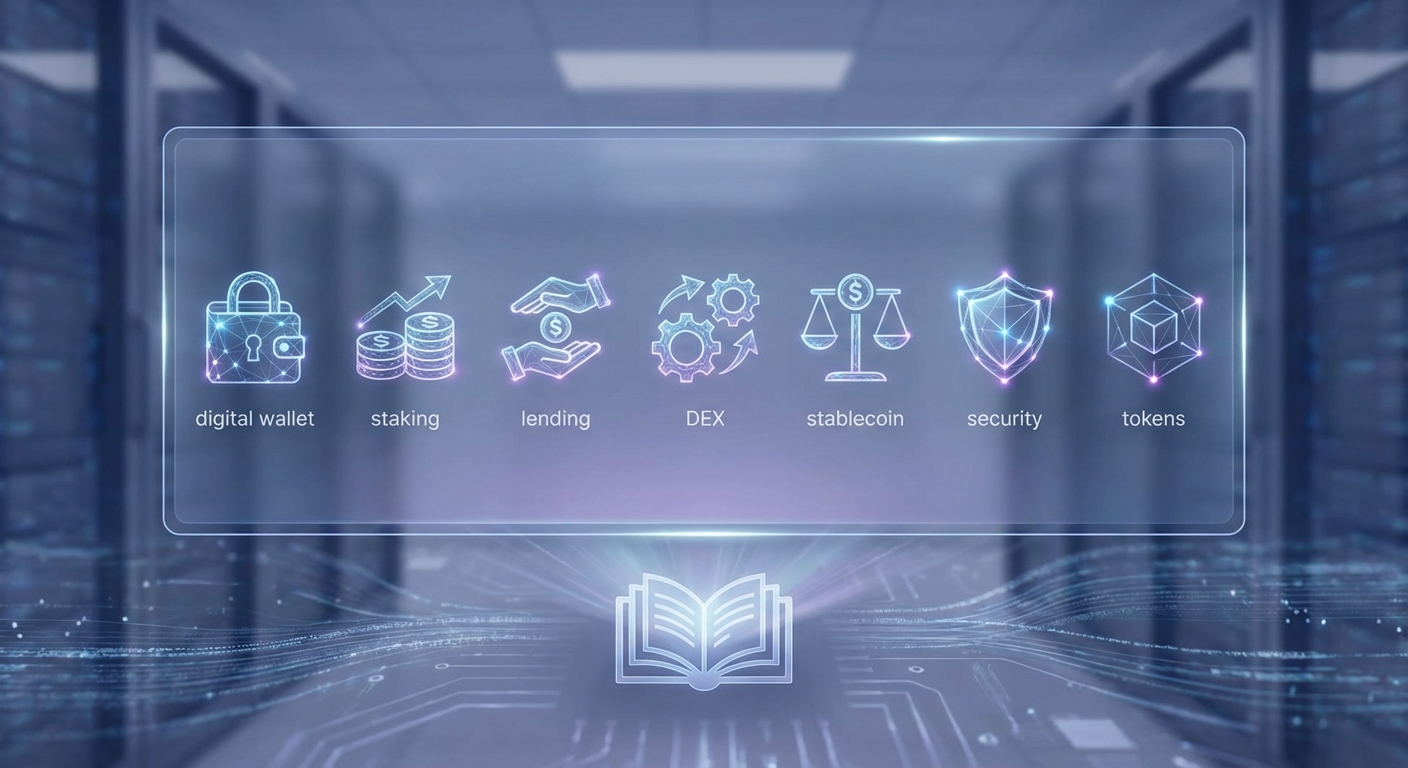
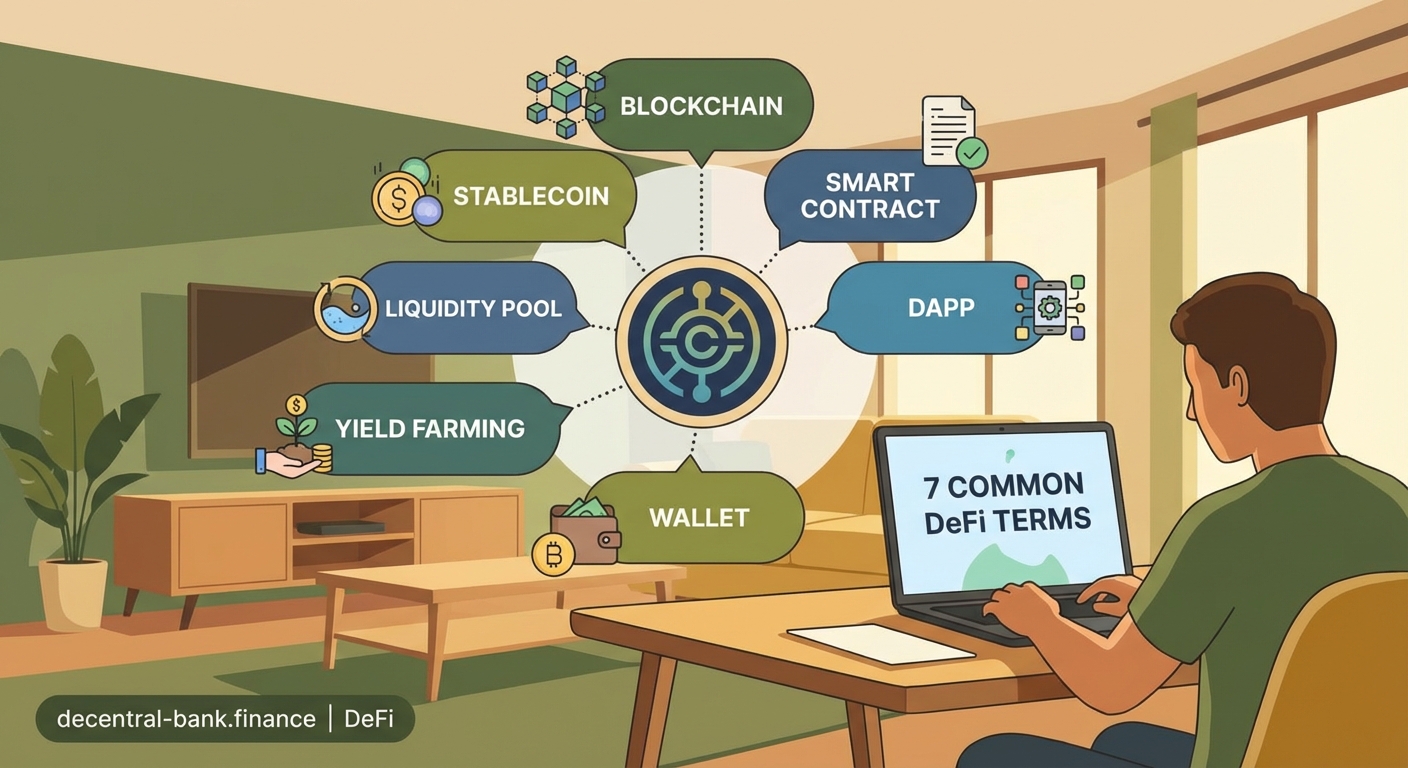
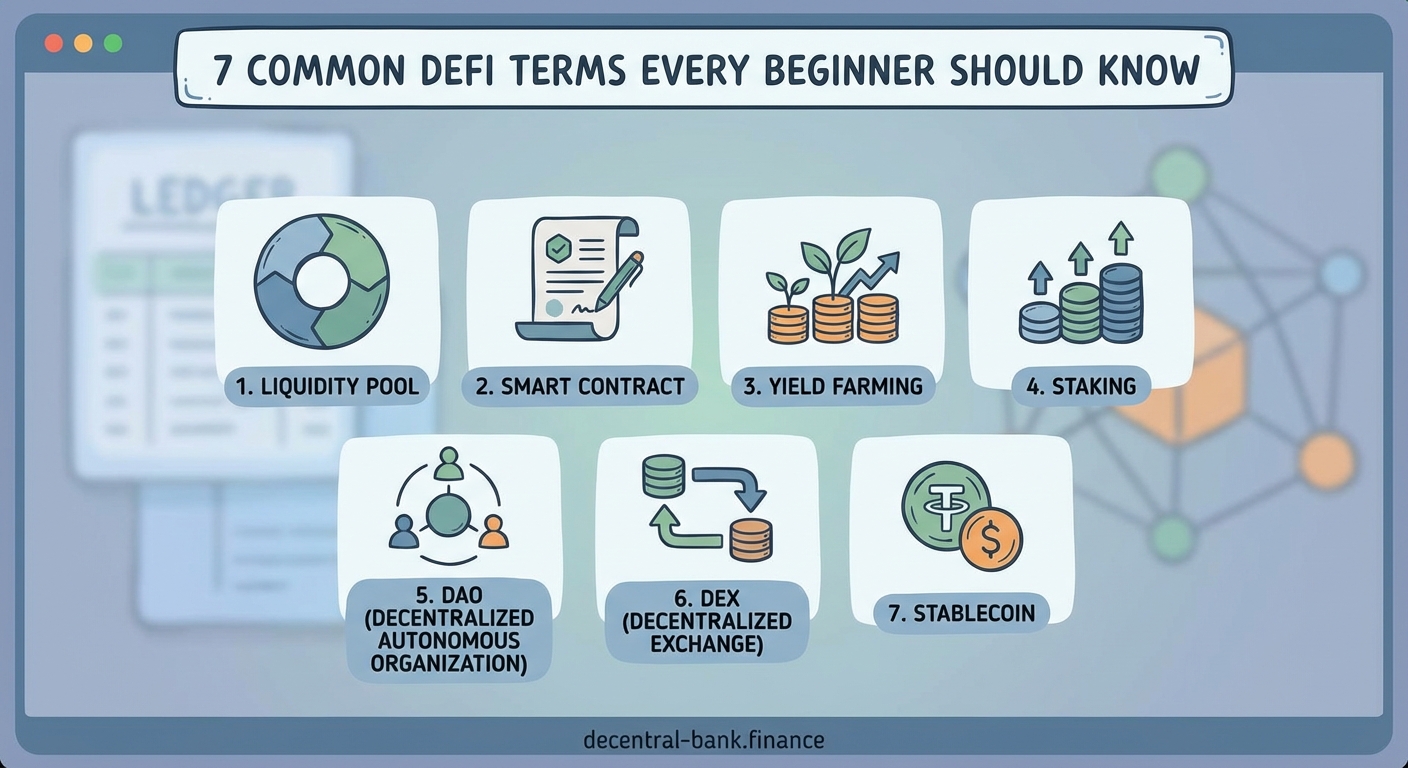
Understanding DeFi terms for beginners starts with seven essential concepts: smart contracts, decentralized exchanges, liquidity pools, gas fees, staking, yield farming, and stablecoins. These foundational terms unlock the ability to participate safely in decentralized finance platforms. Mastering this vocabulary helps you evaluate opportunities, avoid common pitfalls, and make informed decisions about lending, borrowing, trading, and earning with your crypto assets.
Understanding smart contracts and why they matter
Smart contracts are self-executing agreements written in code that run on blockchain networks. Think of them as vending machines for financial services. You insert money, select what you want, and the machine automatically delivers without needing a person to oversee the transaction.
Traditional contracts require lawyers, banks, or other intermediaries to enforce terms. Smart contracts eliminate that middleman entirely. When predetermined conditions are met, the contract executes automatically. No delays, no disputes about interpretation, no trust required.
Here’s a practical example. You want to lend someone cryptocurrency and earn interest. A smart contract can automatically transfer your crypto to the borrower, calculate interest daily, and return your principal plus earnings at the end of the term. All without a bank processing the loan or tracking payments.
The code is visible to everyone on the blockchain. This transparency means you can verify exactly what will happen before committing your funds. However, bugs in the code can create vulnerabilities, which is why audited smart contracts from established protocols matter. How does DeFi actually work without banks or middlemen? explains this concept in greater depth.
Decentralized exchanges and how they differ from traditional platforms
Decentralized exchanges, commonly called DEXs, let you trade cryptocurrencies directly with other users without a company controlling your funds. Traditional exchanges like Coinbase or Binance hold your crypto in their custody. DEXs never take possession of your assets.
When you trade on a DEX, you connect your wallet directly to the platform. Smart contracts facilitate the exchange between you and another trader. Your crypto stays in your wallet until the exact moment the trade executes. This eliminates the risk of an exchange getting hacked and losing your funds.
Popular DEXs include Uniswap, SushiSwap, and PancakeSwap. Each operates slightly differently but shares the same core principle: peer-to-peer trading without intermediaries. You maintain full control of your private keys throughout the entire process.
The tradeoff? DEXs typically have less liquidity than major centralized exchanges, which can mean slightly worse prices for large trades. They also require you to manage your own security. There’s no customer service number to call if you send funds to the wrong address.
Liquidity pools explained in simple terms
Liquidity pools are collections of cryptocurrency locked in smart contracts that enable trading on decentralized exchanges. Instead of matching buyers and sellers like traditional exchanges, DEXs use these pools to facilitate instant trades.
Here’s how it works. Users called liquidity providers deposit pairs of tokens into a pool. For example, they might add both ETH and USDC to an ETH/USDC pool. When someone wants to trade ETH for USDC, they trade against this pool rather than waiting for another person to match their order.
Liquidity providers earn fees from every trade that happens in their pool. If you contribute 1% of the total pool, you earn 1% of all trading fees. This creates a passive income opportunity, though it comes with risks we’ll address shortly.
The ratio between tokens in a pool determines the price. As people trade, the ratio shifts, and prices adjust automatically. This mechanism is called an automated market maker, or AMM. It’s elegant but can create unexpected outcomes for liquidity providers.
Providing liquidity can generate steady income, but impermanent loss is a real risk that catches many beginners off guard. Never commit funds you can’t afford to lose while you’re learning.
How to provide liquidity on Uniswap without losing money covers strategies to minimize these risks.
Gas fees and why they fluctuate so much
Gas fees are transaction costs paid to blockchain validators who process and secure your transactions. Every action on a blockchain requires computational power. Gas fees compensate the network participants who provide that power.
Think of gas as the fuel that powers your transaction. Just like gasoline prices at the pump, gas fees fluctuate based on network demand. When lots of people are trying to make transactions simultaneously, fees spike. During quiet periods, they drop.
Ethereum has historically had the highest gas fees because it’s the most popular smart contract platform. A simple transaction might cost anywhere from $2 to $50 depending on network congestion. Complex interactions with DeFi protocols can cost even more.
Several factors affect gas fees:
- Network congestion levels at the moment you transact
- Complexity of the smart contract you’re interacting with
- Speed priority you select for transaction processing
- Overall demand for block space on the network
You can reduce gas costs by transacting during off-peak hours, typically weekends or late at night in major time zones. Some wallets also let you set custom gas prices, accepting slower processing in exchange for lower fees.
Alternative blockchains like Polygon, Arbitrum, and Optimism offer much lower gas fees while maintaining compatibility with Ethereum applications. Many DeFi users now operate primarily on these networks to avoid expensive transaction costs.
Staking and how it generates passive income
Staking means locking your cryptocurrency in a protocol to help secure the network or provide liquidity in exchange for rewards. It’s similar to earning interest in a savings account, but the mechanism works differently.
Proof-of-stake blockchains require validators to stake tokens as collateral. This stake acts as a security deposit. If validators try to cheat or attack the network, they lose their staked tokens. This economic incentive keeps the network secure.
Most people don’t run their own validator nodes because it requires technical knowledge and significant capital. Instead, they participate through staking pools or protocols that aggregate smaller amounts from many users.
Staking rewards typically range from 4% to 20% annually, depending on the network and current participation rates. Higher rewards often come with higher risks. Some protocols offer unsustainably high returns that collapse when the token price drops or the project fails.
Three common ways to stake:
- Direct staking through a blockchain’s native wallet
- Delegating to a validator through a staking pool
- Depositing into a DeFi protocol that stakes on your behalf
How to start staking crypto provides step-by-step instructions for each method.
Your staked tokens are often locked for a period. You can’t access them immediately if you need to sell. This illiquidity is an important consideration when deciding how much to stake.
Yield farming and its risks
Yield farming involves moving cryptocurrency between different DeFi protocols to maximize returns. Farmers constantly seek the highest yields, often combining multiple strategies simultaneously to compound their earnings.
A typical yield farming strategy might look like this: deposit USDC into a lending protocol to earn interest, receive the protocol’s governance token as a bonus reward, stake that governance token in another pool to earn additional yield, and then reinvest everything to compound returns.
The potential returns can be substantial. Some yield farms offer triple-digit annual percentage yields. However, these high returns come with significant risks that beginners often underestimate.
| Strategy Type | Typical Return | Risk Level | Time Commitment |
|---|---|---|---|
| Simple staking | 5-12% APY | Low | Minimal |
| Liquidity provision | 10-30% APY | Medium | Low |
| Single-protocol farming | 20-50% APY | Medium-High | Medium |
| Multi-protocol farming | 50-200% APY | Very High | High |
The biggest risk is impermanent loss, which occurs when the price ratio between tokens in a liquidity pool changes. If you provided ETH and USDC, and ETH doubles in price, you would have earned more by simply holding ETH instead of providing liquidity.
Smart contract vulnerabilities present another major risk. Yield farmers often use new, unaudited protocols chasing the highest returns. If a smart contract has a bug or gets exploited, you can lose everything.
Many high-yield farms also suffer from token inflation. The protocol prints new tokens as rewards, but if there’s insufficient demand for those tokens, the price crashes and your “high yield” becomes worthless.
Stablecoins and why they’re essential for DeFi
Stablecoins are cryptocurrencies designed to maintain a stable value, usually pegged to the US dollar. They solve a critical problem in DeFi: how to transact without exposing yourself to cryptocurrency price volatility.
Three main types exist:
- Fiat-collateralized stablecoins backed by actual dollars in bank accounts (USDC, USDT)
- Crypto-collateralized stablecoins backed by other cryptocurrencies locked in smart contracts (DAI)
- Algorithmic stablecoins that use complex mechanisms to maintain their peg (though many have failed)
USDC and USDT are the most widely used stablecoins. Each token represents one US dollar held in reserve by the issuing company. You can redeem them for actual dollars, though most people simply trade them for other cryptocurrencies.
Stablecoins serve multiple purposes in DeFi. They provide a safe harbor during market volatility. They enable efficient trading between different cryptocurrencies without converting back to fiat. They facilitate lending and borrowing with predictable values.
How do stablecoins maintain their $1 peg during market crashes? examines the mechanisms that keep these tokens stable.
The stability isn’t perfect. During extreme market stress, even major stablecoins can temporarily trade slightly above or below their $1 peg. Most deviations are small and quickly correct, but understanding this risk matters.
Regulatory uncertainty also looms over stablecoins. Governments worldwide are developing frameworks to regulate these assets, which could significantly impact how they operate in the future.
Protecting yourself while learning these concepts
Understanding terminology is just the first step. Applying this knowledge safely requires additional precautions that many beginners overlook in their excitement to participate.
Start with small amounts you can afford to lose completely. Your first transactions are learning experiences. Mistakes will happen, and that’s okay if the financial impact is minimal.
Never rush into opportunities promising unusually high returns. Legitimate DeFi protocols offer reasonable yields. If something claims 1000% APY, it’s either extremely risky or an outright scam. How to spot a rug pull before you lose your crypto helps identify warning signs.
Use hardware wallets for significant holdings. How to choose between hot wallets and cold wallets for your crypto explains the security tradeoffs between different wallet types.
Research protocols before committing funds. Look for:
- Audited smart contracts from reputable security firms
- Established track records of at least several months
- Active development teams with transparent communication
- Reasonable yields that align with sustainable economics
- Clear documentation explaining how everything works
Join communities around the protocols you’re interested in. Discord servers, Telegram groups, and Reddit forums provide valuable insights from experienced users. Ask questions. Most DeFi communities welcome beginners who show genuine interest in learning.
Keep detailed records of all transactions for tax purposes. DeFi activities create taxable events in most jurisdictions. Tracking everything from the start saves massive headaches later.
Building your DeFi knowledge foundation
These seven terms form the vocabulary you need to understand most DeFi conversations and opportunities. Smart contracts power the entire ecosystem. DEXs and liquidity pools enable trading. Gas fees are the cost of doing business. Staking and yield farming represent different approaches to earning returns. Stablecoins provide stability and utility.
Each concept connects to the others. Liquidity pools use smart contracts. Yield farming happens on DEXs. Staking often involves stablecoins. Understanding how these pieces fit together transforms DeFi from an intimidating mystery into a logical system you can navigate confidently.
Start by observing before participating. Browse DeFi platforms without connecting your wallet. Read documentation. Watch tutorials. Follow experienced users on social media. This research phase builds intuition that protects you from costly mistakes.
When you’re ready to participate, begin with the simplest activities. Make a small trade on a DEX. Provide a tiny amount of liquidity to a major pool. Stake a small amount with an established protocol. Each successful transaction builds confidence and practical understanding.
The DeFi space evolves rapidly. New protocols launch constantly. Existing ones update their features. Regulations shift. Staying informed requires ongoing learning, but the foundation these seven terms provide remains constant. Master them, and you’ll have the literacy needed to evaluate new opportunities as they emerge and participate in this financial revolution on your own terms.