Choosing your first decentralized exchange feels overwhelming when you’re staring at gas fees, wallet connections, and unfamiliar terminology. Most platforms assume you already understand how DeFi actually works without banks or middlemen, leaving beginners to figure out critical details through expensive trial and error. The good news is that several exchanges now prioritize accessibility without sacrificing security or functionality.
The best decentralized exchanges for beginners combine intuitive interfaces with educational resources, reasonable fees, and strong security measures. Platforms like Uniswap, PancakeSwap, and Curve offer different advantages depending on your blockchain preference, trading goals, and experience level. Understanding wallet requirements, gas costs, and slippage settings before your first trade prevents costly mistakes and builds confidence in managing your own assets.
What Makes a DEX Beginner-Friendly
Not all decentralized exchanges treat newcomers equally. Some throw you into advanced trading interfaces with minimal guidance. Others walk you through each step.
The difference comes down to design philosophy.
Beginner-friendly platforms share several characteristics. They display clear price quotes before you commit. They explain why transactions might fail. They offer reasonable default settings that protect you from common errors.
Interface clarity matters more than you might think. When you’re trying to swap tokens for the first time, visual feedback about what’s happening with your funds reduces anxiety. Simple confirmation screens that show exactly what you’re approving make a massive difference.
Customer support exists in different forms across DEXs. Some maintain active Discord communities where experienced users help newcomers. Others publish detailed documentation and video tutorials. A few offer in-app guidance that appears when you hover over unfamiliar terms.
Fee transparency separates good platforms from frustrating ones. The best exchanges show you network fees, platform fees, and estimated total costs before you approve anything. Hidden costs that only appear after you’ve initiated a transaction create terrible first experiences.
Understanding Wallet Connection Requirements
Every decentralized exchange requires you to connect a self-custody wallet. This fundamental difference from centralized platforms confuses many beginners.
Your wallet holds your private keys. The DEX never takes custody of your funds. This arrangement gives you complete control but also complete responsibility.
Most beginners start with MetaMask or Trust Wallet. Both support multiple blockchains and integrate smoothly with popular exchanges. Setting up your first DeFi wallet correctly prevents security issues down the road.
Connection happens through a simple approval process. You click “Connect Wallet” on the DEX interface. Your wallet extension or app opens. You approve the connection. The DEX can now read your token balances and request transaction approvals.
The exchange never gets access to move funds without your explicit permission for each transaction. Understanding what happens when you approve a smart contract helps you make informed decisions about which permissions to grant.
Some wallets work better with certain chains. If you plan to use Ethereum-based DEXs, MetaMask offers excellent compatibility. For Binance Smart Chain trading, Trust Wallet provides smoother integration. Choosing between different wallet types depends on your security needs and trading frequency.
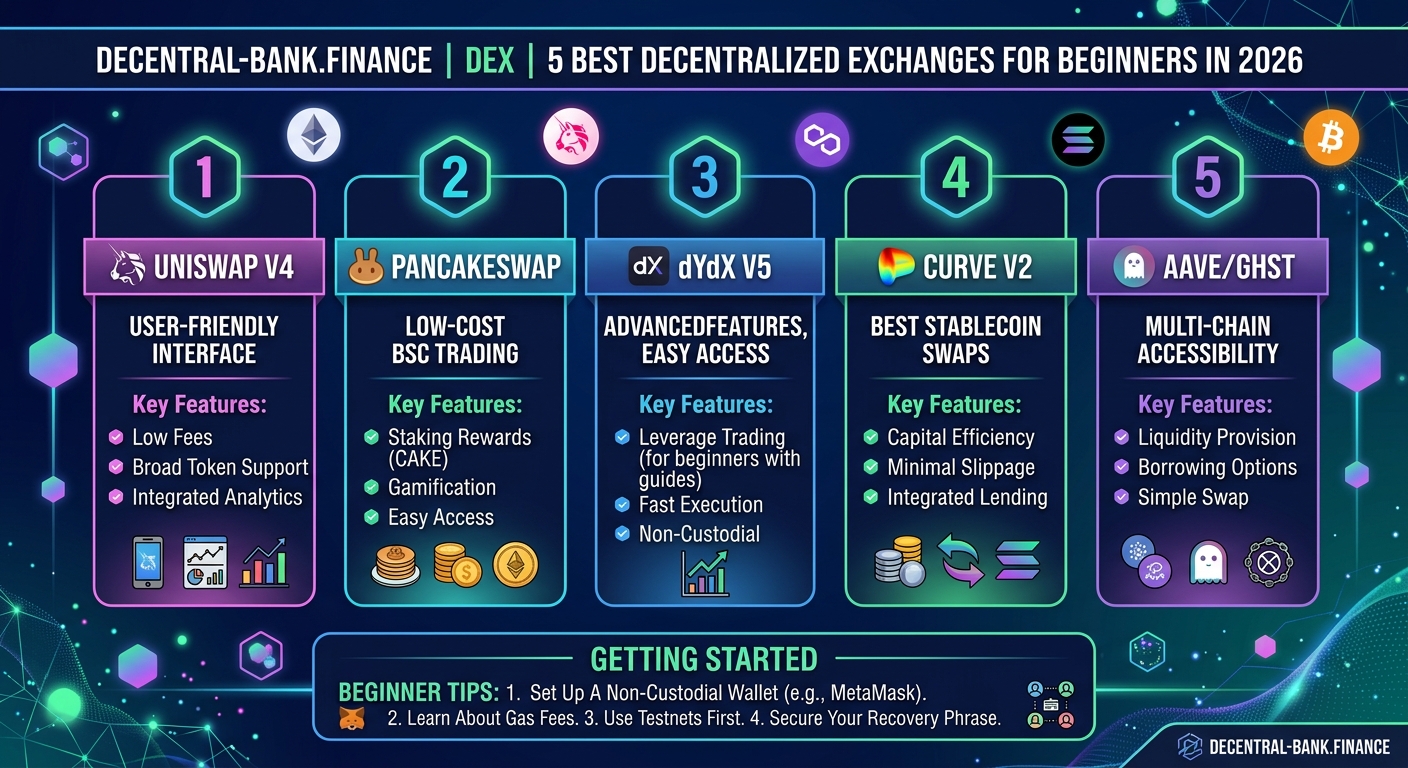
Top Five Exchanges for Your First Trades
Uniswap
Uniswap pioneered the automated market maker model that most DEXs now use. The interface looks clean and minimal, which helps when you’re learning basic swap mechanics.
Version 3 introduced concentrated liquidity features that advanced traders love. As a beginner, you can ignore these complexities and stick with simple token swaps.
The platform supports thousands of token pairs on Ethereum mainnet. Gas fees can run high during network congestion, but the exchange clearly displays estimated costs before you commit.
Uniswap’s documentation explains concepts like slippage tolerance and price impact in straightforward language. The help center covers common issues without assuming technical knowledge.
One downside for beginners is the lack of fiat on-ramps. You need to already own ETH or other tokens before trading. Many newcomers buy ETH on a centralized exchange first, then transfer it to their wallet for Uniswap trading.
PancakeSwap
PancakeSwap operates on BNB Chain, where transaction fees cost pennies instead of dollars. This makes it perfect for practicing trades without worrying about expensive mistakes.
The interface feels more playful than Uniswap, with colorful graphics and gamification elements. Some users find this approachable. Others prefer more serious aesthetics.
Beyond basic swaps, PancakeSwap offers staking opportunities and liquidity farming. You can explore these features once comfortable with simple trading.
The platform includes built-in educational pop-ups that explain terms when you hover over them. This contextual learning helps you build knowledge while actually using the exchange.
BNB Chain’s lower fees let you experiment with small amounts. You can practice setting slippage tolerance, adjusting gas prices, and timing your trades without significant financial risk.
Curve Finance
Curve specializes in stablecoin trading with minimal slippage. If you plan to move between different stablecoins, Curve offers better rates than general-purpose DEXs.
The interface looks more technical than Uniswap or PancakeSwap. Numbers and graphs dominate the screen. This might feel intimidating at first but actually provides useful information once you understand what you’re looking at.
Curve’s strength lies in its stability-focused pools. When you swap USDC for DAI, price impact stays minimal even for larger trades. This efficiency matters when you’re trying to preserve value while moving between stablecoins.
The platform supports multiple chains including Ethereum, Polygon, and Arbitrum. You can choose networks with lower fees while accessing the same liquidity pools.
Advanced features like voting and gauge weights can wait until you’re comfortable with basic swaps. Curve lets you ignore complexity until you’re ready to learn more.
SushiSwap
SushiSwap started as a Uniswap fork but evolved into its own ecosystem. The interface feels familiar if you’ve used Uniswap, making it easy to switch between platforms.
Multi-chain support stands out as a major advantage. You can trade on Ethereum, Polygon, Arbitrum, and a dozen other networks from the same interface. This flexibility helps you find the best combination of fees and token availability.
The analytics dashboard shows detailed information about token pairs, liquidity depth, and trading volume. These metrics help you assess whether a particular pair has enough liquidity for your trade size.
SushiSwap’s community maintains active forums where beginners can ask questions. The team publishes regular updates about new features and security improvements.
One consideration is that smaller token pairs might have less liquidity than on Uniswap. Always check the price impact indicator before confirming trades on less popular pairs.
1inch
1inch functions as a DEX aggregator rather than a standalone exchange. It searches multiple DEXs simultaneously to find you the best price for your trade.
This approach saves you from manually checking rates across different platforms. The interface shows you which exchanges 1inch is pulling liquidity from and how your trade gets split between them.
For beginners, aggregation means better prices without additional complexity. You make one transaction, and 1inch handles the routing behind the scenes.
The platform includes a limit order feature that lets you set a target price. Your trade executes automatically when the market reaches your specified rate. This functionality bridges the gap between DEX simplicity and centralized exchange features.
Gas optimization algorithms help reduce transaction costs on Ethereum. 1inch bundles operations efficiently, sometimes saving 30-40% compared to executing the same trades manually.
Step-by-Step Process for Your First Swap
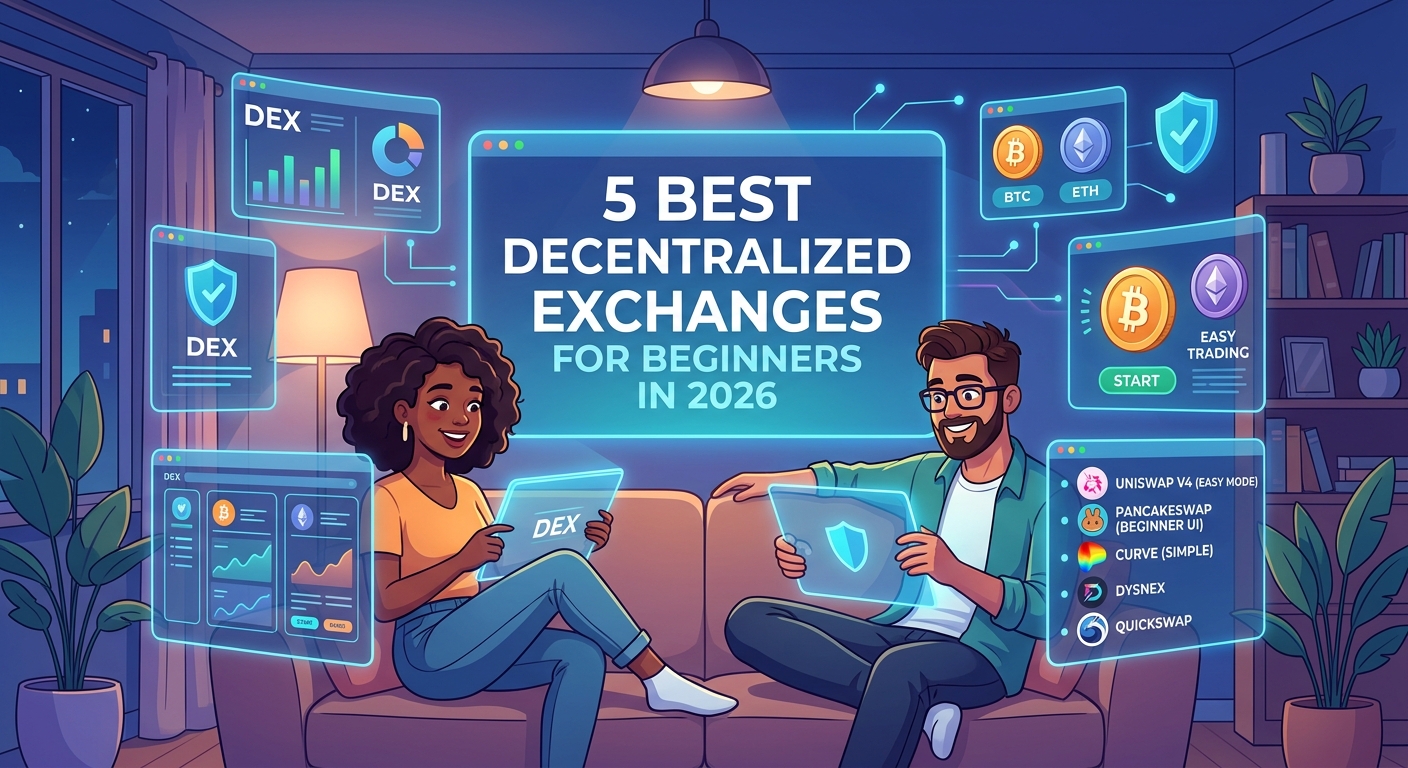
Making your first decentralized exchange trade involves several distinct steps. Understanding each one prevents confusion and reduces error risk.
-
Fund your wallet with the base token for your chosen blockchain. Ethereum DEXs require ETH for gas fees. BNB Chain needs BNB. Polygon uses MATIC. You need this native token even if you’re trading different assets.
-
Visit the DEX website and connect your wallet. Click the connect button, select your wallet type, and approve the connection in your wallet interface. The DEX will display your token balances once connected.
-
Select the tokens you want to swap. Choose your input token (what you’re selling) and output token (what you’re buying). The interface shows available balance for your input token.
-
Enter the amount you want to trade. Type the quantity of input tokens or output tokens. The interface calculates the other side of the trade automatically based on current prices.
-
Review the exchange rate and price impact. Check that the rate looks reasonable compared to centralized exchange prices. Price impact above 1% suggests low liquidity for that pair.
-
Adjust slippage tolerance if needed. Default settings work for most trades. Increase slippage only if your transaction keeps failing due to price movement. Higher slippage means you accept worse prices to guarantee execution.
-
Approve the token spending limit if this is your first time trading that token. This separate transaction gives the DEX permission to move your tokens. You only do this once per token per DEX.
-
Confirm the swap transaction. Review all details one final time. Check the minimum received amount. Approve the transaction in your wallet. Wait for blockchain confirmation.
Common Fee Structures Explained
Decentralized exchanges charge fees differently than centralized platforms. Understanding these costs helps you budget accurately and choose the right platform for your needs.
| Fee Type | Typical Range | Who Receives It | When You Pay |
|---|---|---|---|
| Network Gas | $1-50 on Ethereum, $0.10-2 on other chains | Blockchain validators | Every transaction |
| Platform Fee | 0.05%-0.3% of trade value | DEX protocol and liquidity providers | Each swap |
| Slippage Cost | Varies by liquidity | Market makers | Trades in low-liquidity pairs |
| Price Impact | 0.1%-5%+ depending on size | Liquidity pool rebalancing | Large trades relative to pool size |
Network gas fees fluctuate based on blockchain congestion. Ethereum costs spike during high activity periods. Layer 2 solutions like Arbitrum and Optimism offer similar security with 90% lower fees.
Platform fees get distributed to liquidity providers who supply tokens to trading pools. These fees incentivize users to deposit assets, which improves trading conditions for everyone.
Understanding why DEX trades fail often comes down to insufficient gas or slippage settings that don’t account for market volatility.
Some platforms offer fee discounts if you hold their governance token. PancakeSwap reduces fees for CAKE holders. SushiSwap provides benefits to SUSHI stakers. These programs reward platform loyalty but require additional token purchases.
Security Practices Every Beginner Needs
Decentralized exchanges put you in control of your assets. This autonomy comes with security responsibilities that centralized platforms handle for you.
Start by protecting your seed phrase like it’s the password to your bank account. Losing your seed phrase means permanently losing access to your funds. No customer service team can recover it for you.
Never share your seed phrase with anyone. Legitimate platforms never ask for it. Scammers often impersonate support staff and request this information. Real DEX teams will never contact you first asking for sensitive details.
Verify website URLs before connecting your wallet. Phishing sites copy legitimate DEX interfaces but steal your credentials. Bookmark the correct URLs for exchanges you use regularly. Type them manually rather than clicking search results or social media links.
Checking if a DeFi protocol is safe before trading protects you from malicious smart contracts. Audit reports, community reputation, and total value locked all indicate trustworthiness.
Review token approvals periodically. Each approval gives a smart contract permission to spend your tokens. Revoke approvals for platforms you no longer use. Token approval exploits target old permissions that users forget about.
Test small amounts first. Your first trade on any new DEX should involve minimal funds. Once you’ve confirmed everything works as expected, you can trade larger amounts with confidence.
“The biggest mistake new DEX users make is rushing into large trades without understanding how the platform works. Start with $20-50 worth of tokens. Learn the interface. Make mistakes when they cost pennies, not hundreds of dollars. Your future self will thank you for this patience.” — DeFi educator and smart contract auditor
Comparing Different Blockchain Options
Choosing which blockchain to use for DEX trading affects your costs, speed, and available tokens. Each network offers different tradeoffs.
Ethereum hosts the most established DEXs and deepest liquidity. You’ll find virtually any token you want to trade. The downside is high gas fees that make small trades uneconomical. Consider Ethereum for larger trades where percentage fees matter more than flat gas costs.
BNB Chain provides much cheaper transactions with decent liquidity for popular tokens. The network processes blocks faster than Ethereum, so your trades confirm in seconds rather than minutes. Some users criticize its more centralized validator structure, but for beginners learning DEX mechanics, it offers a low-cost practice environment.
Polygon combines Ethereum compatibility with low fees. Many popular DEXs deployed versions on Polygon specifically to serve cost-conscious traders. Liquidity doesn’t match Ethereum mainnet, but major pairs trade smoothly.
Arbitrum and Optimism use Layer 2 technology to scale Ethereum. You get Ethereum’s security with dramatically lower costs. These networks require bridging assets from Ethereum mainnet, adding one extra step but saving substantially on ongoing trading fees.
Solana-based DEXs like Raydium offer incredibly fast transactions and minimal fees. The ecosystem feels different from Ethereum-based platforms, with its own wallet standards and token formats. Learning curve increases slightly, but costs drop to fractions of a cent per trade.
Using the same wallet for multiple blockchains simplifies management as you expand across networks. Modern wallets support dozens of chains from a single seed phrase.
Mistakes That Cost Beginners Money
Learning from others’ errors saves you from expensive lessons. These common mistakes trap newcomers repeatedly.
Ignoring price impact warnings. When you trade illiquid pairs, your transaction itself moves the market price. A 5% price impact means you’re getting 5% worse rates than the displayed price. For a $1,000 trade, that’s $50 lost to market mechanics. Stick to pairs with deep liquidity until you understand how impermanent loss and price impact work.
Setting slippage too high. Some users encounter failed transactions and immediately crank slippage to 10% or higher. This exposes you to front-running bots that detect your transaction and manipulate prices to extract maximum value. Keep slippage at 0.5-1% for stablecoin swaps and 1-3% for volatile tokens.
Trading without sufficient gas funds. Your wallet needs native tokens to pay transaction fees. Running out of ETH, BNB, or MATIC mid-trade means you can’t complete swaps or move funds. Always maintain a buffer of gas tokens separate from your trading capital.
Falling for rug pull schemes. New tokens with astronomical promised returns often turn out to be scams. Developers drain liquidity after attracting enough victims. Research tokens thoroughly before trading anything outside the top 100 by market cap.
Approving unlimited token spending. Most DEXs request unlimited approval by default, letting them spend all your tokens of a particular type. While convenient, this creates security risks if the platform gets hacked. Consider approving only the amount you plan to trade immediately.
Panic trading during volatility. Gas fees spike when everyone rushes to trade simultaneously. Your $10 swap might cost $50 in fees during extreme market movements. Wait for network congestion to clear unless you’re managing time-sensitive positions.
Tools That Make Trading Easier
Several free tools enhance your DEX experience and help you make better decisions.
GasNow and Etherscan Gas Tracker show real-time network congestion. Check these before trading on Ethereum to avoid overpaying during fee spikes. They predict optimal gas prices for different confirmation speeds.
DexScreener and DexTools aggregate trading data across multiple DEXs. Compare prices, view charts, and analyze liquidity depth before executing trades. These platforms help you spot opportunities and avoid low-liquidity traps.
Token approval checkers like Revoke.cash show all permissions you’ve granted to smart contracts. Review and revoke unused approvals regularly to minimize security exposure.
Portfolio trackers like Zapper and DeBank display your holdings across multiple wallets and chains. They calculate your total value, track profit and loss, and identify optimization opportunities.
Transaction simulators preview what will happen before you approve a transaction. Tenderly and Blocknative show expected outcomes, helping you catch errors before they cost money.
Price alert services notify you when tokens reach target prices. This lets you execute planned trades without constantly monitoring markets.
Building Confidence Through Practice
Your first few DEX trades will feel uncertain. This discomfort is normal and fades with experience.
Start with well-known tokens on established platforms. Swapping between ETH, USDC, and other top-20 tokens on Uniswap or PancakeSwap minimizes risk while you learn interface mechanics.
Document your trades in a simple spreadsheet. Record the date, tokens involved, amounts, fees paid, and any issues encountered. This log helps you identify patterns and improve your decision-making process.
Join beginner-focused communities where you can ask questions without judgment. Reddit’s r/DeFi and platform-specific Discord servers maintain channels specifically for newcomers. Experienced users often enjoy helping others avoid mistakes they made themselves.
Experiment with different DEXs to find interfaces that match your preferences. Some people prefer minimal designs. Others want detailed analytics and customization options. There’s no single best choice for everyone.
Understanding DeFi terminology accelerates your learning curve. Knowing what AMM, TVL, and APY mean helps you parse platform documentation and community discussions.
Set realistic expectations about returns. DEX trading doesn’t generate automatic profits. The same market dynamics that apply to centralized exchanges affect decentralized platforms. Your edge comes from lower fees, better privacy, and complete asset control.
Advanced Features to Explore Later
Once comfortable with basic swaps, several advanced features become accessible on beginner-friendly DEXs.
Limit orders let you specify exact prices for trades. Your order sits waiting until market conditions match your target. This feature traditionally existed only on centralized exchanges but now appears on platforms like 1inch and Uniswap X.
Liquidity provision involves depositing token pairs into pools that facilitate trading. Providing liquidity on Uniswap earns you fees from every trade using your deposited assets. The strategy carries risks that require understanding before committing significant capital.
Yield farming combines liquidity provision with additional token rewards. Platforms incentivize deposits by distributing governance tokens to liquidity providers. Returns can look attractive but understanding yield risks prevents nasty surprises.
Cross-chain swaps move assets between different blockchains in a single transaction. Services like Stargate and Synapse integrate with major DEXs to enable this functionality. Bridges introduce additional security considerations worth researching thoroughly.
Governance participation gives token holders voting rights on platform decisions. How governance tokens provide control explains the mechanics and implications of this participation.
These features expand your capabilities but aren’t necessary for successful DEX usage. Master the fundamentals first. Advanced strategies make more sense once you’ve built solid foundational knowledge.
Finding the Right Exchange for Your Goals
No single DEX serves every user perfectly. Your ideal platform depends on specific priorities and circumstances.
Choose Ethereum-based exchanges if you want maximum token selection and deepest liquidity. Accept higher fees as the cost of accessing the most established DeFi ecosystem.
Select BNB Chain platforms when learning and practicing matter more than accessing every possible token. Low fees let you experiment freely without worrying about costly mistakes.
Pick aggregators like 1inch when getting the best price matters more than using a specific platform. Let the technology handle optimization while you focus on trading decisions.
Consider multi-chain DEXs if you plan to trade across several networks. Managing one interface for multiple blockchains simplifies your workflow compared to learning separate platforms for each chain.
Prioritize platforms with strong community support if you anticipate needing help. Active Discord servers and comprehensive documentation make problem-solving much easier.
Your needs will evolve as you gain experience. Many traders use multiple DEXs for different purposes. Uniswap for Ethereum trading, PancakeSwap for BNB Chain, and 1inch for price optimization across both. This multi-platform approach maximizes your flexibility.
Taking Your First Steps Safely
Starting with decentralized exchanges represents a significant step toward financial sovereignty. You’re taking control of your assets instead of trusting third parties to manage them.
The learning curve exists but flattens faster than you expect. Your first trade takes research and careful execution. Your tenth trade feels routine. Your hundredth becomes second nature.
Begin with small amounts on low-fee chains. Build confidence through successful transactions. Gradually increase trade sizes as your comfort grows. This measured approach prevents expensive learning moments while building genuine competence.
The best decentralized exchanges make this journey manageable through clear interfaces, helpful documentation, and reasonable costs. Choose platforms that match your current skill level rather than chasing advanced features you don’t yet need.
Your first successful DEX trade marks the beginning of genuine participation in decentralized finance. Each transaction strengthens your understanding of how blockchain-based systems operate. You’re not just trading tokens. You’re learning to navigate an entirely new financial infrastructure that puts you in the driver’s seat.