
You’ve heard that liquidity providers on Uniswap can earn passive income from trading fees. But you’ve also heard the horror stories about impermanent loss eating away at profits. The truth is, both are real. Providing liquidity can be profitable, but only if you understand the mechanics and protect yourself from the risks that catch most beginners off guard.
Providing liquidity on Uniswap means depositing two tokens into a pool to earn trading fees. Success requires choosing stable pairs, understanding impermanent loss, monitoring price ranges in v3, and calculating whether fee income exceeds potential losses. Start small, use correlated assets, and track your position daily to protect capital while generating passive income from decentralized finance.
Understanding what liquidity provision actually means
When you provide liquidity on Uniswap, you’re depositing two tokens into a smart contract that acts as an automated market maker. Traders swap tokens using your liquidity, and you earn a percentage of every trade as a fee.
Sounds simple, right? The complexity comes from how the protocol maintains balance.
Your deposited tokens don’t just sit there. The smart contract automatically adjusts the ratio between your two tokens as traders buy and sell. If you deposit ETH and USDC, and ETH’s price rises, the contract sells some of your ETH for USDC to maintain the pool’s mathematical balance.
This automatic rebalancing is where impermanent loss comes from. You end up with less of the token that went up and more of the token that went down compared to just holding both tokens in your wallet.
The fees you earn need to exceed this loss for the position to be profitable.
Choosing the right token pairs
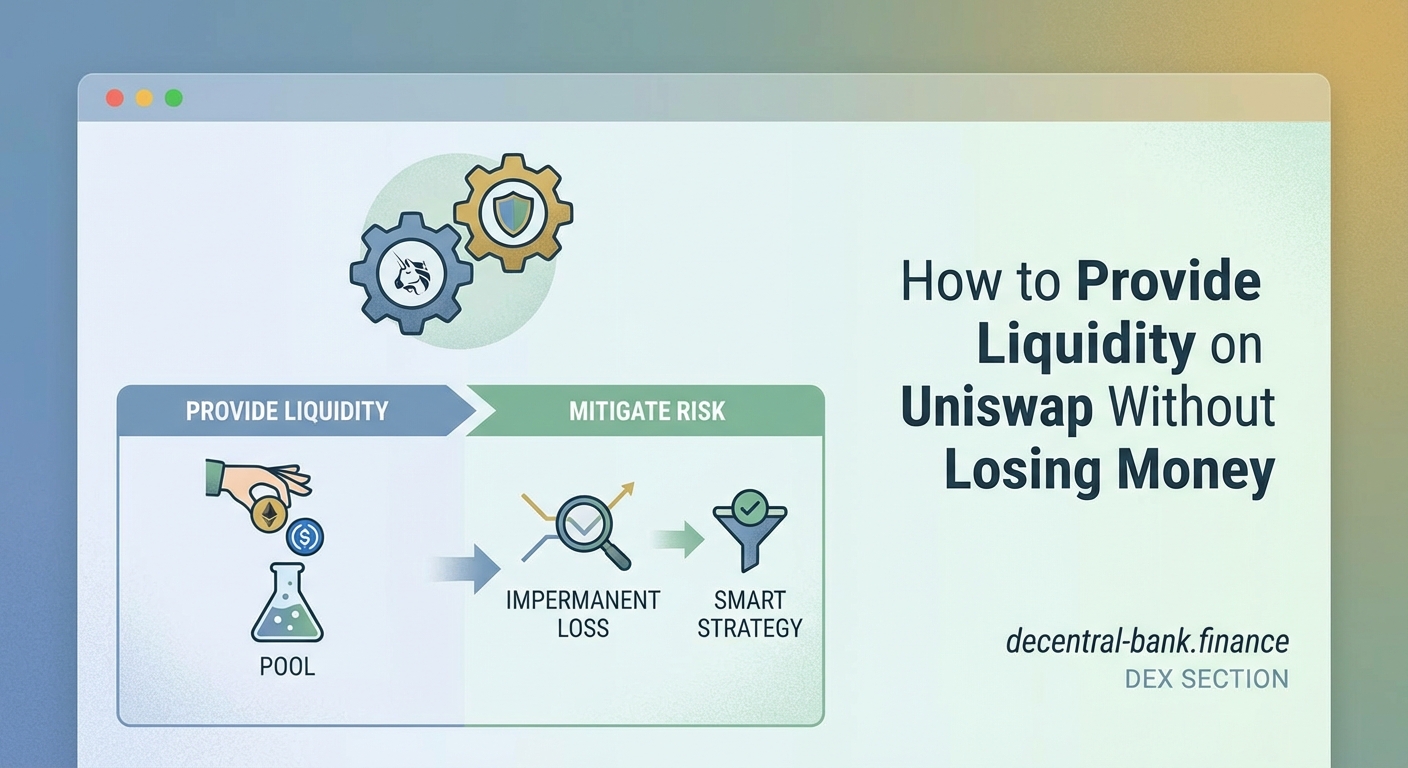
Not all liquidity pools are created equal. Your pair selection determines most of your success or failure.
Stablecoin pairs like USDC/DAI or USDT/USDC experience minimal impermanent loss because both tokens track the same $1 peg. Price movements between them are tiny, usually just a few cents. The downside? Lower trading volume often means lower fee income.
Correlated asset pairs like ETH/stETH or WBTC/tBTC offer a middle ground. These tokens tend to move together in price, reducing impermanent loss while generating decent fee volume.
Volatile pairs like ETH/SHIB or any token paired with a memecoin can generate massive fees during hype cycles. But impermanent loss can destroy your position if one token crashes while the other holds steady.
Here’s what to consider:
- Trading volume determines fee generation
- Price correlation between tokens affects impermanent loss risk
- Pool fee tier (0.05%, 0.3%, or 1%) impacts your earnings
- Token volatility creates both opportunity and risk
How Uniswap v3 changes the game
Uniswap v3 introduced concentrated liquidity, fundamentally changing how provision works. Instead of spreading your liquidity across all possible prices, you choose a specific price range.
If ETH trades between $2,000 and $3,000, you can concentrate your entire position in that range. Your capital earns fees only when the price stays within your boundaries. If the price moves outside your range, you stop earning until it returns.
This concentration multiplies your capital efficiency. You can earn the same fees with less capital compared to v2. But it also multiplies your risk and complexity.
Your range selection matters enormously. Too narrow, and the price exits your range frequently. Too wide, and you dilute your capital efficiency.
Active management becomes necessary. Successful v3 providers monitor their positions daily and adjust ranges as market conditions change.
Step by step process to start providing liquidity
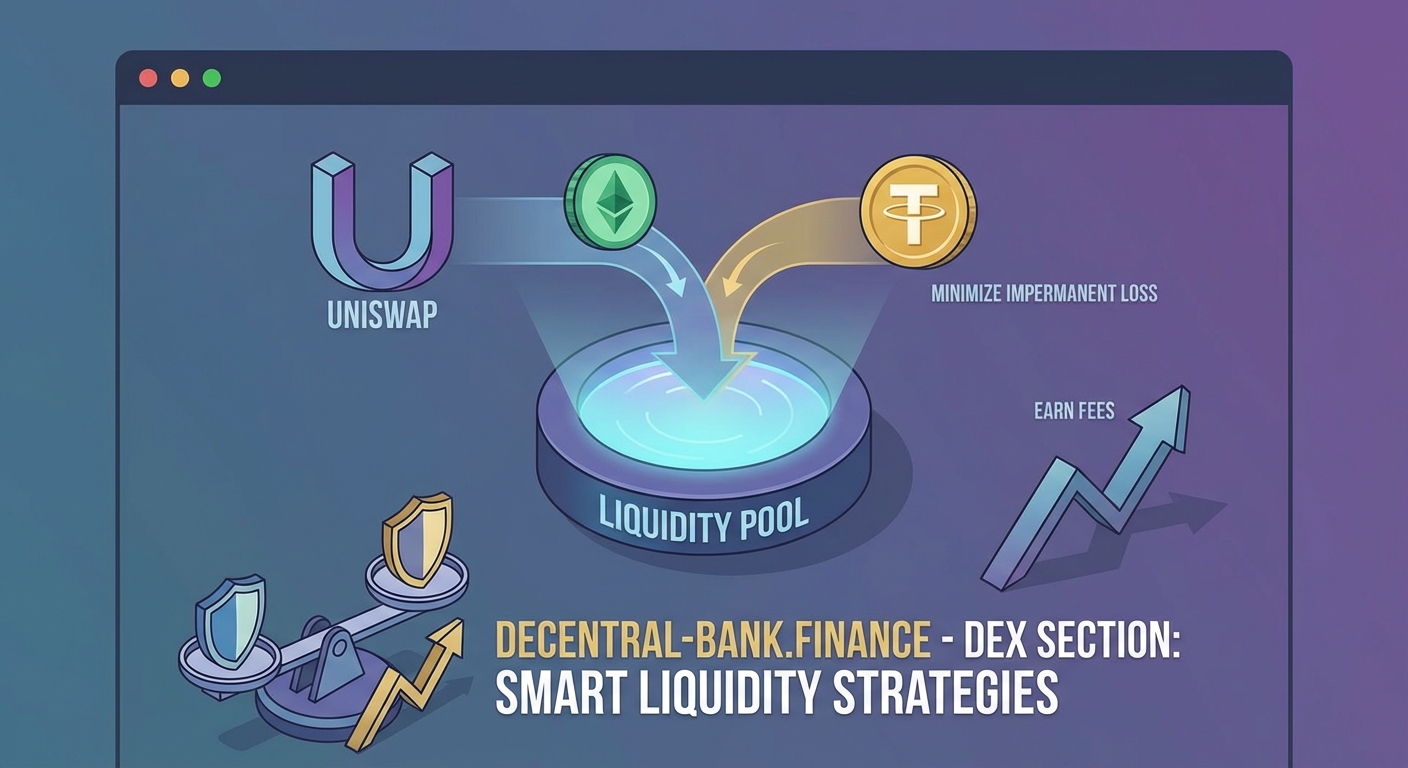
Getting started requires preparation and careful execution. Follow these steps to minimize mistakes.
- Choose your token pair based on your risk tolerance and the criteria above.
- Acquire equal values of both tokens (roughly 50/50 split by dollar value).
- Connect your wallet to the Uniswap interface at app.uniswap.org.
- Navigate to the Pool section and click “New Position.”
- Select your two tokens from the dropdown menus.
- Choose your fee tier (0.3% is standard for most pairs).
- Set your price range in v3 (or skip this in v2 for full range).
- Review the estimated fees and confirm the transaction.
- Approve both token contracts if this is your first time.
- Confirm the deposit transaction and pay the gas fee.
Your liquidity position is now active. You’ll receive an NFT representing your position in v3, or LP tokens in v2.
Calculating whether you’ll actually make money
Math separates profitable providers from those who lose capital. You need to track three numbers constantly.
First, calculate your impermanent loss. If you deposited $1,000 of ETH at $2,000 and $1,000 of USDC, and ETH rises to $3,000, you’ll have less ETH and more USDC than if you just held both. The difference in total value is your impermanent loss.
Second, track your accumulated fees. Uniswap displays unclaimed fees in your position details. These fees compound if you don’t claim them, but in v3 they don’t automatically reinvest.
Third, compare the two. If your fees exceed your impermanent loss, you’re profitable. If not, you would have been better off holding.
Here’s a comparison table of different scenarios:
| Scenario | Price Change | Impermanent Loss | Fees Earned (30 days) | Net Result |
|---|---|---|---|---|
| Stable pair (USDC/DAI) | 0.1% | 0.001% | 0.5% | +0.499% profit |
| Correlated (ETH/stETH) | 2% | 0.04% | 1.2% | +1.16% profit |
| Moderate volatility (ETH/USDC) | 25% | 2.5% | 3.5% | +1% profit |
| High volatility (ETH/SHIB) | 150% | 15% | 8% | -7% loss |
These numbers are illustrative, but they show the fundamental relationship. Higher volatility creates higher fees but also higher losses.
Managing impermanent loss risk
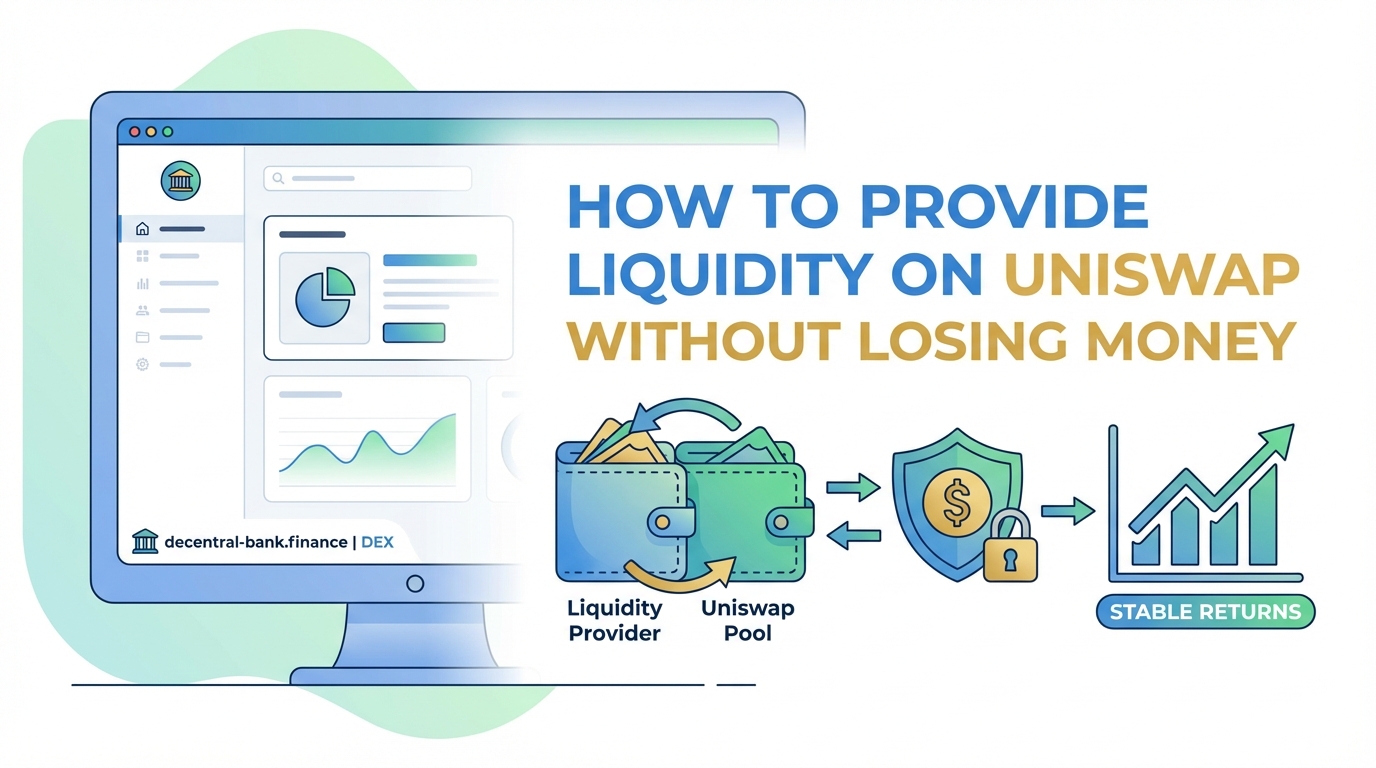
You can’t eliminate impermanent loss entirely, but you can minimize it through smart strategies.
Stick to correlated pairs when starting out. ETH and stETH move together. So do wrapped versions of the same asset like WBTC and renBTC. The closer the price correlation, the lower your impermanent loss.
Choose wider price ranges in v3. A range from $1,800 to $3,200 for ETH gives you breathing room. You’ll earn lower fees per dollar compared to a tight range, but you won’t need to constantly rebalance.
Monitor your position daily. Set price alerts at the edges of your range. When the price approaches your boundary, decide whether to adjust your range or accept going out of range temporarily.
Consider single-sided staking alternatives if impermanent loss concerns you too much. Some protocols let you stake one token without pairing it, though these aren’t technically Uniswap positions.
The most successful liquidity providers treat it like active investing, not passive income. They monitor positions daily, adjust ranges weekly, and exit when market conditions turn unfavorable. Passive providers often lose money.
Fee tiers and what they mean for your returns
Uniswap v3 offers three fee tiers: 0.05%, 0.3%, and 1%. Your choice affects both your earnings and your competition.
The 0.05% tier suits stablecoin pairs with minimal price movement. Competition is intense because many providers target these “safe” pools. Your returns come from volume, not volatility.
The 0.3% tier works for most standard pairs like ETH/USDC or ETH/DAI. This is the default for most traders and offers a balance between competitive fees and reasonable returns.
The 1% tier targets exotic or highly volatile pairs. Fewer providers compete here because the risk is higher. But when volume spikes, returns can be substantial.
Higher fee tiers don’t automatically mean higher returns. A 1% fee tier with low volume can earn less than a 0.05% tier with massive volume.
Check the pool’s 24-hour volume and total value locked before committing. High volume relative to TVL means more fee generation per dollar you provide.
Common mistakes that destroy returns
Most beginners make the same errors. Avoid these to protect your capital.
Providing liquidity to low-volume pools wastes your capital. That obscure token pair might seem promising, but if daily volume is under $10,000, your fees will be negligible.
Setting ranges too narrow in v3 creates constant management headaches. You’ll spend more on gas fees adjusting your position than you earn in trading fees.
Ignoring gas costs kills profitability on small positions. If you’re depositing $500 and gas costs $50, you need 10% returns just to break even. Start with at least $2,000 to make gas fees a smaller percentage.
Panic withdrawing during volatility locks in impermanent loss. The “impermanent” part means it only becomes permanent when you withdraw. If you hold through volatility and the price returns to your entry point, the loss disappears.
Failing to claim and compound fees leaves money on the table. In v2, fees auto-compound. In v3, you need to manually claim and reinvest them.
Tools and resources for tracking performance
You can’t manage what you don’t measure. These tools help you monitor your positions effectively.
The Uniswap interface shows basic metrics like unclaimed fees and current value. But it doesn’t calculate impermanent loss or compare your returns to simple holding.
Third-party analytics platforms like Revert Finance, APY.vision, and Croco Finance provide detailed performance tracking. They calculate impermanent loss, show historical fee earnings, and compare your returns to holding.
Set up price alerts through trading platforms or apps like CoinGecko. When ETH approaches the edge of your range, you’ll get notified to take action.
Spreadsheet tracking works for serious providers. Log your entry prices, amounts, and dates. Update weekly with current values and fees. This manual approach gives you the deepest understanding of your performance.
When to exit a liquidity position
Knowing when to withdraw is as important as knowing when to enter.
Exit when impermanent loss exceeds fee earnings and shows no sign of reversing. If you’re down 5% from impermanent loss and only earned 1% in fees, and volatility is increasing, cut your losses.
Exit when market conditions change fundamentally. If you provided liquidity to a stablecoin that loses its peg, get out immediately. The same applies if one token in your pair faces regulatory issues or technical problems.
Exit when you need the capital for better opportunities. Liquidity provision locks your funds. If you find a higher-returning opportunity elsewhere, don’t let sunk cost fallacy keep you in an underperforming position.
Exit when gas fees make small adjustments unprofitable. If you have a $1,000 position and need to spend $100 in gas to adjust your range, just withdraw and wait for lower gas prices or larger capital.
Strategies for different market conditions
Adapt your approach based on whether markets are trending, ranging, or crashing.
During ranging markets with sideways price action, tighter ranges in v3 maximize your returns. ETH bouncing between $2,800 and $3,200 for weeks? Set your range there and collect fees.
During trending markets with strong directional moves, wider ranges or v2 full-range positions protect you from going out of range. You’ll earn lower fees per dollar, but you’ll keep earning as the price moves.
During high volatility or crashes, consider exiting entirely. The fees rarely compensate for the impermanent loss during 30%+ daily swings. Preserve capital and return when conditions stabilize.
During low volatility periods, stablecoin pairs become more attractive. When crypto markets are boring, the consistent returns from USDC/DAI pairs look better.
Making your first position count
Start small with a pair you understand. ETH/USDC on the 0.3% tier gives you exposure to the most liquid pool on Uniswap.
Use a wide range for your first v3 position. Set your range 30% above and below the current price. This gives you weeks or months of earning time without needing adjustments.
Track your position daily for the first week. Note how fees accumulate, how price movements affect your ratio of tokens, and how impermanent loss changes.
Set a review date 30 days out. After a month, calculate your total return including fees and impermanent loss. Compare it to what you would have earned just holding both tokens.
This hands-on learning teaches you more than any guide can. You’ll develop intuition for which pairs work, which ranges make sense, and whether liquidity provision fits your investment style.
Building sustainable passive income from liquidity
Success with Uniswap liquidity provision comes from treating it as an active strategy with passive elements, not a set-and-forget investment.
Choose pairs with strong fundamentals and consistent volume. Avoid chasing high APR numbers on obscure tokens that could disappear overnight.
Size your positions appropriately for your portfolio. Liquidity provision should be a small percentage of your crypto holdings, not your entire stack.
Reinvest fees regularly to compound your returns. The difference between claiming and reinvesting versus letting fees sit adds up significantly over months.
Stay informed about protocol updates and market conditions. Uniswap continues to evolve, and new features or competitors might offer better opportunities.
The providers who consistently profit are those who combine patience with active monitoring, who understand the math behind their positions, and who adjust their strategy as conditions change. Start with one small position, learn from it, and scale up only after you’ve proven to yourself that you can generate positive returns.
Leave a Reply