
You open a bank account, deposit money, and trust the bank to hold it safely. The bank lends your money to others and pays you a small percentage. You accept this arrangement because it feels normal.
But what if you could lend directly to borrowers, earn higher interest, and skip the bank entirely? That’s the promise of decentralized finance, or DeFi. Instead of institutions controlling your money, code does the work.
DeFi uses blockchain networks and smart contracts to automate financial services without banks. Users interact directly with protocols that handle lending, borrowing, trading, and earning interest. Everything runs on transparent code that anyone can verify. You maintain control of your assets through a personal wallet, eliminating the need for intermediaries to approve transactions or hold your funds.
Smart contracts replace human decision makers
Traditional banks employ people to approve loans, process transfers, and manage accounts. DeFi protocols use smart contracts instead.
A smart contract is a program that runs on a blockchain. It executes automatically when certain conditions are met. No person needs to review or approve anything.
Here’s a simple example. You want to borrow $1,000. A traditional bank checks your credit score, employment history, and debt levels. A loan officer decides whether to approve you.
In DeFi, you deposit $1,500 worth of cryptocurrency as collateral. The smart contract automatically lends you $1,000. If the value of your collateral drops too low, the contract automatically sells it to repay the loan. No credit check. No waiting. No loan officer.
The contract follows rules written in code. Those rules apply to everyone equally. The blockchain records every transaction publicly, so anyone can verify the system works as promised.
Blockchain networks provide the foundation
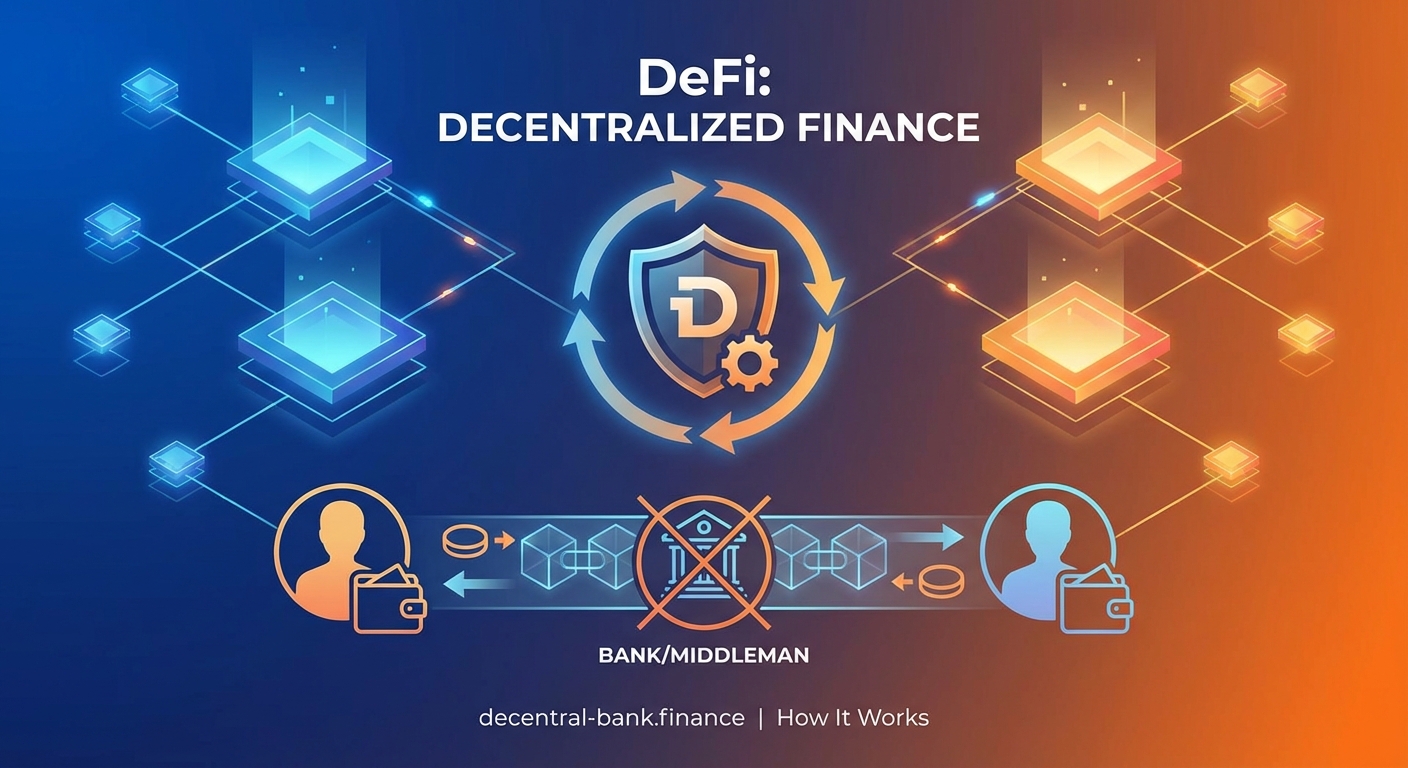
Smart contracts need somewhere to run. That’s where blockchain networks come in.
A blockchain is a distributed ledger maintained by thousands of computers worldwide. Each computer, called a node, holds a copy of the entire transaction history. When someone initiates a transaction, nodes verify it follows the rules, then add it to the ledger.
This structure creates several advantages:
- No single company controls the network
- Transactions can’t be reversed or altered after confirmation
- Anyone can verify the state of accounts and contracts
- The system keeps running even if some nodes go offline
- Users don’t need permission to participate
Ethereum hosts most DeFi applications today. Other networks like Binance Smart Chain, Solana, and Avalanche also support DeFi protocols. Each network has different speeds, costs, and security tradeoffs.
The blockchain stores your account balance, tracks your transactions, and enforces the rules of every smart contract. It’s the infrastructure that makes trustless finance possible.
Wallets give you direct control
In traditional finance, the bank holds your money. You access it through their website or app. They can freeze your account, decline transactions, or limit withdrawals.
DeFi works differently. You control your funds through a wallet.
A wallet is software that manages your private keys. These keys are long strings of characters that prove ownership of your cryptocurrency. Think of them like a password, but impossible to reset if lost.
Popular wallets include MetaMask, Trust Wallet, and Ledger hardware devices. You install the wallet, create an account, and receive a recovery phrase (usually 12 or 24 words). This phrase can restore your wallet if you lose access to your device.
Your wallet lets you:
- Send and receive cryptocurrency
- Connect to DeFi protocols
- Sign transactions to approve actions
- View your balances and transaction history
When you use a DeFi protocol, your wallet stays connected to the application. You approve each action, like depositing funds or taking a loan. The protocol never holds your private keys. You remain in control.
This control comes with responsibility. If someone steals your private keys or recovery phrase, they can take everything. No customer service team can help you recover lost funds. Security becomes your job.
Lending protocols match savers and borrowers
One of the most popular DeFi services is lending. Protocols like Aave and Compound let you earn interest on cryptocurrency or borrow against your holdings.
Here’s how it works from a lender’s perspective:
- You deposit cryptocurrency into a lending pool
- The protocol adds your funds to a shared reserve
- Borrowers take loans from this pool and pay interest
- You earn a portion of that interest based on your share of the pool
- You can withdraw your funds anytime (assuming enough liquidity exists)
Interest rates adjust automatically based on supply and demand. When lots of people want to borrow a particular asset, rates go up. When borrowing demand drops, rates fall.
From a borrower’s perspective:
- You deposit collateral (usually worth more than you want to borrow)
- The protocol calculates how much you can borrow based on collateral value
- You withdraw the borrowed amount and start accruing interest
- You repay the loan plus interest whenever you want
- The protocol returns your collateral after repayment
If your collateral value drops below a certain threshold, the protocol automatically liquidates some of it to repay the loan. This protects lenders from losses.
No credit checks. No approval process. No waiting period. The smart contract handles everything based on the collateral you provide.
Decentralized exchanges enable direct trading
Centralized exchanges like Coinbase hold your cryptocurrency and match buyers with sellers. Decentralized exchanges (DEXs) let you trade directly from your wallet.
Uniswap pioneered the automated market maker model. Instead of matching individual buyers and sellers, it uses liquidity pools.
A liquidity pool contains pairs of tokens. For example, one pool might hold Ethereum and a stablecoin called USDC. When you want to trade Ethereum for USDC, you add Ethereum to the pool and remove USDC. The ratio of tokens in the pool determines the exchange rate.
The protocol charges a small fee (often 0.3%) on each trade. This fee goes to liquidity providers, people who deposit both tokens into the pool to enable trading.
Anyone can become a liquidity provider. You deposit equal values of both tokens, receive pool tokens representing your share, and earn a portion of trading fees. When you want out, you return the pool tokens and withdraw your share plus accumulated fees.
This system works without order books, matching engines, or centralized control. The smart contract handles pricing, execution, and fee distribution automatically.
Stablecoins bridge crypto and traditional currency
Cryptocurrency prices fluctuate wildly. Bitcoin might gain or lose 10% in a single day. That volatility makes it hard to use crypto for everyday transactions or as a stable store of value.
Stablecoins solve this problem. These are cryptocurrencies designed to maintain a stable value, usually pegged to the US dollar.
USDC and USDT are backed by actual dollars held in bank accounts. For every token in circulation, the issuing company claims to hold one dollar in reserve. You can redeem tokens for dollars through the company.
DAI takes a different approach. It’s backed by cryptocurrency collateral locked in smart contracts. The protocol maintains the $1 peg through algorithmic mechanisms that adjust supply based on demand.
Stablecoins serve several purposes in DeFi:
- Provide a stable asset for trading pairs
- Let you exit volatile positions without converting to traditional currency
- Enable lending and borrowing at predictable values
- Facilitate payments and transfers
Most DeFi protocols use stablecoins extensively. They combine the stability of traditional currency with the programmability and accessibility of cryptocurrency.
Yield farming and liquidity mining reward participation
DeFi protocols need liquidity to function. Lending pools need deposits. DEXs need liquidity providers. To attract users, many protocols offer additional rewards beyond normal interest or fees.
Yield farming involves moving your cryptocurrency between different protocols to maximize returns. You might:
- Deposit stablecoins in a lending protocol to earn interest
- Use those interest-bearing tokens as collateral to borrow another asset
- Provide that borrowed asset to a liquidity pool
- Stake the liquidity pool tokens in another protocol for extra rewards
Each step generates returns. Compound them together, and you might earn 20%, 50%, or even higher annual percentage yields (APY).
Liquidity mining is when protocols distribute their own tokens to users who provide liquidity. These tokens often grant governance rights or a share of protocol revenue. Early users can earn substantial rewards.
Both strategies carry significant risks:
| Strategy | Potential Return | Main Risks |
|---|---|---|
| Simple lending | 2-10% APY | Protocol hacks, smart contract bugs |
| Liquidity provision | 5-30% APY | Impermanent loss, token price changes |
| Yield farming | 20-200% APY | Multiple protocol risks, gas fees, complexity |
| Liquidity mining | Variable | Token price collapse, changing reward rates |
High yields often reflect high risk. Protocols offering 100%+ APY might be new, unproven, or unsustainable. The rewards might come from token emissions that dilute value over time.
Risks you need to understand
DeFi eliminates certain risks associated with traditional finance. No bank can freeze your account or refuse your transaction. No government can easily seize your funds.
But it introduces new risks:
Smart contract vulnerabilities: Bugs in code can be exploited by hackers. Protocols have lost hundreds of millions to exploits. Once funds are stolen, they’re usually gone forever.
Volatility: Cryptocurrency prices swing dramatically. Your collateral value can drop suddenly, triggering liquidation. Your borrowed amount might surge in value, creating unexpected debt.
Liquidation: If your collateral ratio falls below the required threshold, the protocol automatically sells your assets. You lose your collateral and might still owe money if the sale doesn’t cover the debt.
Rug pulls: Some projects are outright scams. Developers create a protocol, attract deposits, then drain the funds and disappear.
Regulatory uncertainty: Governments are still figuring out how to regulate DeFi. Future laws could restrict access or impose new requirements.
Before putting significant money into any DeFi protocol, research its security audits, track record, and total value locked. Start with small amounts to learn how everything works. Never invest more than you can afford to lose completely.
Getting started with DeFi safely
If you want to try DeFi, follow these steps:
-
Set up a secure wallet: Download MetaMask or another reputable wallet. Write down your recovery phrase on paper and store it somewhere safe. Never share it with anyone or store it digitally.
-
Buy cryptocurrency: Purchase Ethereum or another network’s native token through a centralized exchange. You’ll need this to pay transaction fees (called gas).
-
Transfer to your wallet: Send a small test amount first. Verify it arrives correctly before transferring more.
-
Research protocols: Stick with established platforms that have been audited and have substantial total value locked. Read documentation to understand how they work.
-
Start small: Make a small deposit to learn the interface. Try withdrawing to confirm you understand the process.
-
Monitor positions: Check your collateral ratios if you’ve borrowed. Watch for liquidation risk. Stay aware of your exposure.
-
Secure your accounts: Use strong passwords, enable two-factor authentication where available, and be extremely cautious of phishing attempts.
Many people lose money in DeFi through avoidable mistakes. Taking time to learn reduces your risk significantly.
Why this matters for the future of finance
Banks profit by standing between you and your money. They pay you 0.5% interest on savings while charging borrowers 6%. They take days to process transfers. They exclude billions of people who lack proper documentation or live in the wrong countries.
DeFi offers an alternative. You can lend directly to borrowers and keep more of the interest. You can trade assets instantly without waiting for business hours. You can access financial services with just an internet connection and a smartphone.
The technology is still early. User interfaces are clunky. Transaction fees can be high. Security risks are real. But the core innovation works.
Smart contracts can enforce agreements without human intermediaries. Blockchain networks can maintain transparent, tamper-proof records. Wallets can give individuals true ownership of digital assets.
These building blocks enable financial services that are more accessible, transparent, and efficient than traditional alternatives. As the technology matures and interfaces improve, more people will choose systems where they control their own money rather than trusting institutions to do it for them.
Making DeFi work for you
Understanding how DeFi works is the first step. The second is deciding whether it fits your needs and risk tolerance.
If you value control over your assets and want access to financial services without intermediaries, DeFi offers real advantages. If you prefer the safety nets and customer service of traditional banks, that’s perfectly reasonable too.
The important thing is knowing you have options. Money doesn’t have to flow through banks. Loans don’t require credit checks. Trading doesn’t need centralized exchanges. These services can run on transparent code that treats everyone the same.
Start learning with small amounts you’re comfortable losing. Read documentation. Join communities. Ask questions. The technology becomes less intimidating once you actually use it.
DeFi won’t replace traditional finance overnight. But it’s creating a parallel financial system that’s open to anyone willing to learn how it works.
Leave a Reply